Join us on a literary world trip!
Add this book to bookshelf
Grey
Write a new comment Default profile 50px
Grey
Subscribe to read the full book or read the first pages for free!
All characters reduced
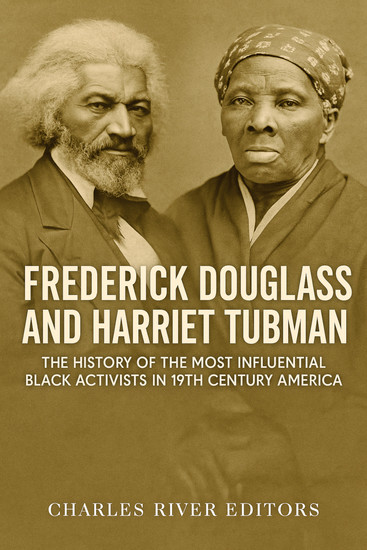
Frederick Douglass and Harriet Tubman - The History of the Most Influential Black Activists in 19th Century America - cover

Frederick Douglass and Harriet Tubman - The History of the Most Influential Black Activists in 19th Century America

Editors Charles River

Publisher: Charles River Editors

  • 0
  • 0
  • 0

Summary

With the possible exception of Dr. Martin Luther King, Jr., no African American has been more instrumental in the fight for minorities’ civil rights in the United States than Frederick Douglass 1818–1895), an American social reformer, orator, writer and statesman. His list of accomplishments would be impressive enough even without taking into account the fact that he was born into slavery.
 
Douglass was born into slavery, and it’s believed his father was a white man, even perhaps his master Aaron Anthony. When Douglass was about 12, his slaveowner’s wife, Sophia Auld, began teaching him the alphabet in defiance of the South’s laws against teaching slaves how to read. When her husband Hugh found out, he was furious, reminding her that if the slave learned to read, he would become dissatisfied with his condition and desire freedom. Those words would prove prophetic.
 
Douglass is noted as saying that "knowledge is the pathway from slavery to freedom,” and he took that advice to heart, teaching himself how to read and write with his knowledge of the alphabet. On September 3, 1838, Douglass successfully escaped slavery, traveling by boat to Delaware, Philadelphia, and finally New York, all in the span of a day. Douglass found a “new world had opened upon me.”
 
After escaping from slavery, Douglass became a leader of the abolitionist movement, gaining national notice for his dazzling oratory and anti-slavery writing. He stood out as the living embodiment of an intellectual former slave, the antithesis of slaveholders’ arguments that blacks were an inferior race. Douglass remained active in the fight for civil rights and abolition throughout the Civil War and Reconstruction, even meeting President Lincoln and strongly urging him to let black men enlist in the Union. As Douglass constantly stated, nobody had more to fight for in the Civil War than black men.
 
Harriet Tubman is one of the most famous women in American history, and from an early age every American learns of her contributions to abolition and the Underground Railroad. The woman who became known as the Moses of her people personally led more than 13 expeditions to free slaves in the South, and she was so integral in helping escaped slaves achieve freedom that her name is practically synonymous with the Underground Railroad today.
 
If anything, the central role she played in the Underground Railroad has become so ingrained among subsequent generations that Tubman’s life has been shrouded in legend, and other important aspects have been overlooked. In order to fully appreciate and understand both Harriet Tubman’s life and the important role she played in the abolitionist movement, it is necessary to examine the circumstances in which she was raised and what events drove her to the path she chose. Anthropologist Douglas Armstrong notes “[s]o little information about Tubman has been based on fact and so much based on myth and created history” that it has only been recently that historians have “come to the point where we can recognize her true contributions.”
 
In fact, Tubman’s entire life consisted of struggles and persistence, whether she was fighting on behalf of slaves, the Union army during the Civil War, or women’s rights. After managing to escape the severe beatings and humiliation of slavery herself, she put her life on the line over and over again to help others, and she could proudly boast, “I was the conductor of the Underground Railroad for eight years, and I can say what most conductors can't say — I never ran my train off the track and I never lost a passenger.” But that was only part of her involvement with abolition; Tubman was well-acquainted with other famous abolitionists of her time, including Frederick Douglass and John Brown, and she threw herself into efforts to further the cause of abolition in various ways. Her life and work were publicized nearly 50 years before her death by Franklin Sanborn.
Available since: 06/10/2025.
Print length: 106 pages.

Other books that might interest you

  • Best Women’s Erotica of the Year Volume 10 - cover

    Best Women’s Erotica of the Year...

    Rachel Kramer Bussel

    • 0
    • 0
    • 0
    There is a lot to be desired in Bussel's latest addition to the BWE series! 


    "Anything goes" in this wild and thrilling collection of erotic fiction. 


    From lesbian vampires to the ghost of Nathaniel Hawthorne, exhibitionism for a daring woman's neighbors and sexy onstage burlesque moves, the women in these stories are hot, horny, and determined to get exactly what they want. Whether they're bedding a longtime partner or hooking up with someone they've just met, they always find a way to get exactly what they want. From outlandish erotic fantasies in public and private to tender intimacies, sexual healing and hotness take many forms in these arousing tales by authors including Sally Bend, Katrina Jackson, T.C. Mill, Garnell Wallace, and more. 


    Edited by the award-winning Rachel Kramer Bussel, Best Women's Erotica of the Year, Volume 10 serves up twenty-one steamy adult stories that are sure to fan the flames of listeners' desires! 


    Contains mature themes.
    Show book
  • As the Crow Flies - From their pens to your ears genius in every story - cover

    As the Crow Flies - From their...

    John Davys Beresford

    • 0
    • 0
    • 0
    John Davys Beresford was born on 17th March 1873.  His life was blighted by infantile paralysis which left him partially disabled. 
    After an education at Oundle school he trained to be an architect.  However, he quickly decided that his life was to be centred on a literary career.  His first offerings were in drama and as a journalist. 
    As well as being a book reviewer for the Manchester Guardian he contributed to New Statesman, The Spectator, Westminster Gazette, and the Theosophist magazine The Aryan Path.   
    His spiritual journey in early adulthood had claimed him as an agnostic, in defiance of his clergyman father.  This view he later abandoned in preference to describing himself as a Theosophist and a pacifist. 
    As well as many novels, many themed with spiritual and philosophical elements.  Beresford was also a gifted short story writer particularly across the science-fiction, horror and ghost genres. 
    All of these elements helped him to obtain a prominent place in Edwardian Literary London. 
    John Davys Beresford died on the 2nd February 1947. He was 73.
    Show book
  • What Are You Doing Here? - My Autobiography - cover

    What Are You Doing Here? - My...

    Baroness Floella Benjamin

    • 0
    • 0
    • 0
    This audio edition is read by the author, Floella Benjamin.Winner at the 2022 Parlimentary Book AwardsBaroness Floella Benjamin is an inspiration, an actress and much-loved children’s television presenter who is a member of the House of Lords. But how did the girl from Trinidad end up lunching with the Queen?In What Are You Doing Here? Floella describes arriving in London as a child, part of the Windrush generation, and the pain caused by the racism she encountered every day. It was offset by the love of her parents, who gave her the pride in her heritage, self-belief and confidence that have carried her through life. From winning a role in groundbreaking musical Hair (while clearly stating she would not take her clothes off) to breaking down barriers on Play School, from refusing to be typecast in roles to speaking out for diversity at the BBC and BAFTA, she has remained true to herself.She also reveals how she met husband Keith, became a mother of two, was befriended by Kenneth Williams, hugged President Obama, and found a purpose that would underpin everything she did – campaigning for the needs of children. Sharing the lessons she has learned, imbued with her joy and positivity, this autobiography is the moving testimony of a remarkable woman.
    Show book
  • The Human Condition - Exploring the Intricacies of Human Nature (4 in 1) - cover

    The Human Condition - Exploring...

    John Harpoon

    • 0
    • 0
    • 0
    This book contains the following four titles: 
    - The Cereal Killer: The invention of breakfast cereal marked a turning point in modern eating habits, blending health-conscious innovation with industrial progress. During the late 19th century, many Americans consumed heavy, meat-based breakfasts, which were criticized by health reformers for contributing to widespread digestive issues and lethargy. It was against this backdrop that breakfast cereal was born—a light, convenient, and nutritious alternative that would revolutionize morning meals. 
    - The Millennial Methuselah: The story of the woman destined for a millennium begins in an unassuming town, far removed from the glare of the modern world. Born in an era where tradition met the dawn of technological innovation, her arrival into the world was marked by a profound sense of wonder. Family and friends often recalled the unusual calmness that surrounded her birth, as if the universe had whispered its secrets into her soul. 
    - Perplexing Passings: Unsolved mysteries hold a unique and enduring fascination, inviting us into a world where questions linger and definitive answers seem perpetually out of reach. These enigmas, spanning unexplained deaths, puzzling disappearances, and baffling phenomena, captivate our imagination by defying the order and logic we strive to impose on life. Each unresolved case becomes more than a story; it transforms into a puzzle that teases the intellect and stirs the emotions. 
    - The Unreachable Riches: Throughout history, the allure of hidden treasure has captured the human imagination like few other pursuits. Tales of vast riches buried beneath shifting sands, concealed within uncharted jungles, or locked away in remote mountain fortresses have been passed down through generations.
    Show book
  • Hand and Heart - From their pens to your ears genius in every story - cover

    Hand and Heart - From their pens...

    Elizabeth Gaskell

    • 0
    • 0
    • 0
    Elizabeth Stevenson was born in Chelsea in London on 29th September 1810.  
    Both parents embedded their strong Unitarian beliefs into Elizabeth who rebelliously was often reluctant to display these religious convictions.  
    The early death of Elizabeth’s mother saw her sent away to be brought up by her maternal aunt in Knutsford, Cheshire.  
    Her father now remarried but Elizabeth spent most of her childhood in Cheshire away from her father and his new family but was supportive towards her half-siblings.  
    Elizabeth’s aunt encouraged her education and particularly to read and express herself through writing.   
    In 1828, her brother John, who worked in the merchant navy, disappeared on a journey to India. This disastrous loss depressed her father, and she went to his household to nurse him for the next year before he died.  
    In 1832, she fell in love with William Gaskell, a Unitarian minister like her father, and married him.  They settled in Manchester. This booming industrial city had a great impact on Elizabeth who felt the need to speak up for poor workers and their exploitation by large industrial companies. A collection of poems and short stories, ‘Sketches among the Poor’ appeared in 1837, co-authored by her husband.  Her first major work, under a pseudonym, was ‘Mary Barton: A Tale of Manchester Life’ published in 1848. 
    During her career she worked continually with Charles Dickens and published much in his various magazines. With him she published ‘Lizzie Leigh’ in 1850 which dealt with the taboo subject of prostitution.  She was an excellent writer and impressed her many Victorian literary peers. Much of her writing reflects her work as a social critic highlighting the exploitation of the working class and the situation of women in society.  
    On 12th November 1865, Elizabeth Gaskell died in Holybourne, Hampshire, after suffering from a heart attack a month earlier.
    Show book
  • Rescuing the Newborn Brain - cover

    Rescuing the Newborn Brain

    Andrew Whitelaw

    • 0
    • 0
    • 0
    Andrew Whitelaw is Emeritus Professor of Neonatal Medicine in the University of Bristol. At the age of seven he was shocked to meet a girl his own age who could not walk or talk because of severe cerebral palsy. He tells, from his own experience, how it became possible to investigate and image the brain of newborn babies, to understand the different ways that babies brains can be damaged and to develop treatments to prevent injury or help the brain to recover.  He describes how many dedicated colleagues persevered with research despite setbacks and failures. 
    Show book