Join us on a literary world trip!
Add this book to bookshelf
Grey
Write a new comment Default profile 50px
Grey
Subscribe to read the full book or read the first pages for free!
All characters reduced
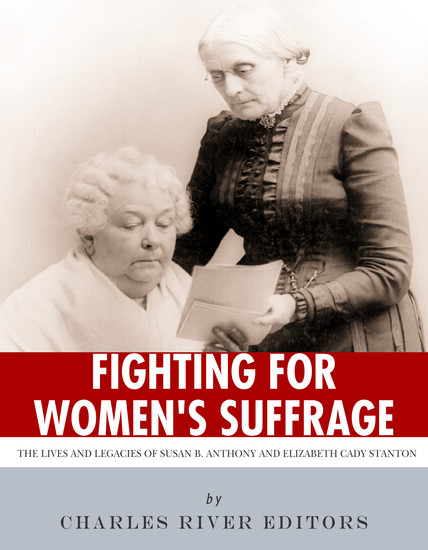
Fighting for Women’s Suffrage - The Lives and Legacies of Susan B Anthony and Elizabeth Cady Stanton - cover

Fighting for Women’s Suffrage - The Lives and Legacies of Susan B Anthony and Elizabeth Cady Stanton

Editors Charles River

Publisher: Charles River Editors

  • 0
  • 0
  • 0

Summary

Elizabeth Cady Stanton is something of an unsung hero in the history of the feminist movement. Though she is still primarily known as an advocate of women’s suffrage and is closely linked to the better known Susan B. Anthony, Stanton was shunned by many of her fellow suffragists because her ideas seem too radical and because many were disturbed by her barely Deist view of religion.  Over a century after her death, modern feminists tend to overlook Stanton in favor of Anthony, while remembering that Stanton enjoyed taking on the traditional 19th century gender roles of being the mother of a large family and remaining devoted to her husband throughout her life. And while Anthony’s comments about abortion are still fiercely debated by pro-life and pro-choice crowds, Stanton held conservative views toward abortion. It’s clear that Elizabeth Cady Stanton was very much her own woman, certainly a fitting description that she would not have wanted any other way.
 
Though she is not as well known or fondly remembered as her closest counterpart, Stanton preceded Anthony as an advocate of women’s rights. It was Stanton who issued the Declaration of Sentiments at the first women's rights convention in Seneca Falls, New York in 1848, touching off the organized movement that worked toward suffrage and equality. At the same time, Stanton was an ardent abolitionist, and she focused on progressive issues like custody rights, divorce, women’s property rights, employment issues, and even birth control.
 
During the last 100 years, Susan B. Anthony has been one of the most venerated women in American history, but in the 80 years before that, she was one of the most hated women in American history. Anthony took note of her contemporaries’ distaste for her but remained defiant, asserting, “I have encountered riotous mobs and have been hung in effigy, but my motto is: Men's rights are nothing more. Women's rights are nothing less.”
 
Today, of course, every American is taught about their nation’s most famous suffragist, who tirelessly advocated and lobbied for women to be granted the right to vote. Though it wouldn’t become legal until 14 years after Anthony’s death, Anthony took it upon herself to illegally vote in 1872, which initiated one of the late 19th century’s most famous political court cases. Anthony was able to publicize women’s plight and her cause even as she was subjected to a kangaroo court in which the judge ordered the jury to find her guilty, but she managed to embarrass authorities so much that they released her from jail instead of allowing her to appeal the conviction and continue to bring attention to her case. 
 
Though Anthony is best remembered today for working towards women’s suffrage with other women like Elizabeth Cady Stanton, she was an active and progressive advocate for all of the leading human rights issues of her time. Anthony was an ardent abolitionist from day one, and she spent much of the first 40 years of her life championing the cause of African-Americans, even befriending men like Frederick Douglass and William Lloyd Garrison along the way. She also championed “radical” ideas as 8 hour work days, minimum wage laws, and equal pay for women.
Available since: 06/20/2025.
Print length: 58 pages.

Other books that might interest you

  • World War II - THE CALL OF DUTY - Chapter 1 - THE ROAD TO WAR - cover

    World War II - THE CALL OF DUTY...

    Liam Dale

    • 0
    • 0
    • 0
    The Road to War; September – December 1939 
    From the moment Adolf Hitler marched his troops into Poland on the 1st of September 1939, the Second World War was inevitable, and as the opening skirmishes are played out, hear for yourself, the events that shaped the escalating crisis.
    Show book
  • HR Like a Boss - Your Guide to Amazingly Awesome HR - cover

    HR Like a Boss - Your Guide to...

    John Bernatovicz

    • 0
    • 0
    • 0
    HR Like a Boss offers HR professionals all the tools they need to help employees feel more connected to their organization and ensure the organization’ s success. Written by a creative entrepreneur who has devoted his career to the HR community, this book combines real-life stories of HR professionals who embody the characteristics of a “ boss”—meaning a skilled business leader—with actionable insights for making an impact on their people, organization, and community. 
    ©2024 John Bernatovicz (P)2023 John Bernatovicz
    Show book
  • The Diary That Changed the World - The Remarkable Story of Otto Frank and the Diary of Anne Frank - cover

    The Diary That Changed the World...

    Karen Bartlett

    • 0
    • 0
    • 0
    "A meticulous account of the fascinating, convoluted and sometimes ugly publishing history of the world's most famous diary. Karen Bartlett's book is all the more relevant at a time of untruths and fake news." – Caroline Moorehead, bestselling author of Village of Secrets: Defying the Nazis in Vichy France
    ***
    When Otto Frank unwrapped his daughter's diary with trembling hands and began to read the first pages, he discovered a side to Anne that was as much a revelation to him as it would be to the rest of the world.
    Little did Otto know he was about to create an icon recognised the world over for her bravery, sometimes brutal teenage honesty and determination to see beauty even where its light was most hidden.
    Nor did he realise that publication would spark a bitter battle that would embroil him in years of legal contest and eventually drive him to a nervous breakdown and a new life in Switzerland. Today, more than seventy-five years after Anne's death, the diary is at the centre of a multi-million-pound industry, with competing foundations, cultural critics and former friends and relatives fighting for the right to control it.
    In this insightful and wide-ranging account, Karen Bartlett tells the full story of The Diary of Anne Frank, the highly controversial part it played in twentieth-century history, and its fundamental role in shaping our understanding of the Holocaust.
    At the same time, she sheds new light on the life and character of Otto Frank, the complex, driven and deeply human figure who lived in the shadows of the terrible events that robbed him of his family, while he painstakingly crafted and controlled his daughter's story.
    Show book
  • On Dreams - Aristotle’s Philosophical and Scientific Inquiry into Dreaming - cover

    On Dreams - Aristotle’s...

    Aristotle, Tim Zengerink

    • 0
    • 0
    • 0
    What if you could decode your dreams to gain clarity, inspiration, and profound insights about your life? 
    In this classic treatise, Aristotle investigates the mysterious realm of dreams, exploring their origins, nature, and significance. Adapted for modern readers, this work merges philosophical curiosity with early scientific thought, guiding you toward a deeper appreciation of how dreams reflect our minds, experiences, and innermost thoughts. 
    What You’ll Discover in This Modern Translation: 
    - The possible functions and causes of dreaming 
    - Aristotle’s early scientific approach to interpreting dream phenomena 
    - How dreams link to memory, perception, and imagination 
    - Timeless perspectives that resonate with modern psychological studies 
    Imagine tapping into the wisdom of your subconscious for problem-solving, creativity, and personal growth. Aristotle’s analysis offers a unique window into the mind’s nightly theater, providing timeless ideas that remain startlingly relevant. 
    Open the door to the hidden world of your dreams. Get your copy now and begin a fascinating exploration of the mind’s nocturnal narratives.
    Show book
  • Pay Up! - Conservative Myths About Tax Cuts for the Rich - cover

    Pay Up! - Conservative Myths...

    John L. Campbell

    • 0
    • 0
    • 0
    Since the Reagan era, conservatives in the United States have championed cutting taxes, especially for wealthy individuals and corporations, as the best way to achieve economic prosperity. In his new book, Pay Up!, John L. Campbell shows that while these claims are highly influential, they are also wrong. Using historical and cross-national evidence, the book challenges and refutes every justification conservatives have made for tax cuts—that American taxes are too high; they hurt the economy; they facilitate government waste; they constitute an unfair downward redistribution of income; and they threaten individual freedom—and conversely shows that countries can actually benefit from higher taxes, especially when tax increases fall most heavily on those most able to pay them. Through clear prose and a well-reasoned argument, Campbell's book provides an accessible, engaging, and much-needed perspective on the role of taxes in American society.
    Show book
  • The Shocking Truth about International Aid - cover

    The Shocking Truth about...

    Zoey Fraisers

    • 0
    • 0
    • 0
    International aid has long been heralded as a solution to the world’s most pressing problems, from poverty and hunger to disease and disaster recovery. It is a system built on the idea that wealthier nations and organizations have the responsibility to assist those in need, providing the necessary resources to help vulnerable populations rise above their circumstances. With trillions of dollars allocated to aid efforts across the globe, it would seem that international aid is fulfilling its mission to promote global well-being. However, a closer examination reveals a far more complex, and often disheartening, reality. 
      
    While aid is essential in times of crisis, its long-term effects are often overlooked. Far too frequently, the aid process is tainted by inefficiencies, corruption, and political agendas, which hinder its effectiveness and frequently exacerbate the problems it seeks to solve. Donor countries may provide aid with specific political or economic interests in mind, making the assistance less about altruism and more about advancing a nation's own objectives. Likewise, organizations tasked with distributing aid can become bogged down by bureaucratic red tape, mismanagement, and a lack of accountability, leading to resources being squandered or diverted from the people who need them most. 
      
    The impact of international aid is not always as straightforward as it appears. While some projects undoubtedly achieve their goals, many others fail to deliver lasting results, leaving behind a trail of dependency rather than empowerment. Aid can often unintentionally disrupt local economies and social structures, creating reliance on external support rather than fostering self-sufficiency. In some cases, aid even perpetuates cycles of poverty by undermining local industries or creating a mindset of dependency that stifles innovation and growth.
    Show book