Join us on a literary world trip!
Add this book to bookshelf
Grey
Write a new comment Default profile 50px
Grey
Subscribe to read the full book or read the first pages for free!
All characters reduced
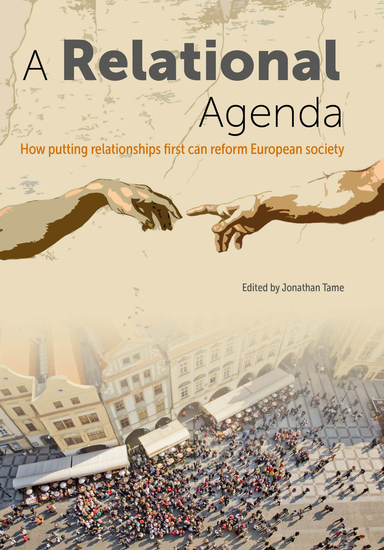
A Relational Agenda - How putting relationships first can reform European society - cover

A Relational Agenda - How putting relationships first can reform European society

Guy Brandon, Michel Schlüter, Jonathan Tame, Matthias Nebel, Paul Dembinski

Publisher: Sallux Publishing

  • 0
  • 0
  • 0

Summary

What framework can guide Christian engagement with major economic, social and political issues in public life in 21st century Europe?
What other schools of thought exist apart from Catholic Social Teaching and Christian Democracy?

Sallux has collaborated with the Jubilee Centre in Cambridge over several years to apply a new framework, agenda and strategy for Christian social reform, called Relational Thinking. It starts with the Christian belief that human beings are created by a relational God to form relational societies – the contemporary application of the ancient adage to 'love our neighbour as ourselves'.

This book is a compilation of fi ve reports, two of which discuss the overall concept of Relational Thinking, while the others demonstrate how it can be applied to three contemporary issues: the need for monetary reform, the challenges of artifi cial intelligence and the ethics of remuneration. You can fi nd other examples of issues being analysed from a relational perspective, from business to city transformation.

Deeply biblical, Relational Thinking builds bridges through the language of relationships to connect Christians with people of other faiths or none, and o er a fresh approach to Europe's greatest public policy challenges today.
Available since: 09/30/2022.
Print length: 272 pages.

Other books that might interest you

  • The Anxious Generation - Raising Resilient Tech-Savvy Kids in a Smartphone World - cover

    The Anxious Generation - Raising...

    Roshni Anand

    • 0
    • 0
    • 0
    This audiobook is narrated by an AI Voice.   
    Smartphones have changed childhood forever — and parents are struggling to keep up. 
    In The Anxious Generation, parenting expert Roshni Anand explores how constant notifications, digital comparison, and screen overload are affecting children’s confidence, attention, and emotional health. 
    Through science-based insights and practical tools, you’ll learn how to guide your kids toward balance instead of burnout. 
    Discover how to: 
    Set healthy screen-time boundaries without constant fights 
    Build real-world confidence in a digital age 
    Foster resilience, focus, and empathy 
    Reconnect as a family through presence, not pressure 
    This audiobook gives parents a clear framework to raise resilient, tech-savvy, emotionally strong kids — children who can thrive both online and offline. 
    Perfect for listeners interested in parenting, family communication, mental health, mindfulness, and digital well-being.
    Show book
  • Meditations - cover

    Meditations

    Marcus Aurelius

    • 0
    • 0
    • 0
    Meditations is a series of personal writings by Marcus Aurelius, Roman Emperor from 161 to 180 AD, recording his private notes to himself and ideas on Stoic philosophy.Marcus Aurelius wrote the 12 books of the Meditations in Koine Greek as a source for his own guidance and self-improvement. It is possible that large portions of the work were written at Sirmium, where he spent much time planning military campaigns from 170 to 180. Some of it was written while he was positioned at Aquincum on campaign in Pannonia, because internal notes tell us that the first book was written when he was campaigning against the Quadi on the river Granova (modern-day Hron) and the second book was written at Carnuntum.It is unlikely that Marcus Aurelius ever intended the writings to be published and the work has no official title, so "Meditations" is one of several titles commonly assigned to the collection. These writings take the form of quotations varying in length from one sentence to long paragraphs.The Meditations is divided into 12 books that chronicle different periods of Aurelius' life. Each book is not in chronological order and it was written for no one but himself. The style of writing that permeates the text is one that is simplified, straightforward, and perhaps reflecting Aurelius' Stoic perspective on the text. Depending on the English translation, Marcus' style is not viewed as anything regal or belonging to royalty, but rather a man among other men, which allows the reader to relate to his wisdom.
    Show book
  • Ancient Mesopotamia: A Captivating Introduction to the Rise and Fall of Mesopotamian Civilizations and Empires - cover

    Ancient Mesopotamia: A...

    Captivating History

    • 0
    • 0
    • 0
    Did you know that the first early battery and diving apparatus were invented in ancient Mesopotamia?  
    The land between the Tigris and Euphrates Rivers is called the “cradle of civilization,” and for good reason! Although Mesopotamia’s first civilization, Sumer, developed parallel with those of Egypt and nearby Elam, it was a place of many firsts for humanity. Some of them are well known, such as the wheel and the writing script. But it was the ancient Mesopotamians who first came up with the concept of time, the mathematical sexagesimal system, and a calendar with twelve months. It is all these inventions and ideas that set Mesopotamia apart from other civilizations that developed at approximately the same time.  
    There are so many interesting facts about the history and life of the people in Mesopotamia. By listening to this audiobook, you will find out:How agriculture and the domestication of animals led to the development of the world’s earliest civilizationWho were the peoples that occupied the region of Mesopotamia and came up with epics such as Gilgamesh?Who was Sargon of Akkad, and how did he rise to power to unite the cities and form one of the world’s first empires?How the first cuneiform script was invented and how it changed over time to fit the many languages spoken in the Akkadian EmpireWhy a new local ruler was needed to found the Third Dynasty of UrWho was Hammurabi, and why was he so important for the history of humankind?Why was Babylon obscured by Assyria?What role the Chaldeans played in the Assyrian EmpireAnd so much more! 
    Scroll up and click the “add to cart” button today to learn more about this incredible time in history!
    Show book
  • Who Owns The Moon? - In Defence of Humanity's Common Interests in Space - cover

    Who Owns The Moon? - In Defence...

    A. C. Grayling

    • 0
    • 0
    • 0
    Silicon for microchips; manganese for batteries; titanium for missiles. 
     
    The moon contains a wealth of natural resources. So, as the Earth’s supplies have begun to dwindle, it is no surprise that the world’s superpowers and wealthiest corporations have turned their eyes to the stars. As this new Space Race begins, A.C. Grayling asks: who, if anyone, owns the moon? Or Mars? Or other bodies in near space? And what do those superpowers and corporations owe to Planet Earth and its inhabitants as a whole? 
     
    From feudal common land, through the rules of the sea, to the vast, nationless expanse of Antarctica, Grayling explores the history of the places which no one, and therefore everyone, owns. Examining the many ways this so-called terra nullius has fallen victim to ‘the tragedy of the commons’ – the tendency for communal resources to be exploited by a few individuals for personal gain at the expense of everyone else – Who Owns the Moon? puts forward a compelling argument for a bold new global consensus, one which recognises and defends the rights of everyone who lives on this planet.
    Show book
  • Calling Sergeant Crockford - cover

    Calling Sergeant Crockford

    Ruth D'Alessandro

    • 0
    • 0
    • 0
    It's the dawn of the Swinging Sixties. The Cold War is at its height and support for the Campaign for Nuclear Disarmament is building. The Berkshire Constabulary's Detective Gwen Crockford is promoted to Woman Police Sergeant in Newbury – the town at the heart of Britain's atomic weapons programme. 
     
    Gwen's initial reservations that her posting in rural Berkshire will be boring soon prove to be unfounded. A serial sex attacker on the loose, an attempted murder at Greenham Common US Airforce Base, and a charismatic heiress with a family secret keep things interesting for the capable sergeant. 
     
    Laser-focused on her police career – and resigned to the single life – Gwen is forced to re-evaluate her plans when a nature-loving war veteran PC walks into the station with an orphaned fox cub, and there's a shocking discovery in a railway station lavatory. 
     
    Written by her daughter Ruth and rich in social history, this is the story of a real-life woman police sergeant at the top of her game, guiding her WPCs through the immense societal changes of the early 1960s.
    Show book
  • Communism and the Conscience of the West - cover

    Communism and the Conscience of...

    Fulton J. Sheen

    • 0
    • 0
    • 0
    For decades, this book has been recognized as the finest book ever written by a Catholic on the subject of communism. Dedicated to Our Lady in prayerful hope for the conversion of Russia, this is one of Fulton Sheen’s most forgotten yet most important books. In Communism and the Conscience of the West, Sheen explains the problems with society stemming from socialism and communism, which continue to infect universities and political discourse today. This timeless book exposes communism’s defects, its attitude toward the family, the decline of historical liberalism, and the rise of the antireligious spirit that pervades our world.  
    Readers will be impressed as Sheen diagnoses the issues facing our once peaceful cities, with history being put on trial, scrubbed, rewritten, and explained in terms of class hate. While communism destroys human freedom, Sheen illustrates how man is free as a result of two guarantees: one economic and the other spiritual. The economic enables man to call something his own which is outside of himself. The spiritual is the soul, which makes man independent of an earthly tyrant or a political dictator. In short, man’s soul is his own on the inside, as his property is his own on the outside.  
    Sheen carefully illustrates how even though we are living at a time when man has all the material conditions necessary for his happiness, “having lost the purpose of life which religion supplied, modern man became increasingly frustrated as his disappointed hedonism turned to pessimism. Thus man, who isolated himself from the religious community, now by reaction finds himself absorbed by the political community as despair becomes the dominant note of contemporary philosophy and literature.” For anyone seeking to understand one of the greatest threats to the Faith and our world, Communism and the Conscience of the West will be your guide.
    Show book