Join us on a literary world trip!
Add this book to bookshelf
Grey
Write a new comment Default profile 50px
Grey
Subscribe to read the full book or read the first pages for free!
All characters reduced
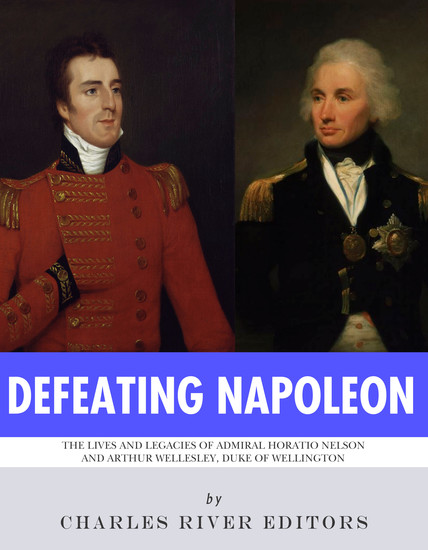
Defeating Napoleon - The Lives and Legacies of Admiral Horatio Nelson and Arthur Wellesley Duke of Wellington - cover

Defeating Napoleon - The Lives and Legacies of Admiral Horatio Nelson and Arthur Wellesley Duke of Wellington

Editors Charles River

Publisher: Charles River Editors

  • 0
  • 0
  • 0

Summary

Over the course of its history, England has engaged in an uncountable number of battles, but none of her military heroes has had a greater military legacy than Admiral Lord Horatio Nelson, 1st Viscount Nelson, 1st Duke of Bronté. Whether traveling to Trafalgar Square or one of the hundreds of pubs named after him, seemingly it becomes easy to believe that no Briton has cast as long a shadow.


Nelson is well known across the world for his decisive victory at Trafalgar, made all the more legendary by the fact that he was mortally wounded at the height of his greatest feat. And it is understandable that any man who could thwart Napoleon’s ambitions as well as Nelson did would earn a place in the history books. But Nelson embodied every virtue of his homeland; a dashing, courageous military officer who was impeccably cultured, and, of course, the best at what he did. Indeed, as the personification of the supremacy of the Royal Navy, the man and his life had a powerful resonance well before his death. When Nelson’s body was immersed in rum during the homeward voyage from Trafalgar, it is said that the sailors would steal a drink, thereby imbibing the spirit of their hero. Rum is still called “Nelson’s Blood” in Britain’s Royal Navy, and consumers can buy a spiced version at the pub in Burnham Thorpe. Nelson’s strategy and tactics are taught at naval colleges around the world, and the current U.K. government is, more than 200 years after his death, considering establishing a public holiday on the anniversary of Trafalgar.
 
By the time of his death, Wellington had been prime minister twice, a shrewd personal advisor to four British monarchs and one of the nation’s most prominent politicians for three decades.  But despite his nearly four decades of peacetime service in and out of politics, Wellington has remained one of the titans of the 19th century because of one June day in 1815. Then, as now, the Duke of Wellington is best remembered for defeating Napoleon in the most famous battle of modern history at Waterloo.
 
Even then, the fact Wellington is remembered for Waterloo belies his extraordinary military career, which saw him come up through fighting in the Netherlands and India before opposing Napoleon’s forces on the Iberian Peninsula for several years. By the time Wellington took command of allied forces during the Hundred Days Campaign and decisively finished the Napoleonic Era at Waterloo, he had participated in about 60 battles and was one of Britain’s greatest war heroes.
 
Historical memory of Wellington often stops there, but he spent half his lifetime in politics after Waterloo, serving as a prime minister in the 1820s and an influential Tory in the House of Lords in the 1830s and 1840s, serving all the while as Commander-in-Chief of Britain’s military. Though he had earned the nickname Iron Duke at the height of his political unpopularity, the originally derisive nickname came to represent his stern will and personality.
Available since: 05/28/2025.
Print length: 161 pages.

Other books that might interest you

  • Sound N’ Fury - Rock N’ Roll Stories - cover

    Sound N’ Fury - Rock N’ Roll...

    Alan Niven

    • 0
    • 1
    • 0
    Most rock ’n’ roll books are a bore. They all have the same narrative arc and are aimed at the dwindling following that now follows an artist that has long passed their AARP date. 
    		 
    Sound N’ Fury does not have a story arc. It is a collection of anecdotes, like a record comprised of various tracks — each one has its point and purpose. Alan Niven, who guided Guns N’ Roses from the gutter of Los Angeles to Wembley Stadium, shares stories from his remarkable life as a manager with an immediacy delivered by an extraordinary recall of dialogue. Readers will encounter not just Guns N’ Roses (who have sold almost 10 million tickets to their shows) but The Rolling Stones, Aerosmith, Clarence Clemons, Whitesnake, Elton John, and others who came from humble origins and experienced fame known only to few. Small-town minds collided with worldwide adulation, expectations, and demands. The results are amusing, affirming, and, predictably, disastrous. Keep in mind that rock ’n’ roll is God’s occupation for the unemployable.
    		 
    Written with a crisp and fluid style, the magnificence and idiocy of the music world will dance off the pages and engross even those who are not rock fans.
    Show book
  • The Boy Who Survived Auschwitz - cover

    The Boy Who Survived Auschwitz

    Adriana Lerman

    • 1
    • 1
    • 0
    Levi Lerman was a cheerful and lively boy from the town of Ostrowiec. He was only fourteen years old when his life took an unimaginable turn with the outbreak of World War II in 1939, when the Nazi forces invaded Poland and occupied his hometown.
    Over a painful six-year period, Levi endured a harsh life in the Ostrowiec ghetto, suffered devastating losses, performed exhausting forced labor, and survived countless transfers to concentration camps, including the extermination camp of Auschwitz-Birkenau.
    In the middle of this torment, a single light guided him through the darkness: his unbreakable determination to live and to protect his father—a strength that helped him survive against all odds.
    Show book
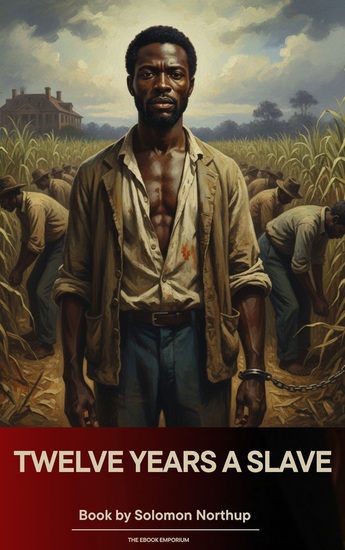
  • Twelve Years a Slave - cover

    Twelve Years a Slave

    Solomon Northup

    • 0
    • 1
    • 0
    "They can take your freedom, but they cannot take your identity."
    
    In 1841, Solomon Northup was a professional violinist and family man living in Saratoga Springs, New York. After being lured to Washington D.C. with the promise of work, he was drugged, shackled, and stripped of his name. For the next twelve years, he was passed from master to master in the bayous of Louisiana, enduring the sadistic cruelty of men like Edwin Epps while witnessing the quiet heroism of his fellow enslaved people. Twelve Years a Slave is a visceral, unflinching look at the "peculiar institution" through the eyes of a man who knew both the dignity of liberty and the agony of the lash. It remains a foundational text of American history and a testament to the endurance of the human spirit.
    
    The Mechanics of Oppression: Northup provides a meticulous, almost journalistic description of the economics and daily operations of the slave trade. He details the cultivation of cotton and sugar, the social hierarchies of the plantation, and the psychological warfare used to keep human beings in subjection.
    
    A Quest for Justice: The narrative is propelled by Northup's secret attempts to communicate with his family in the North. His eventual rescue is a heart-stopping moment of tension and triumph, highlighting the legal and social complexities of a divided nation where a man's status as "property" or "person" could depend entirely on the color of his skin and the geography of his location.
    
    Why It Is a Vital Classic: While many narratives were edited to suit political agendas, Northup's account is praised for its stark realism and descriptive power. It provides names, dates, and locations that were later verified by historians, making it one of the most credible and devastating indictments of slavery ever written.
    
    Bear witness to the truth. Purchase "Twelve Years a Slave" today.
    Show book