Join us on a literary world trip!
Add this book to bookshelf
Grey
Write a new comment Default profile 50px
Grey
Subscribe to read the full book or read the first pages for free!
All characters reduced
Day 1 of the Battle of Shiloh - The History of the Fighting that Nearly Ended Ulysses S Grant’s Civil War Career - cover

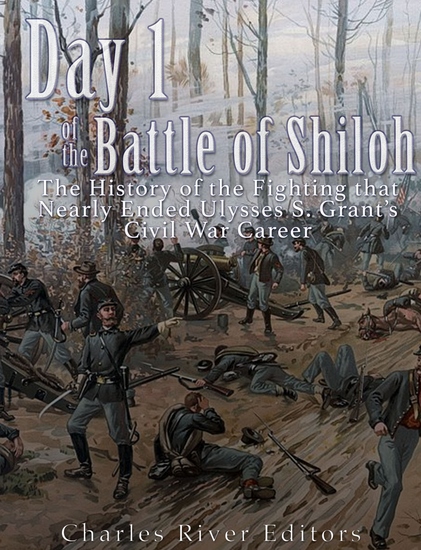
Day 1 of the Battle of Shiloh - The History of the Fighting that Nearly Ended Ulysses S Grant’s Civil War Career

Editors Charles River

Publisher: Charles River Editors

  • 0
  • 0
  • 0

Summary

“The turning point of our fate." – Jefferson Davis on the death of Albert Sidney Johnston at Shiloh


“Probably no single battle of the war gave rise to such wild and damaging reports.” – William Tecumseh Sherman


After Union General Ulysses S. Grant captured Fort Henry and Fort Donelson in early 1862, Confederate General Albert Sidney Johnston, widely considered the Confederacy’s best general, concentrated his forces in northern Georgia and prepared for a major offensive that culminated with the biggest battle of the war to that point, the Battle of Shiloh. On the morning of April 6, Johnston directed an all out attack on Grant’s army around Shiloh Church, and though Grant’s men had been encamped there, they had failed to create defensive fortifications or earthworks. They were also badly caught by surprise. With nearly 45,000 Confederates attacking, Johnston’s army began to steadily push Grant’s men back toward the river.  


As fate would have it, the Confederates may have been undone by friendly fire at Shiloh. Johnston advanced out ahead of his men on horseback while directing a charge near a peach orchard when he was hit in the lower leg by a bullet that historians now widely believe was fired by his own men. Nobody thought the wound was serious, including Johnston, who continued to aggressively lead his men and even sent his personal physician to treat wounded Union soldiers taken captive. But the bullet had clipped an artery, and shortly after being wounded Johnston began to feel faint in the saddle. With blood filling up his boot, Johnston unwittingly bled to death. The delay caused by his death, and the transfer of command to subordinate P.G.T. Beauregard, bought the Union defenders critical time on April 6, and the following day Grant’s reinforced army struck back and pushed the Confederate army off the field.


The Battle of Shiloh lasted two days, but the battle over the battle had just begun. Grant’s army had just won the biggest battle in the history of North America, with nearly 24,000 combined casualties among the Union and Confederate forces. Usually the winner of a major battle is hailed as a hero, but Grant was hardly a winner at Shiloh. The Battle of Shiloh took place before costlier battles at places like Antietam and Gettysburg, so the extent of the casualties at Shiloh shocked the nation. Moreover, at Shiloh the casualties were viewed as needless; Grant was pilloried for allowing the Confederates to take his forces by surprise, as well as the failure to build defensive earthworks and fortifications, which nearly resulted in a rout of his army. Speculation again arose that Grant had a drinking problem, and some even assumed he was drunk during the battle. Though the Union won, it was largely viewed that their success owed to the heroics of General Sherman in rallying the men and Don Carlos Buell arriving with his army, and General Buell was happy to receive the credit at Grant’s expense.


As a result of the Battle of Shiloh, Grant was demoted to second-in-command of all armies in his department, an utterly powerless position. And when word of what many considered a “colossal blunder” reached Washington, several congressmen insisted that Lincoln replace Grant in the field. Lincoln famously defended Grant, telling critics, “I can’t spare this man. He fights.”


Day 1 of the Battle of Shiloh: The History of the Fighting that Nearly Ended Ulysses S. Grant’s Civil War Career explains the campaign and events that led up to the controversial first day of the battle, and how the fighting that day affected the careers of the major generals involved. Accounts of the battle by important leaders like Sherman, Grant, and Braxton Bragg are included, along with analysis of the generals and fighting. 
 
 
Available since: 05/01/2025.
Print length: 49 pages.
Other books that might interest you

  • Black Fat Femme - Revealing the Power of Visibly Queer Voices in Media and Learning to Love Yourself - cover

    Black Fat Femme - Revealing the...

    Ed.D. Jonathan P. Higgins,...

    • 0
    • 0
    • 0
    A celebration of (and how to find your own) queer intersectional identity through the lens of media 
      
    In Black. Fat. Femme.: Revealing the Power of Visibly Queer Voices in Media and Learning to Love Yourself, educator and media critic Dr. Jonathan P. Higgins―aka Doctor Jon Paul―delivers an honest and extraordinary new take on how the author, and other Black Fat Femmes like them, have come to find and understand their identity. 
      
    You'll learn about how standing at the intersection of multiple identities, communities, and causes shapes people and how they see the world. You'll also discover how public figures like Andre Leon Talley and Latrice Royale have helped people learn who they are and what is possible in life. 
      
    Inside the book: 
      
    • An examination of the importance of real representation in the media for marginalized people 
    • Discussions of the pioneers who fought so hard to be authentically who they are, both onscreen and off 
    • Explorations of how and why Black Fat Femme people have been left out and erased from LGBTQ+ conversations 
      
    Perfect for anyone with an interest in unique voices and truly singular perspectives, Black. Fat. Femme. is a one-of-a-kind book that will help you see the world with entirely new eyes.
    Show book
  • Destiny of Liberty - cover

    Destiny of Liberty

    Mwanandeke Kindembo

    • 0
    • 0
    • 0
    In this book, author Mwanandeke Kindembo presented the reader with his manifesto, or a shared reality that exemplifies his ultimate mission. Which is based on finding within himself the motivation, or the correct vision to improve the world around him. He showed us the geography of his passions and how he is ready to step in to lead people to the promised land of liberty. The author delved into his own hidden agendas to find a more realistic worldview based on direct experience, rather than imaginary subjects. He placed more emphasis on land reform, the history of the D.R.Congo, the social and cultural influence, economic and political struggles of Africa. The book is filled with drastic, yet beautiful transformations that will change the course of the lives of many. Change for the better, thereby enabling citizens to live according to their fullest desires and potentials. The author has demonstrated an ideal view that will progress over time to developing his own unique understanding of his process, rather than relying on socially accepted belief systems. 
    Dedication (in the author's own words): I want to take this precious time to dedicate this book to my continent mama Africa, and especially to my compatriots in the Democratic Republic of Congo and any believer in the destiny of liberty. I am truly one of you. I come to you in the name of peace and love. Oh Africa! My love for you will never cease or end until I see that day that you get your full freedom; with your children. I ask this in the name of democracy and all the attributes that are associated with the redemption and freedom of nations.
    Show book
  • More than a Glitch - Confronting Race Gender and Ability Bias in Tech - cover

    More than a Glitch - Confronting...

    Meredith Broussard

    • 0
    • 0
    • 0
    The word "glitch" implies an incidental error, as easy to patch up as it is to identify. But what if racism, sexism, and ableism aren't just bugs in mostly functional machinery—what if they're coded into the system itself? Meredith Broussard demonstrates in More Than a Glitch how neutrality in tech is a myth and why algorithms need to be held accountable. 


    Broussard, a data scientist and one of the few Black female researchers in artificial intelligence, masterfully synthesizes concepts from computer science and sociology. She explores a range of examples: from facial recognition technology trained only to recognize lighter skin tones, to mortgage-approval algorithms that encourage discriminatory lending, to the dangerous feedback loops that arise when medical diagnostic algorithms are trained on insufficiently diverse data. Even when such technologies are designed with good intentions, Broussard shows, fallible humans develop programs that can result in devastating consequences. 


    Broussard argues that the solution isn't to make omnipresent tech more inclusive, but to root out the algorithms that target certain demographics as "other" to begin with. With sweeping implications for fields ranging from jurisprudence to medicine, More Than a Glitch is a must-listen for anyone invested in building a more equitable future.
    Show book
  • A Rare Recording of US Senator Huey P Long Delivering His 1935 "St Vitus Dance Government" Speech - cover

    A Rare Recording of US Senator...

    Senator Huey P. Long

    • 0
    • 0
    • 0
    Huey Pierce Long Jr. (August 30, 1893 - September 10, 1935), nicknamed "The Kingfish", was an American politician who served as the 40th governor of Louisiana from 1928 to 1932 and as a United States senator from 1932 until his assassination in 1935. He was a left-wing populist member of the Democratic Party and rose to national prominence during the Great Depression for his vocal criticism of President Franklin D. Roosevelt and his New Deal, which Long deemed insufficiently radical. The following recording is of Long’s 1935 radio broadcast speech, The St. Vitus Dance Government.
    Show book
  • LSAT Hacks: Transform Your Score with Simple Secrets - "Boost your LSAT score! Dive into captivating audio lessons packed with secrets for success" - cover

    LSAT Hacks: Transform Your Score...

    Raymond Lockwood

    • 0
    • 0
    • 0
    Audiobook Description for 'LSAT Hacks: Transform Your Score with Simple Secrets' 
    Are you eager to advance in your career and reinforce your knowledge by acing the LSAT for 2024-2025?  
    Looking for a thorough guide that covers everything you need to excel in the LSAT for 2024-2025?  
    Your search ends here!  
    This audiobook is your ultimate partner for enhancing your understanding, applying effective strategies, and engaging in practical exercises. With it, you're set for success. 
    Updated for the LSAT 2024-2025 Exam Format. 
    Key Features of This Comprehensive Guide: 
    - In-depth insights into the LSAT 2024-2025 Exam 
    - Detailed explanations of the LSAT and its components 
    - Effective strategies for preparation and exam tactics 
    Our guide stands out through its thorough coverage, essential for your success on the exam. Topics are not simply touched upon; they are explored in depth with clarity and precision. 
    Please note that this guide is an independent resource and not affiliated with any official LSAT organization. 
    Crafted with a clear structure and accessible language, our LSAT Exam Guide for 2024-2025 ensures smooth transitions between subjects. Say farewell to complex jargon, and embrace content that is clear, concise, and technically sound. 
    So why hesitate? Click the BUY NOW button, secure your copy, and embark on your journey to LSAT success for 2024-2025! 
    Begin your LSAT preparation today!
    Show book
  • The Return of Resentment - The Rise and Decline and Rise Again of a Political Emotion - cover

    The Return of Resentment - The...

    Robert A. Schneider

    • 0
    • 0
    • 0
    The term "resentment" has dominated US news analysis since November 2016. Despite its increased use, this word seems to defy easy categorization. Does "resentment" describe many interlocking sentiments, or is it just another way of saying "anger"? Does it suggest an irrational grievance, as opposed to a legitimate callout of injustice? Does it imply political leanings, or is it nonpartisan by nature? 


    In The Return of Resentment, Robert A. Schneider explores these questions and more, moving from eighteenth-century Britain to the aftermath of the French Revolution to social movements throughout the twentieth century. Schneider illustrates how resentment has morphed across time, coming to express a collective sentiment felt by people and movements across the political spectrum. In this history, we discover resentment's modernity and its ambiguity—how it can be used to dismiss legitimate critique and explain away violence, but also convey a moral stance that demands recognition. Schneider anatomizes the many ways resentment has been used to label present-day movements, from followers of Trump and supporters of Brexit to radical Islamicists and proponents of identity politics. Addressing our contemporary political situation in a novel way, The Return of Resentment challenges us to think critically about the roles different emotions play in politics.
    Show book