Join us on a literary world trip!
Add this book to bookshelf
Grey
Write a new comment Default profile 50px
Grey
Subscribe to read the full book or read the first pages for free!
All characters reduced
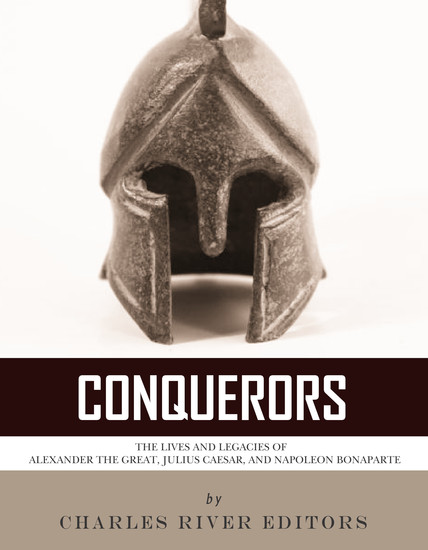
Conquerors - The Lives and Legacies of Alexander the Great Julius Caesar and Napoleon Bonaparte - cover

Conquerors - The Lives and Legacies of Alexander the Great Julius Caesar and Napoleon Bonaparte

Editors Charles River

Publisher: Charles River Editors

  • 0
  • 0
  • 0

Summary

Over the last 2,000 years, ambitious men have dreamed of forging vast empires and attaining eternal glory in battle, but of all the conquerors who took steps toward such dreams, none were ever as successful as antiquity’s first great conqueror. Leaders of the 20th century hoped to rival Napoleon’s accomplishments, while Napoleon aimed to emulate the accomplishments of Julius Caesar. But Caesar himself found inspiration in Alexander the Great (356-323 B.C.), the Macedonian King who managed to stretch an empire from Greece to the Himalayas in Asia at just 30 years old. It took less than 15 years for Alexander to conquer much of the known world.
 
As fate would have it, Alexander died of still unknown causes at the height of his conquests, when he was still in his early 30s. Although his empire was quickly divided, his legacy only grew, and Alexander became the stuff of legends even in his own time. Alexander was responsible for establishing 20 cities in his name across the world, most notably Alexandria in Egypt, and he was directly responsible for spreading Ancient Greek culture as far east as modern day India and other parts of Asia. For the ancient world, Alexander became the emblem of military greatness and accomplishment; it was reported that many of Rome’s greatest leaders, including Pompey the Great, Augustus, and Caesar himself all visited Alexander’s tomb in Alexandria, a mecca of sorts for antiquity’s other leaders.
 
Possibly the most important man of antiquity, and even all of history, was Julius Caesar. Alexander Hamilton, the famous American patriot, once remarked that “the greatest man who ever lived was Julius Caesar”. Such a tribute, coming from one of the Founding Fathers of the quintessential modern democracy in reference to a man who destroyed the Roman Republic, is testament to the enduring mark that Caesar left upon the world. The ultimate conqueror, statesman, dictator, visionary, and opportunist, during his time in power Caesar expanded the borders of Rome to almost twice their previous size, revolutionized the infrastructure of the Roman state, and destroyed the Roman Republic for good, leaving a line of emperors in its place. His legacy is so strong that his name has become, in many languages, synonymous with power: the Emperors of Austria and Germany bore the title Kaiser, and the Czars of Russia also owe the etymology of their title to Caesar. His name also crept further eastward out of Europe, even cropping up in Hindi and Urdu, where the term for “Emperor” is Kaisar.
 
Even in his time, Caesar was in many ways larger than life, and because of his legacy as virtual founder of the Roman Empire, much of what was written about – and by – him during his life and immediately after his assassination was politically motivated. His successor, Octavian Augustus, had a strong interest in ensuring that Caesar’s life be painted in a favorable light, while Caesar’s political enemies attempted to paint him as a corrupt, undemocratic dictator who was destroying the old order of the Republic.
 
When historians are asked to list the most influential people of the last 200 years, a handful of names might vary, but there is no question that the list will include Napoleon Bonaparte (1769-1821), the most successful French leader since Charlemagne and widely acknowledged as one of the greatest generals ever. Indeed, Napoleon was likely the most influential man of the 19th century, leaving an indelible mark on everything from the strategy and tactics of warfare to the Napoleonic Code that drafted laws across the continent. To defeat Napoleon, the Europeans had to form large coalitions multiple times, which helped bring about the entangling alliances that sparked World War I after Europe was rebuilt following Waterloo and the Congress of Vienna. 
Available since: 05/04/2025.
Print length: 104 pages.

Other books that might interest you

  • All the Ways Our Dead Still Speak - A Funeral Director on Life Death and the Hereafter - cover

    All the Ways Our Dead Still...

    Caleb Wilde

    • 0
    • 0
    • 0
    What if our dead remain with us? What if closure is not the goal? No matter what you believe about the afterlife, what if the hereafter intersects with the here and now? 


    Caleb Wilde, author of the acclaimed memoir Confessions of a Funeral Director, was a skeptic. The baffling stories people told him—deathbed visions of long-dead parents, visits from the other side—must be hallucinations or wishful thinking, he thought. But the more stories he heard, and the more he learned about non-Western understandings of body and spirit, the less sure he was. 


    All the Ways Our Dead Still Speak takes listeners on a lyrical and tender quest to encounter the hereafter. As Wilde picks up bodies, organizes funerals, and meets with grieving families in a small town in Pennsylvania, those who remain share with him—and us—what they experience in the thin places between life and death. Entwining these stories with his own as a sixth-generation funeral director, and with the findings of neuroscience and the solace of faith, Wilde creates a searching, reverent inquiry into all the ways our dead remain with us. In the process, he takes on prevailing dogmas about death: from a narrow Christian view of heaven and hell, to secular assumptions that death is the end, to pop-psychology maxims that say we all need "closure" after our loved ones die.
    Show book
  • Lady in Waiting: Book Summary & Analysis - cover

    Lady in Waiting: Book Summary &...

    Briefly Summaries

    • 0
    • 0
    • 0
    This is a concise summary and analysis of Lady in Waiting, by Anne Glenconner.
     
    It is not the original book and is not affiliated with or endorsed by Anne Glenconner.
     
    Ideal those seeking a quick and insightful overview.
     
    Lady in Waiting is a captivating memoir that offers an intimate glimpse into the life of a woman who stood beside royalty and witnessed the complexities of the British aristocracy firsthand. With wit, charm, and honesty, the author shares stories from her time as a lady-in-waiting to Princess Margaret, blending personal triumphs and tragedies with unique insights into royal life. From glamorous events to deep personal losses, this memoir is a powerful reflection on loyalty, resilience, and the enduring strength of friendship.
    Show book
  • Rahel Varnhagen - The Life of a Jewish Woman - cover

    Rahel Varnhagen - The Life of a...

    Hannah Arendt

    • 0
    • 0
    • 0
    Rahel Varnhagen: The Life of a Jewish Woman is the biography of a remarkable, complicated, troubled, passionate woman, an important figure in German romanticism, the person who in a sense founded the Goethe cult that would become central to German cultural life in the nineteenth century, as well as someone who confronted with unusual determination and bore the burden of being both a woman in a man's world and an assimilated Jew in Germany. 


    Rahel Levin Varnhagen was, Arendt writes, "neither beautiful nor attractive . . . and possessed no talents with which to employ her extraordinary intelligence and passionate originality." Arendt sets out to tell the story of Rahel's life as Rahel might have told it and, in doing so, to reveal the way in which intellectual and social assimilation works out in one person's destiny. 


    On her deathbed Rahel is reported to have said, "The thing which all my life seemed to me the greatest shame, which was the misery and misfortune of my life—having been born a Jewess—this I should on no account now wish to have missed." Only because she had remained both a Jew and a pariah, Arendt observes, "did she find a place in the history of European humanity."
    Show book
  • Cicero - Biography of a Roman Lawyer Writer and Statesman - cover

    Cicero - Biography of a Roman...

    Kelly Mass

    • 0
    • 0
    • 0
    Marcus Tullius Cicero was a Roman statesman, lawyer, scholar, philosopher, and Academic skeptic who became a prominent figure in the political and intellectual life of the late Roman Republic. He is best remembered for his eloquence and his staunch defense of ethical ideals in the face of political turmoil, a period that ultimately led to the rise of the Roman Empire. Cicero’s influence extended far beyond his time as he became one of Rome's most revered orators and prose stylists, producing an extensive body of work encompassing treatises on rhetoric, philosophy, and politics. His works remain fundamental to the study of Latin and Western philosophy today. 
    Cicero was born into a wealthy municipal family within the Roman equestrian order and held the esteemed office of consul in 63 BC, a significant achievement in his career. His oratorical prowess was unrivaled, and his skill in public speaking earned him a reputation that endured through the centuries. His publications spanned a broad range of subjects, from the theoretical aspects of rhetoric to the practical concerns of governance and philosophy. Cicero’s mastery of the Latin language was profound—he is said to have written over three-quarters of all surviving Latin literature from his time. His works, characterized by their clarity and depth, formed the foundation for subsequent Latin prose, influencing European languages and thinkers well into the 19th century.
    Show book
  • Explore the World's Wonders with Ease: A Fun Travel Guide - "Discover the World’s Marvels! Dive into Engaging Travel Guide Audio Lessons for Unforgettable Adventures!" - cover

    Explore the World's Wonders with...

    Nathaniel Drake

    • 0
    • 0
    • 0
    Discover the World’s Wonders Effortlessly: An Enjoyable Travel Companion 
    ⭐⭐ Simplified Audio Guide ⭐⭐ 
    Are you aiming to advance your career and deepen your knowledge by exploring the world's wonders with ease? 
    Looking for an all-encompassing guide that offers every detail you need to unlock global wonders effortlessly with engaging travel insights? 
    Your search ends here! 
    This travel guide is your definitive companion for broadening your understanding, applying your skills, and participating in immersive exercises. With this guide, you are set for success. 
    Updated for the Travel Season. 
    Key features of this comprehensive guide: 
    - Profound insights about Unlock Global Wonders Effortlessly with Engaging Travel Insights Certification 
    - Detailed explanation of Unlock Global Wonders Effortlessly with Engaging Travel Insights 
    - Effective strategies for travel preparation and exploration 
    Our guide stands out with its thorough coverage, which is crucial for your travel success. Concepts are not merely touched upon but explored with meticulous detail. 
    Please note that this guide is not associated with any official travel entities and is an independent resource for your benefit. 
    Crafted with a clear structure and easy-to-understand language, our travel guide ensures seamless transitions between topics. Say goodbye to confusing jargon and hello to clear, precise, and technically accurate content. 
    So, why wait? Click the BUY NOW button, secure your guide, and start your journey to unlocking global wonders effortlessly!
    Show book
  • Fifty Percent of Mountaineering is Uphill - The Life of Canadian Mountain Rescue Pioneer Willi Pfisterer - cover

    Fifty Percent of Mountaineering...

    Susanna Pfisterer

    • 0
    • 0
    • 0
    Winner of the Alberta Readers' Choice Award! 
     
    Fifty Percent of Mountaineering Is Uphill is the enthralling true story of Jasper's Willi Pfisterer, a legend in the field of mountaineering and safety in the Rocky Mountains. For more than thirty years, Willi was an integral part of Jasper's alpine landscape, guiding climbers up to the highest peaks, and rescuing them from perilous situations. 
     
    Originally from Austria, this mountain man came to Canada in the 1950s to assail the Rockies, and stayed to become an integral part of mountain safety in Western Canada and the Yukon. His daughter, Susanna Pfisterer, has shaped his stories and lectures as an engaging and educational adventure story. Accompanied by the humorous wisdom of the "Sidehillgouger," listeners will traverse an historical and spectacular terrain.
    Show book