Join us on a literary world trip!
Add this book to bookshelf
Grey
Write a new comment Default profile 50px
Grey
Subscribe to read the full book or read the first pages for free!
All characters reduced
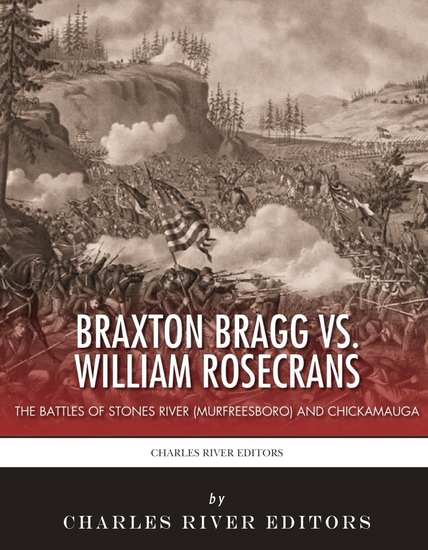
Braxton Bragg vs William Rosecrans - The Battles of Stones River and Chickamauga - cover

Braxton Bragg vs William Rosecrans - The Battles of Stones River and Chickamauga

Editors Charles River

Publisher: Charles River Editors

  • 0
  • 0
  • 0

Summary

Americans have long been fascinated by the Civil War and its biggest battles, particularly Gettysburg, Antietam, and Shiloh, all of which involved Robert E. Lee or Ulysses S. Grant. But one of the 6 biggest battles of the war, and the one that took the heaviest toll by % on both armies was fought at the end of 1862 in Tennessee, and it involved neither of those generals.
 
In late December 1862, William Rosecrans’s Union Army of the Cumberland was contesting Middle Tennessee against Braxton Bragg’s Army of Tennessee, and for three days the two armies savaged each other as Bragg threw his army at Rosecrans in a series of desperate assaults. Bragg’s army was unable to dislodge the Union army, and he eventually withdrew his army after learning that Rosecrans was on the verge of receiving reinforcements. Though the battle was stalemated, the fact that the Union army was left in possession of the field allowed Rosecrans to declare victory and embarrassed Bragg.
 
Though Stones River is mostly overlooked as a Civil War battle today, it had a decisive impact on the war. The two armies had both suffered nearly 33% casualties, an astounding number in 1862 that also ensured Rosecrans would not start another offensive campaign in Tennessee until the following June. The Union victory also ensured control of Nashville, Middle Tennessee, and Kentucky for the rest of the war, prompting Lincoln to tell Rosecrans, “You gave us a hard-earned victory, which had there been a defeat instead, the nation could scarcely have lived over."
 
Americans have long been fascinated by the Civil War and its biggest battles, particularly Gettysburg, Antietam, and Shiloh, all of which involved Robert E. Lee or Ulysses S. Grant. But the second biggest battle of the entire war mostly gets overlooked among casual readers, despite the fact it represented the last great chance for the Confederates to salvage the Western theater.
 
In mid-September, the Union Army of the Cumberland under General William Rosecrans had taken Chattanooga, but rather than be pushed out of the action, Army of Tennessee commander Braxton Bragg decided to stop with his 60,000 men and prepare a counterattack south of Chattanooga at a creek named Chickamauga.  To bolster his fire-power, Confederate President Jefferson Davis sent 12,000 additional troops under the command of Lieutenant General James Longstreet, whose corps had just recently fought at Gettysburg in July.   
 
On the morning of September 19, 1863, Bragg's men assaulted the Union line, which was established in a wooded area thick with underbrush along the river.  That day and the morning of the next, Bragg continue to pummel Union forces, with the battle devolving from an organized succession of coordinated assaults into what one Union soldier described as “a mad, irregular battle, very much resembling guerrilla warfare on a vast scale in which one army was bushwhacking the other, and wherein all the science and the art of war went for nothing.”
 
Late that second morning, Rosecrans was misinformed that a gap was forming in his front line, so he responded by moving several units forward to shore it up.  What Rosecrans didn’t realize, however, was that in doing so he accidentally created a quarter-mile gap in the Union center, directly in the path of Longstreet’s men.  Described by one of Rosecrans’ own men as “an angry flood,” Longstreet's attack was successful in driving one-third of the Union Army off the field, with Rosecrans himself running all the way to Chattanooga, where he was later found weeping and seeking solace from a staff priest. 
 
In the aftermath of the Battle of Chickamauga, several Confederate generals blamed the number of men lost during what would be the bloodiest battle of the Western Theater on Bragg’s incompetence, also criticizing him for refusing to pursue the escaping Union army.
Available since: 05/02/2025.
Print length: 80 pages.

Other books that might interest you

  • Essays: First Series Prudence - cover

    Essays: First Series Prudence

    Ralph Waldo Emerson

    • 0
    • 0
    • 0
    Prudence is not timidity. It is not caution for its own sake. It is the art of knowing when to act and when to wait, when to follow reason and when to trust instinct. In Prudence, Ralph Waldo Emerson reclaims this often-misunderstood virtue, not as mere carefulness but as the wisdom of navigating life with both vision and restraint.
    For Emerson, prudence is not the enemy of boldness but its quiet architect. It does not stifle ambition but shapes it, guiding passion with clarity and purpose. A mind without prudence rushes blindly; a mind ruled by it never moves at all. The balance is where true mastery lies.
    Part of Essays: First Series, Prudence is neither a defense of conservatism nor a rejection of daring. It is an exploration of how thought and action, reason and impulse, can coexist in harmony. To read it is to rethink not just how we act, but how we decide when to act at all.
    Show book
  • Jane Austen - and her Country-House Comedy - cover

    Jane Austen - and her...

    William Henry Helm

    • 0
    • 0
    • 0
    Jane Austen and her Country-House Comedy" by William Henry Helm delves deep into the life and literary genius of one of the most celebrated authors in English literature - Jane Austen. The book is an insightful and engaging exploration of the origins and inspirations behind her beloved novels. 
     
    Unraveling the Genius: With meticulous research and an expert eye, Helm unravels the brilliance of Jane Austen's writing, examining the themes, characters, and social commentary that have made her work endure through the ages. 
     
    The World of Jane Austen: Helm takes readers on a captivating journey to the Regency era, where they will gain a vivid understanding of the society and manners that shaped Austen's novels. From the charming country houses to the intricacies of the English gentry, every aspect of Austen's world comes to life. 
     
    Witty and Charming: Through fascinating anecdotes and in-depth analysis, the book highlights Austen's razor-sharp wit, her skill in portraying human nature, and her ability to infuse even the most trivial social situations with humor and insight. 
     
    The Inspirations: Discover the real-life inspirations behind Austen's unforgettable characters and settings. From the spirited Elizabeth Bennet to the enigmatic Mr. Darcy, each character finds its roots in the people Austen encountered and observed. 
     
    A Glimpse into Her Life: "Jane Austen and her Country-House Comedy" offers a glimpse into the author's personal life, shedding light on her family, friendships, and the experiences that influenced her writing.
    Show book
  • Code White - Sounding the Alarm on Violence against Health Care Workers - cover

    Code White - Sounding the Alarm...

    Margaret M. Keith, James T. Brophy

    • 0
    • 0
    • 0
    When health care workers call a Code White, it’s an emergency response for a violent incident: a call for help. But it’s one that goes unanswered in hospitals, clinics, and long-term care homes across the country. Code White exposes a shocking epidemic of violence that’s hidden in plain sight, one in which workers are bruised, battered, assaulted, and demeaned, but carry on in silence, with little recourse or support.
    		 
    Researchers Margaret M. Keith and James T. Brophy lay bare the stories of over one hundred nurses and personal support workers, aides and porters, clerical workers and cleaners. The nightmarish experiences they relate are not one-off incidents, but symptoms of deep systemic flaws that have transformed health care into one of the most dangerous occupational sectors in Canada.
    		 
    The same questions echo in the wake of each and every brutal encounter: Is violence and trauma really just “part of the job”? Why is this going underreported and unchecked? What needs to be done, and how?
    Show book
  • The Birth of Tragedy - cover

    The Birth of Tragedy

    Friedrich Nietzsche

    • 0
    • 0
    • 0
    Immerse yourself in the timeless clash between order and chaos with The Birth of Tragedy by Friedrich Nietzsche. This groundbreaking work delves deep into the eternal struggle between the Apollonian and Dionysian forces, challenging conventional wisdom and inviting you to explore the essence of art, life, and culture. 
    Through a series of profound aphorisms, Nietzsche uncovers the raw beauty and inherent tragedy of existence, urging us to question our deepest beliefs and embrace the creative power of the human spirit. Experience his revolutionary ideas in a way that's both intellectually stimulating and emotionally resonant. 
    Narrated by an advanced AI voice, this audiobook offers a modern, immersive listening experience that brings Nietzsche's visionary insights to life with clarity and sophistication. Whether you're a philosophy enthusiast or a curious seeker of truth, The Birth of Tragedy promises to transform the way you see the world. 
    Press play and embark on this philosophical journey that redefines the boundaries of art and thought.
    Show book
  • Your Resilient Self - How to Thrive Under Pressure - cover

    Your Resilient Self - How to...

    Caleb David

    • 0
    • 0
    • 0
    Life is full of challenges, unexpected setbacks, and moments of intense pressure. The question isn’t whether you’ll face adversity—it’s how you’ll respond when it comes. Your Resilient Self is your ultimate guide to developing the mental strength, emotional fortitude, and unshakable confidence needed to thrive, no matter what life throws your way. 
    Resilience isn’t just about surviving tough times—it’s about using them as stepping stones to become even stronger. In this book, you’ll discover how to transform challenges into opportunities, reframe failures as fuel for growth, and build a mindset that allows you to stay calm, focused, and empowered even in the most difficult situations.What You’ll Learn: 
    ✔ The Science of Resilience – Understand how your brain processes stress and how to train it for mental toughness. 
     ✔ Reframing Challenges – Learn to shift your perspective and see adversity as an opportunity for growth, not defeat. 
     ✔ Emotional Mastery – Develop techniques to control your reactions, reduce stress, and stay composed under pressure. 
     ✔ Building Mental Toughness – Train yourself to maintain confidence, clarity, and focus in high-stakes situations. 
     ✔ The Power of Grit and Perseverance – Unlock the secrets of those who push past limits and succeed despite obstacles. 
     ✔ Creating Resilient Habits – Daily practices that will strengthen your ability to bounce back from setbacks and keep moving forward. 
     ✔ Overcoming Fear and Self-Doubt – Break free from limiting beliefs that hold you back from reaching your full potential. 
    This book is for anyone who wants to build resilience—whether you’re facing personal struggles, career challenges, or simply want to develop a stronger, more adaptable mindset.
    Show book
  • Little Women Podcast: The Real-Life Friedrich Bhaer - cover

    Little Women Podcast: The...

    Niina Niskanen

    • 0
    • 0
    • 0
    There was a real-life Friedrich Bhaer. In fact, Louisa May Alcott wanted to marry him and even start a school with him. This man appears in literal disguises in all of her novels. He is Friedrich in Little Women, Mac in Rose in Bloom and David in Work and many more. Henry and Louisa shared a deep friendship, was it more than friendship? In Little Women Jo's and Friedrich's age gap is 16 years. It is the same age difference as between Henry and Louisa. 
    One of the models for Jo and Friedrich might be Louisa's friend Elizabeth and her husband. Her life was surprisingly similar to the book Jo. She wasn't a writer, but there are parallels. Based on what I have found, her marriage with her lawyer husband was a happy one. She was devoted to the educational work and in the same way, as Jo does, she promoted co-education, for both male and female students. She became a dean of the university. Same way as Jo who becomes the matriarch of the Bhaer Academy in "Jo´s Boys".. 
    There is a very compelling case to be made that Henry David Thoreau was the real-life Friedrich Bhaer. Louisa once called her friend Emerson "The God of my idolatry" but it was Henry who merited her lifelong affection. The ties between Henry and the Alcotts are more extensive than one might expect. From the time when the Alcotts moved to Concord in March 1840 until Henry's passing in 1862. He was a frequent guest in the Alcott´s home taking tea or dinner with the family. Bronson who admired the young man's intellect often visited him in his hut at Walden Pond. If the connection between Henry and the Alcotts was strong, the connection between Louisa and Henry was even stronger
    Show book