Join us on a literary world trip!
Add this book to bookshelf
Grey
Write a new comment Default profile 50px
Grey
Subscribe to read the full book or read the first pages for free!
All characters reduced
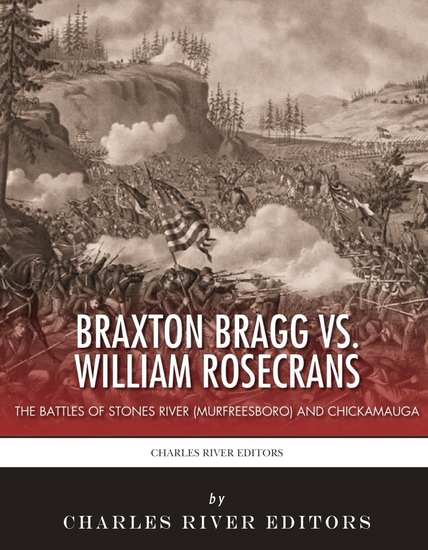
Braxton Bragg vs William Rosecrans - The Battles of Stones River and Chickamauga - cover

Braxton Bragg vs William Rosecrans - The Battles of Stones River and Chickamauga

Editors Charles River

Publisher: Charles River Editors

  • 0
  • 0
  • 0

Summary

Americans have long been fascinated by the Civil War and its biggest battles, particularly Gettysburg, Antietam, and Shiloh, all of which involved Robert E. Lee or Ulysses S. Grant. But one of the 6 biggest battles of the war, and the one that took the heaviest toll by % on both armies was fought at the end of 1862 in Tennessee, and it involved neither of those generals.
 
In late December 1862, William Rosecrans’s Union Army of the Cumberland was contesting Middle Tennessee against Braxton Bragg’s Army of Tennessee, and for three days the two armies savaged each other as Bragg threw his army at Rosecrans in a series of desperate assaults. Bragg’s army was unable to dislodge the Union army, and he eventually withdrew his army after learning that Rosecrans was on the verge of receiving reinforcements. Though the battle was stalemated, the fact that the Union army was left in possession of the field allowed Rosecrans to declare victory and embarrassed Bragg.
 
Though Stones River is mostly overlooked as a Civil War battle today, it had a decisive impact on the war. The two armies had both suffered nearly 33% casualties, an astounding number in 1862 that also ensured Rosecrans would not start another offensive campaign in Tennessee until the following June. The Union victory also ensured control of Nashville, Middle Tennessee, and Kentucky for the rest of the war, prompting Lincoln to tell Rosecrans, “You gave us a hard-earned victory, which had there been a defeat instead, the nation could scarcely have lived over."
 
Americans have long been fascinated by the Civil War and its biggest battles, particularly Gettysburg, Antietam, and Shiloh, all of which involved Robert E. Lee or Ulysses S. Grant. But the second biggest battle of the entire war mostly gets overlooked among casual readers, despite the fact it represented the last great chance for the Confederates to salvage the Western theater.
 
In mid-September, the Union Army of the Cumberland under General William Rosecrans had taken Chattanooga, but rather than be pushed out of the action, Army of Tennessee commander Braxton Bragg decided to stop with his 60,000 men and prepare a counterattack south of Chattanooga at a creek named Chickamauga.  To bolster his fire-power, Confederate President Jefferson Davis sent 12,000 additional troops under the command of Lieutenant General James Longstreet, whose corps had just recently fought at Gettysburg in July.   
 
On the morning of September 19, 1863, Bragg's men assaulted the Union line, which was established in a wooded area thick with underbrush along the river.  That day and the morning of the next, Bragg continue to pummel Union forces, with the battle devolving from an organized succession of coordinated assaults into what one Union soldier described as “a mad, irregular battle, very much resembling guerrilla warfare on a vast scale in which one army was bushwhacking the other, and wherein all the science and the art of war went for nothing.”
 
Late that second morning, Rosecrans was misinformed that a gap was forming in his front line, so he responded by moving several units forward to shore it up.  What Rosecrans didn’t realize, however, was that in doing so he accidentally created a quarter-mile gap in the Union center, directly in the path of Longstreet’s men.  Described by one of Rosecrans’ own men as “an angry flood,” Longstreet's attack was successful in driving one-third of the Union Army off the field, with Rosecrans himself running all the way to Chattanooga, where he was later found weeping and seeking solace from a staff priest. 
 
In the aftermath of the Battle of Chickamauga, several Confederate generals blamed the number of men lost during what would be the bloodiest battle of the Western Theater on Bragg’s incompetence, also criticizing him for refusing to pursue the escaping Union army.
Available since: 05/02/2025.
Print length: 80 pages.

Other books that might interest you

  • Stop Walking on Eggshells for Parents - How to Help Your Child (of Any Age) with Borderline Personality Disorder Without Losing Yourself - cover

    Stop Walking on Eggshells for...

    MBA Christine Adamec, Randi...

    • 0
    • 0
    • 0
    If you have a child with borderline personality disorder (BPD), you are all-too-aware of the behavioral and emotional issues that are linked to this disorder—including rages, self-harm, sexual acting out, substance abuse, suicidal behaviors, physical and emotional attacks, and more. Traditional parenting strategies that work on other kids just don't work with a borderline child. But you shouldn't lose hope. The good news is that there are parenting strategies that do work. 


    With this comprehensive resource, you will learn all about borderline personality disorder, how it shows up in children, adolescents, and your adult children, how to obtain proper treatment, and how to manage your child's condition at home. You'll find proven-effective strategies to help you communicate and improve your relationship with your child of any age, and, as a result, improve your own life as a parent and an individual. You'll also find real stories and advice from parents who have also experienced raising a child with BPD. 


    Most importantly, you'll learn how to maintain boundaries and validate your child while also meeting your own needs. Whether your child is five or twenty-five, this book offers tools to help you and your family thrive.
    Show book
  • Survive the Unthinkable: Essential Tricks to Conquer Crisis Situations - "Master crisis management with our dynamic audio lessons for surviving the unthinkable!" - cover

    Survive the Unthinkable:...

    Soren Ashwood

    • 0
    • 0
    • 0
    Survive the Unthinkable: Essential Tricks to Conquer Crisis Situations 
    ⭐️⭐️ Simplified Guide & Explanations Included ⭐️⭐️ 
    Are you eager to advance in your personal and professional life while mastering the skills needed to boldly face life's unexpected challenges? 
    Are you in search of a thorough guide that encompasses everything essential for overcoming crisis situations? 
    Your quest ends here! 
    This audiobook is your ultimate resource for enhancing your knowledge, honing your skills, and participating in practical exercises. With this, you'll be well-equipped for success. 
    Updated to reflect the latest strategies for 2024 and beyond. 
    Key features of this enriched guide: 
    - Invaluable insights on overcoming unexpected challenges  
    - Comprehensive explanations of techniques to empower yourself  
    - Effective strategies for preparation and response in crisis situations  
    Our guide stands out through its thorough coverage, critical for achieving triumph in times of crisis. Concepts are not just touched upon; they are explored with clarity and precision. 
    Crafted with a clear structure and accessible language, our guide ensures a seamless flow between topics. Bid farewell to dense jargon and embrace content that is clear, concise, and technically accurate. 
    So, why hesitate? Click the BUY NOW button, secure your guide, and embark on your journey to overcoming life's unexpected challenges with confidence! 
    Start your journey today and gain the tools you need to thrive in unforeseen circumstances!
    Show book
  • The Nature of the Beast - cover

    The Nature of the Beast

    David J Anderson

    • 0
    • 0
    • 0
    Does your dog get sad when you leave for the day? Does your cat purr because she loves you? Do bears attack when they’re angry? You can’t very well ask them.  
     
    In fact, scientists haven’t been able to reach a consensus on whether animals even have emotions like humans do, let alone how to study them. Yet studies of animal emotion are critical for understanding human emotion and mental illness. 
     
    In The Nature of the Beast, pioneering neuroscientist David J. Anderson describes a new approach to solving this problem. He and his colleagues have figured out how to study the brain activity of animals as they navigate real-life scenarios, like  
    fleeing a predator or competing for a mate. His research has revolutionized what we know about animal fear and aggression. Here, he explains what studying emotions and related internal brain states in animals can teach us about human  
    behavior, offering new insights into why isolation makes us more aggressive, how sex and violence connect, and whether there’s a link between aggression and mental illness. 
     
    Full of fascinating stories, The Nature of the Beast reconceptualizes how the brain regulates emotions—and explains why we have them at all.
    Show book
  • The Practice & Theory Of Bolshevism - cover

    The Practice & Theory Of Bolshevism

    Bertrand Russell

    • 0
    • 0
    • 0
    This book records Bertrand Russell's impressions of the new regime after a 1920 visit to Russia following the 1917 Bolshevik Revolution, including his meetings with Lenin, Trostky, and Gorky. It includes a chapter that was authored by Dora Black, educational theorist and feminist author, and Russell's spouse. This chapter was unfortunately removed in the second edition, which was issued after Dora and Bertrand divorced. 
     
    Bertrand Arthur William Russell, 3rd Earl Russell, OM, FRS was a British mathematician, philosopher, logician, and public intellectual.  
     
    In this rare one-of-a-kind audiobook adventure the listener is met with the unexpected nature of a grand literary trek. Here is an audio treat to startle the imagination, invigorate the mind, and touch the spirit of all who hear it. From the studios of veteran artists and producers who were amongst the very first to imagine that books might one day talk - first on tape and later in the digital realm. This audiobook is our gift to you - a group of collective artists who have made their production a life's work and joy. A true audio treasure!
    Show book
  • Magus - The Art of Magic from Faustus to Agrippa - cover

    Magus - The Art of Magic from...

    Anthony Grafton

    • 0
    • 0
    • 0
    In literary legend, Faustus is the quintessential occult personality of early modern Europe. The historical Faustus, however, was something quite different: a magus—a learned magician fully embedded in the scholarly currents and public life of the Renaissance. And he was hardly the only one. Anthony Grafton argues that the magus in sixteenth-century Europe was a distinctive intellectual type, both different from and indebted to medieval counterparts as well as contemporaries like the engineer, the artist, the Christian humanist, and the religious reformer. Alongside these better-known figures, the magus had a transformative impact on his social world. 


    Magus details the arts and experiences of several learned magicians. Grafton explores their methods, the knowledge they produced, the services they provided, and the overlapping political and social milieus to which they aspired—often, the circles of kings and princes. During the late fifteenth and early sixteenth centuries, these erudite men anchored debates about licit and illicit magic, the divine and the diabolical, and the nature of "good" and "bad" magicians. Over time, they turned magic into a complex art, which drew on contemporary engineering as well as classical astrology, probed the limits of what was acceptable in a changing society, and promised new ways to explore the self and exploit the cosmos.
    Show book
  • Queer Qabala - Nonbinary Genderfluid Omnisexual Mysticism & Magick - cover

    Queer Qabala - Nonbinary...

    Enfys J. Book, Christopher Penczak

    • 0
    • 0
    • 0
    Branch Out from Antiquated Interpretations of the Tree of Life 


    The Hermetic Qabala is a rich framework for understanding ourselves, our magickal workings, and the universe, but outdated descriptions often obscure its intrinsically queer and nonbinary nature. With updated, affirming metaphors and word choices, this guide makes it easy for any practitioner to understand and work with the Tree of Life. 


    Enfys J. Book welcomes queer people to see themselves in this esoteric practice and offers a variety of pathworkings, exercises, and spells to deepen their understanding of each of the ten spheres (sephiroth). This book also shows magickal communities how to cocreate spaces and structures that are friendlier and more accessible to all. With a modern, inclusive understanding of the Qabala, you can enhance your magick, fully express your identity, and conquer life's challenges.
    Show book