Join us on a literary world trip!
Add this book to bookshelf
Grey
Write a new comment Default profile 50px
Grey
Subscribe to read the full book or read the first pages for free!
All characters reduced
Benedict Arnold & Ethan Allen - The Revolutionary War’s Most Controversial Leaders - cover

Benedict Arnold & Ethan Allen - The Revolutionary War’s Most Controversial Leaders

Editors Charles River

Publisher: Charles River Editors

  • 0
  • 0
  • 0

Summary

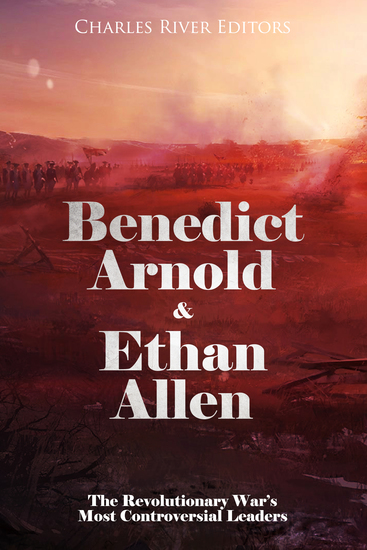
The story of Ethan Allen and his Green Mountain Boys is one of those delightful tales that American schoolchildren hear about in school, but it is also one that is much more interesting to read about in older age. Unlike revered Founding Fathers such as George Washington and Thomas Jefferson, who came from Virginian plantations, Allen was a rough and tumble frontiersman more likely to fight than talk. And yet, he was in no way a dullard, but instead as well-read as many of his contemporaries and more so than the average man of his day. His family story reads almost like a cheap novel, from his heretic father to his hotheaded brothers and his shrewish first wife. By the time he was 30 years old, Allen had run up a significant list of skirmishes with law, something most of his fellow Revolutionary War heroes managed to avoid. Unlike Washington, who received his military training as a soldier in the famous British Army, Allen learned to fight in the backwoods of what is now Vermont, struggling alongside others for independence years before Jefferson wrote the Declaration of Independence.
 
When the American Revolutionary War broke out in earnest, Green did not go to state leaders to ask for a commission to fight; instead, Connecticut officials came to him, and it led to his involvement in the capture of Fort Ticonderoga, a successful but controversial operation that found Allen having to work with none other than Benedict Arnold over who would lead the attack on the British fort.
 
While that success suggested an instinct for battle, Allen would suffer setbacks, and eventually he was captured and held prisoner by the British for nearly two years. Fortunately, the two years he spent as a captive with the British were not wasted, for when he returned home, he joined the people of the newly formed Republic of Vermont and worked towards making it an independent state. Though it took years of work both honorable and underhanded, he ultimately succeeded and remains held in the highest esteem by many in the state of Vermont to this day.
 
On October 7, 1777, Benedict Arnold rode out against orders and led an American assault against British forces led by General John Burgoyne in one of the climactic battles and ultimate turning point of the war at Saratoga. Near the end of the most important American victory of the Revolution, Arnold’s leg was shattered by a volley that also hit his horse, which fell on the leg as well.
 
Arnold would later remark that he wish the shot had hit him in the chest. If it had, he would be remembered as one of America’s greatest war heroes, and probably second only to George Washington among the generals of the Revolution. In fact, when Arnold was injured at the height of his success in October 1777, he had been the most successful leader of American forces during the war to date. Arnold had been instrumental in the seizure of Fort Ticonderoga in 1775, he constructed the first makeshift American navy to defend Lake Champlain and delay British campaigning in 1776, and he was the principal leader at Saratoga in 1777. Even his unsuccessful campaign to Quebec in the winter of 1775 is remembered primarily for the amazing logistical feats undertaken by Arnold and his men to even reach the target.
 
History has accorded Arnold his fair share of credit for the fighting he participated in from 1775-1777. The problem is his contemporaries did not. Arnold was better on the field than any other American general in those years, but his mercurial personality rubbed some the wrong way, and other self-promoting generals, from Ethan Allen to Horatio Gates, credited themselves with success at Arnold’s expense. Meanwhile, the Second Continental Congress frequently if inadvertently slighted Arnold, failing to duly promote him in a timely fashion and failing to pay him four years of back pay even as he spent his own private fortune training, equipping, and feeding his army and navy. 
Available since: 05/01/2025.
Print length: 68 pages.

Other books that might interest you

  • Tao of Mysticism - The Way of Agnostic Universalism - cover

    Tao of Mysticism - The Way of...

    Daniel Lichtenberg Lisy

    • 0
    • 0
    • 0
    ★★★★★ "A fascinating book that delves into the paths of various mystical traditions" 
     ___ 
    Discover the Tao of Mysticism that recognizes the mystery and complexity of our universe! 
    This book outlines the paths through various mystical traditions like Taoism, various forms Buddhism, Hinduism, Christianity and Islam, by embracing the humility, and metaphysics of human condition. 
    Learn how you can acknowledge the transcendent experience that goes beyond ordinary realm of perception, which is not exclusive to any tradition, but rather inclusively universal, while being intimately individual. 
    Order your audio book today!
    Show book
  • The Legends of the Old West - Mythic Figures of America's Frontier - cover

    The Legends of the Old West -...

    Odessa Nightshade

    • 0
    • 0
    • 0
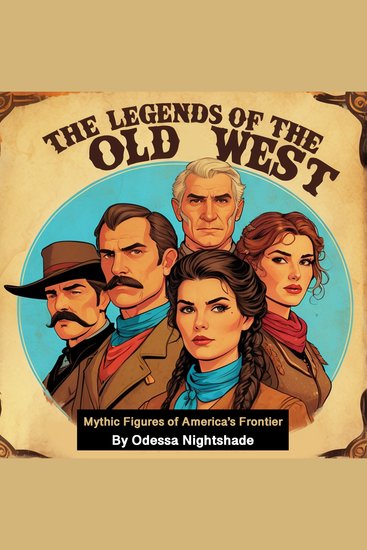
    The American Old West has long been a land of legend, where history and myth intertwine to create some of the most enduring figures in popular culture. From daring gunslingers to fearless lawmen, from resilient pioneers to courageous Native American leaders, the frontier was home to individuals whose stories have been told and retold for generations. But how much of what we believe about these figures is true? Where does history end and legend begin?  
      
    The Wild West holds a unique place in American identity. It represents freedom, adventure, and the spirit of perseverance. However, the romanticized image of the frontier often overshadows the reality of life in those times. The stories of infamous outlaws and heroic sheriffs were frequently exaggerated by dime novels, traveling shows, and later, Hollywood films. While many of these characters did exist, their exploits were often transformed into grandiose tales, making them larger than life. The result is a blurred line between fact and fiction, leaving us to wonder: Were these individuals truly as heroic—or as villainous—as they are remembered?  
      
    One of the most fascinating aspects of Old West legends is their ability to evolve. A figure like Jesse James, once considered a ruthless outlaw, became a folk hero to some, seen as a rebel against authority. Likewise, lawmen like Wyatt Earp, whose life was filled with both victories and controversies, were later immortalized as fearless defenders of justice. The process of mythmaking has not only shaped how we view the past but has also influenced modern storytelling in Western films, books, and television. 
    Show book
  • Big Book of New York Ghost Stories - cover

    Big Book of New York Ghost Stories

    Cheri Revai

    • 0
    • 0
    • 0
     Hauntings lurk and spirits linger in the Empire State—from Manhattan’s Ear Inn to the Seneca Hill Ghost in Oswego.   Reader, beware! Turn these pages and enter the world of the paranormal, where ghosts and ghouls alike creep just out of sight. Author Cheri Farnsworth shines a light in the dark corners of New York and scares those spirits out of hiding in this thrilling collection. From apparitions and objects that fly off of tables at the Manhattan Bistro, to a specter that stalks Pulpit Rock in Lake Placid, there’s no shortage of bone-chilling tales to keep you up at night. Around the campfire or tucked away on a dark and stormy night, this big book of ghost stories is a hauntingly good read.  “Whether you’re an armchair ghost enthusiast or prefer to visit haunted locales, this book, excellently organized for both, is a perfect guide and companion.” —Tamara Thorne, author of Old Wives’ Tales
    Show book
  • Josef Mengele - The Chief Doctor at Birkenau Who Did Human Experiments - cover

    Josef Mengele - The Chief Doctor...

    Kelly Mass

    • 0
    • 0
    • 0
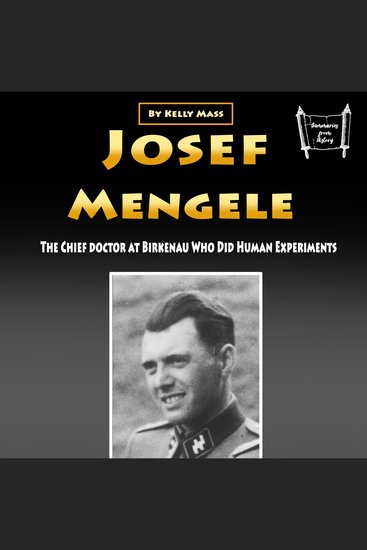
    Fiction books have been written about him. Documentaries have revealed the horrors he executed on innocent victims in concentration camps in Poland. Meet Dr. Josef Mengele, a man with a twisted mind who had no compassion for the subjects he experimented on. His methods were cruel. His conclusions were inconclusive, and his sadism hardly knew any boundaries. 
    At the time of The Second World War, Josef Mengele, typically referred to as the Angel of Death, was a German Schutzstaffel (SS) officer and cosmetic surgeon. He is known for his exploits at the Auschwitz prisoner-of-war camp, where he carried out deadly experiments on slaves and belonged of the team of medical professionals that chose victims for the gas chambers and was just one of the medical professionals who administered the gas. 
    If this is the kind of stuff you like to read about or listen to, then this book is definitely for you. Find out the truth and count yourself lucky that you never fell victim to his sickening methods.
    Show book
  • A Rare Recording of EE Cummings Reading His Own Poetry - cover

    A Rare Recording of EE Cummings...

    EE Cummings

    • 0
    • 0
    • 0
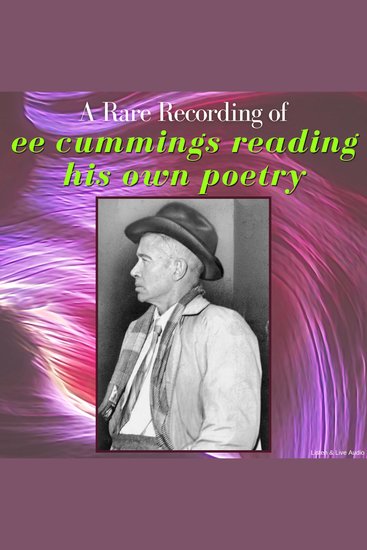
    Edward Estlin Cummings (October 14, 1894 - September 3, 1962), commonly known as e e cummings, was an American poet, painter, essayist, author, and playwright. During World War I, he worked as an ambulance driver and was imprisoned in an internment camp, which provided the basis for his 1922 novel The Enormous Room. The following year he published his first collection of poetry. Cummings wrote approximately 2,900 poems and is often regarded as one of the most important American poets of the 20th century. He is associated with modernist free-form poetry, and much of his work uses idiosyncratic syntax and lower-case spellings for poetic expression. In the following recordings, Cummings reads his poems "somewhere i have never travelled,gladly beyond" (1931), "next to of course god america i" (1926), "anyone lived in a pretty how town" (1940), "Buffalo Bill's (1920), "in Just–" (1920), i carry your heart with me(i carry it in)" (1952). The final audio clip is from a 1955 Cummings speech, "A Poet's Advice to Students."
    Show book
  • Digital Pilgrims - Towards a Quantum Humanity - cover

    Digital Pilgrims - Towards a...

    Adrián Sicilia

    • 0
    • 0
    • 0
    The present has the texture of the future. Hyper-digitalization has made all questions outdated, especially: what are we going to do? For decades, we have been inhabiting and moving within the Digital Environment. Today, the unavoidable question is: what and who are we going to be? 
    Digital Pilgrims proposes novel and urgent debates for a society that has been digitalizing itself for over fifty years. Our coexistence with mature artificial intelligences demands definitions. We are cyborgs moving in environments that exceed time and space, humans in search of meaning for this quantum reality.  
    It is not difficult to speculate about possible futures; the real challenge is to find a path forward in the face of the singularity that is starting to reveal itself, and in the face of the social impact we are just beginning to see. In the middle of the explosion, this book outlines the debates we cannot put off any longer. There are no answers here but rather a guide for us to finally discuss how to orient ourselves on this dizzying voyage.
    Show book