Join us on a literary world trip!
Add this book to bookshelf
Grey
Write a new comment Default profile 50px
Grey
Subscribe to read the full book or read the first pages for free!
All characters reduced
Stories of New York - cover

Stories of New York

Edith Wharton, Bliss Perry, Annie Eliot Trumbull, George A. Hibbard, John Seymour Wood

Publisher: Good Press

  • 0
  • 0
  • 0

Summary

In the evocative anthology *Stories of New York*, the urban landscape of the iconic city is explored through a tapestry of narratives that encapsulate its dynamic essence. This collection offers a varied palette of literary styles, ranging from poignant realism to imaginative fiction, capturing the vibrancy and complexity of New York. The anthology stands as a testament to the diversity of experiences that the city harbors, weaving together pieces that highlight the multifaceted identity of New York—from its bustling streets to the intimate lives of its inhabitants. The contributing authors, including Annie Eliot Trumbull, George A. Hibbard, Bliss Perry, Edith Wharton, and John Seymour Wood, bring a rich historical and cultural context to the collection, drawing from late 19th to early 20th-century literary traditions. Each writer offers a unique lens on the city, reflecting and contributing to movements such as realism and modernism, and infusing their narratives with personal insight and broader social commentary. Their collective voices enrich the anthology, painting a comprehensive portrait of New York as not just a place, but an emblem of broader societal transformations and diverse human experiences. For readers seeking an insightful journey through the Big Apple's myriad stories, *Stories of New York* provides a compelling exploration of a metropolis that has long fascinated storytellers. This anthology affords a singular opportunity to traverse the city's myriad narratives, each contributing a valuable perspective on its multifarious nature. It invites readers to engage with its pages for both their educational depth and the rich dialogue they foster, presenting a multifaceted exploration of one of the world's most iconic cities.
Available since: 04/24/2025.
Print length: 200 pages.
Other books that might interest you

  • Thrilled to Death - Selected Stories - cover

    Thrilled to Death - Selected...

    Lynne Tillman, Luc Sante,...

    • 0
    • 0
    • 0
    From award-winning novelist and cultural critic Lynne Tillman, Thrilled to Death is a collection of selected stories across the career of America's most audacious writer 


    Among the vanguard of American literary writers, Lynne Tillman's work has defied categorization throughout her legendary career—a singular body of work that both redefined and reimagined the short story form entirely. 


    Curated by the author, Thrilled to Death is the definitive entry point for both established fans and new readers alike. These selected stories collect a bold, playful, and eclectic ensemble of Tillman's Borgesian fictions that span decades and traverse themes of sex, death, memory, and anxiety. 


    With argumentative wit, Tillman's meditations and reflections on art, politics, and culture are animated by deliciously paradoxical characters who desire and fret in turn, and who are imbued with searing intelligence and dolorous ambivalence. Describing Tillman's writing, Colm Tóibín says: "Her style has both tone and undertone; it attempts to register the impossibility of saying very much, but it insists on the right to say a little. So what is essential is the voice itself, its ways of knowing and unknowing."
    Show book
  • Exchange is Robbery - From their pens to your ears genius in every story - cover

    Exchange is Robbery - From their...

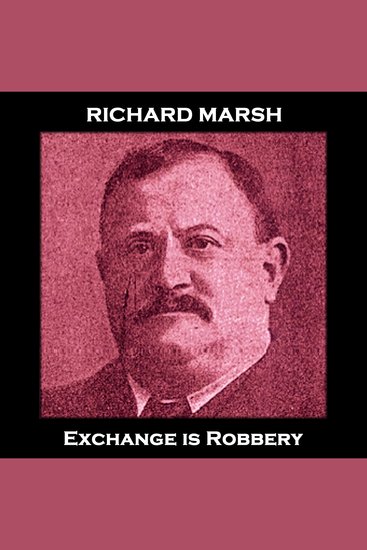
    Richard Marsh

    • 0
    • 0
    • 0
    Richard Bernard Heldmann was born on 12th October 1857, in St Johns Wood, North London.  
    By his early 20’s Heldmann began publishing fiction for the myriad magazine publications that had sprung up and were eager for good well-written content.  
    In October 1882, Heldmann was promoted to co-editor of Union Jack, a popular magazine, but his association with the publication ended suddenly in June 1883.  It appears Heldman was prone to issuing forged cheques to finance his lifestyle.  In April 1884 he was sentenced to 18 months hard labour. 
    In order to be well away from the scandal and the damage that this had caused to his reputation Heldmann adopted a pseudonym on his release from jail.  Shortly thereafter the name ‘Richard Marsh’ began to appear in the literary periodicals.  The use of his mother’s maiden name as part of it seems both a release and a lifeline. 
    A stroke of very good fortune arrived with his novel ‘The Beetle’ published in 1897.  This would turn out to be his greatest commercial success and added some much-needed gravitas to his literary reputation.   
    Marsh was a prolific writer and wrote almost 80 volumes of fiction as well as many short stories, across many genres from horror and crime to romance and humour.   His unusual characters, plotting devices and other literary developments have identified his legacy as one of the best British writers of his time.   
    Richard Marsh died from heart disease in Haywards Heath in Sussex on 9th August 1915.  He was 57.
    Show book
  • Imaginative Woman An - From their pens to your ears genius in every story - cover

    Imaginative Woman An - From...

    Thomas Hardy

    • 0
    • 0
    • 0
    Thomas Hardy was born in the hamlet of Upper Bockhampton about three miles east of Dorchester in Dorset, England, on 2nd June 1840.  
    Despite a fairly wide education and being an avid reader his parents thought it unlikely he would lead a successful scholarly or clerical career and he was apprenticed in 1856, at age 16, to a local architect whose speciality was in church restoration.  Hardy’s only opportunity to read was in the morning before work between the hours of five and eight.  
    On the back of a failed love affair he moved to London and spent five years working as an assistant to the architect Arthur Blomfield, also a restorer and designer of churches. Hardy though had by now become disillusioned with institutionalised forms of Christianity and abandoned any lingering hopes of ordination in the Anglican Church.  However, his writing of poetry was now flourishing, although it was still rejected for publication.  
    His novel ‘Desperate Remedies’, was published anonymously in 1871 and he now resolved to write full time though he was not yet in a position to achieve financial security or literary success. His second novel, ‘Under the Greenwood Tree’, appeared in 1872 and in 1873 ‘A Pair of Blue Eyes’, the most autobiographical of his works arrived. With ‘Far From the Madding Crowd’ in 1874, came critical acclaim, public attention and financial success. This was repeated in 1878 with ‘The Return of the Native’, and the ensuing years saw him rise to ever greater popularity.  
    His classic ‘The Mayor of Casterbridge’ arrived in 1886 and 5 years later ‘Tess of the d’Urbervilles’. The latter only saw publication after extensive alterations to its plot and the deletion of long passages to lessen the shock to the prudish Victorian audience who were dismayed by the seduction and ruin of a young girl by a rakish aristocrat.  
    ‘Jude the Obscure’, his last novel, suffered the same fate when it was published in 1895.  The uproar so disturbed him that he returned to poetry. In 1898 he had an earlier poetry collection, ‘Wessex Poems’ published. 
    Hardy spent the years between 1903 and 1908 writing ‘The Dynasts’, an epic poem on the Napoleonic Wars. 
    In his twilight years came honours and awards from the great and the good in recognition of his stature as one of the most outstanding of British authors across novels, short stories and poetry. George V conferred on him the Order of Merit in 1910. 
    From 1920 to 1927 he worked, in secret, on his autobiography, which was later published after his death as the work of his second wife, Florence Hardy.  
    Thomas Hardy OM died on the 11th January 1928. 
    His heart was buried alongside his first wife in Stinsford churchyard, Dorchester.
    Show book
  • A Touch of Realism - cover

    A Touch of Realism

    Saki Saki

    • 0
    • 0
    • 0
    Lady Blonze is hosting a Christmas party and wants to try a new idea to make it original. Her guest Blanche Boveal suggests a game where each guest has to act as a specific character consistently throughout the visit. At the end, everyone tries to guess each other's characters, and the best actor wins a prize. 
    The story satirizes the upper-class society's attempts to create novel entertainment and their obliviousness to the potential consequences of their games. Saki's signature wit and dark humor are evident in the absurd situations the characters find themselves in while trying to act out their roles.
    Show book
  • A Fight with a Cannon - From their pens to your ears genius in every story - cover

    A Fight with a Cannon - From...

    Victor Hugo

    • 0
    • 0
    • 0
    Victor Marie Hugo was born on 26th February 1802 in Besançon, France.   
    There can be no doubt that Hugo is ranked as the greatest of French authors and poets. In addition to this he fought against social injustice throughout his life and from his frequent elections to the French Assembly. 
    Hugo published his first novel, Han d’Islande (1823), the year after his marriage and so began an immense canon of fiction and poetry not only for France but to World literature.  
    He was elected to the Académie Française in 1841 and the same year came a peerage and entrance to the Higher Chamber as a pair de France, where he spoke against the death penalty, social injustice and in favour of press freedom.  
    In the years leading up to the Revolution of 1848 Hugo began to lean towards Republicanism and greater freedoms.  With the formation of the Second Republic, he was again elected to the Assembly. 
    When Napoleon III seized power in 1851, and established an anti-parliamentary constitution, Hugo openly declared him a traitor to France. This, of course, meant exile where he remained until 1870.  In exile he published his greatest work ‘Les Misérables’, and further widely honoured collections of poetry. 
    Returning home he was again elected to the National Assembly and the Senate.  It was the time of the Franco-Prussian war and with Paris under siege and food ever more scarce, he wrote in his diary that he was now "eating the unknown". 
    Later he was instrumental in strengthening the rights of artists and copyright, steps which led to the international protections of the Berne Convention.  
    Victor Hugo died on 22nd May 1885, aged 83.
    Show book
  • Bruiser - From THE DARKEST NIGHT horror anthology - cover

    Bruiser - From THE DARKEST NIGHT...

    Jamie Flanagan

    • 0
    • 0
    • 0
    Tisha Page is a nurse at Harmony Nursing and Rehabilitation. She cares about her patients, trying to connect with their grief and loss—but it's hard when she's fighting her own battle against sleep deprivation and corporate indifference. The one patient she is able to truly connect with is Nathaniel. Tisha and Nathaniel couldn't be more different, except they both know what it's like to be born a size too big for this world. Too angry, too large, and too inconvenient to ever truly fit in with the rest of society. 
     
    As Nathaniel rages against the slow decay of his life, Tisha begins to see a monster stalking the dismal halls of the Harmony nursing home. Worse than death, the monster wants to take from the patients while they're still alive until they're nothing but husks of their former selves. Tisha must overcome her own slow decay at the hands of apathy and bureaucracy before the monster can take everything she has left.
    Show book