Join us on a literary world trip!
Add this book to bookshelf
Grey
Write a new comment Default profile 50px
Grey
Subscribe to read the full book or read the first pages for free!
All characters reduced
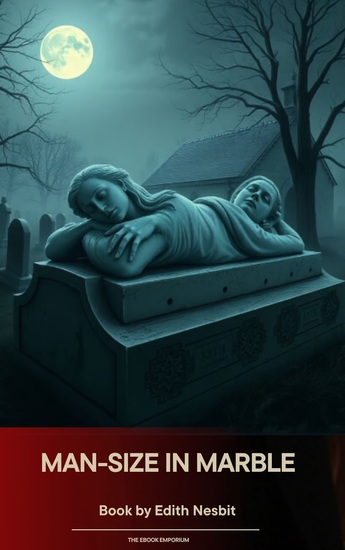
Man-Size in Marble - cover

Man-Size in Marble

Edith Nesbit

Publisher: The Ebook Emporium

  • 0
  • 0
  • 0

Summary

"They are only marble, Jack... they cannot move."

Looking for a peaceful life of artistic inspiration, a young married couple moves into a charming cottage in the English countryside, nestled near an ancient church. The local villagers speak in hushed tones of a dark legend: every Halloween, the two life-sized marble effigies of knights in the church rise from their tombs to walk the earth once more. While the skeptical husband laughs off the "rural superstition," his wife Laura is consumed by an inexplicable dread. As All Saints' Eve approaches, the boundary between stone and flesh begins to blur with devastating consequences.

A Masterclass in Gothic Suspense: Edith Nesbit, the creator of The Railway Children, showcases her darker genius in this quintessential Victorian horror. The story masterfully builds tension through the contrast between the sunny, domestic bliss of the newlyweds and the cold, subterranean malice of the church's inhabitants. It is a haunting exploration of the vulnerability of human happiness in the face of ancient, uncaring forces.

The Terror of the Inanimate: Man-Size in Marble is celebrated for its shocking and visceral conclusion, which remains one of the most famous endings in ghost-story history. Nesbit plays on the primal fear of the uncanny—the idea that something made of stone could possess a sentient, murderous intent. It is a taut, atmospheric work that proves why Nesbit was admired by contemporary horror giants like H.G. Wells and Lord Dunsany.

Stone cold and blood red. Purchase "Man-Size in Marble" today and experience the ultimate in Victorian dread.
Available since: 01/06/2026.
Print length: 64 pages.


Other books that might interest you

  • American Fairy Tales - Minus the Racist Ones - cover

    American Fairy Tales - Minus the...

    L. Frank Baum

    • 0
    • 0
    • 0
    A new narration of L. Frank Baum's 1901 classic American Fairy Tales, but with the two really, really racist ones omitted. 
    Table of ContentsThe Box of RobbersThe Glass DogThe Queen of QuokThe Girl Who Owned a BearThe Enchanted TypesThe Magic BonbonsThe Capture of Father TimeThe Wonderful PumpThe Dummy That LivedThe King of the Polar Bears 
    (Omitted: The Mandarin and the Butterfly, and The Laughing Hippopotamus)
    Show book
  • A Legend - From their pens to your ears genius in every story - cover

    A Legend - From their pens to...

    Alexander Kuprin

    • 0
    • 0
    • 0
    Alexander Kuprin was born in Narovchat, Penza in Russia on 7th September 1870. 
    At 3 his Father died and he and mother moved to Moscow. By 10 he was enrolled at the Second Moscow Military High School and there his interest in literature began. The Alexander Military Academy followed and two years later he was a sub-lieutenant and posted to an Infantry Regiment for a further four years. 
    Despite his duties he was a now a keen writer and published his first short story at this time. His military duties also garnered him experiences for his breakthrough work ‘The Duel’.  Leaving the military he left for Kiev to work for local newspapers.  He continued to publish both stories and novels and by 1901 he was in St Petersburg becoming part of a group that included Chekhov, Ivan Bunin, Maxim Gorky and Leonid Andreyev.  
    In the years that followed further controversial works and acclaim followed.  His comments on the regime meant he was also put under secret police surveillance.   
    As World War I erupted, Kuprin opened a military hospital but was then given command of an infantry company in Finland. He was soon discharged on grounds of ill health.  
    The October Revolution saw him praise Lenin, but he warned that the Bolsheviks threatened Russian culture and might cause further widespread suffering to the peasants.  As Civil War raged he took his family to Helsinki and then on to Paris. 
    Exile saw his talents decline further and his succumbing to alcoholism. He became lonely and withdrawn. The family's poverty increased his malaise.   
    In May 1937, the Kuprin’s returned to Moscow.  He now saw his work published but wrote almost nothing new.  In 1938 his health rapidly deteriorated.  Already suffering from a kidney problems and sclerosis, he had now developed cancer of the oesophagus.  
    Alexander Kuprin died on 25th August 1938.
    Show book
  • Frankenstein Alive - cover

    Frankenstein Alive

    Mary Shelley

    • 0
    • 0
    • 0
    Mary Shelley ) was an English novelist who wrote the Gothic novel Frankenstein; or, The Modern Prometheus in 1818, which is considered an early example of science fiction. She also edited and promoted the works of her husband, the Romantic poet, and philosopher Percy Bysshe Shelley. Her father was the political philosopher William Godwin and her mother the philosopher and feminist activist Mary Wollstonecraft. 
     
    Shelley's mother died less than a month after giving birth to her. She was raised by her father, who provided her with a rich if informal education, encouraging her to adhere to his own anarchist political theories. When she was four, her father married a neighbor, Mary Jane Clairmont, with whom Shelley came to have a troubled relationship. 
     
    In 1814, Shelley began a romance with one of her father's political followers, Percy Bysshe Shelley, who was already married. Together with her stepsister, Claire Clairmont, she and Percy left for France and traveled through Europe. Upon their return to England, Shelley was pregnant with Percy's child. Over the next two years, she and Percy faced ostracism, constant debt, and the death of their prematurely born daughter. They married in late 1816, after the suicide of Percy Shelley's first wife, Harriet. 
     
    In 1816, the couple and her stepsister famously spent a summer with Lord Byron and John William Polidori near Geneva, Switzerland, where Shelley conceived the idea for her novel Frankenstein. The Shelleys left Britain in 1818 for Italy, where their second and third children died before Shelley gave birth to her last and only surviving child, Percy Florence Shelley. In 1822, her husband drowned when his sailing boat sank during a storm near Viareggio. A year later, Shelley returned to England and from then on devoted herself to the upbringing of her son and a career as a professional author.
    Show book
  • A New England Nun - cover

    A New England Nun

    Mary E. Wilkins Freeman

    • 0
    • 0
    • 0
    "Embark on a journey through 19th-century New England with 'A New England Nun' by Mary E. Wilkins Freeman. This annotated edition unveils the nuanced layers of societal expectations and women's autonomy. Explore the symbolism of wild grapes, the metaphorical imagery of an uncloistered nun, and Joe Daggett's poignant honesty. Perfect for literary enthusiasts, this edition provides a rich understanding of historical and feminist themes, making 'A New England Nun' a captivating exploration of tradition, relationships, and personal desires."
    Show book
  • Utopia - cover

    Utopia

    Thomas Moore

    • 0
    • 0
    • 0
    'For if you suffer your people to be ill-educated and their manners to be corrupted from their infancy, and then punish them for those crimes to which their first education disposed them, what else is to be concluded from this, but that you first make thieves and then punish them.'
    
    A classic work of socio-political satire and still widely read and studied to this day, Utopia sees a fictional traveller describe an ideal society; a vehicle for More to highlight the flaws of sixteenth-century Europe.
    
    First published in 1516, Utopia is a political and philosophical satire presented as a dialogue between More and the traveller Raphael Hythlodaeus. Raphael recounts his time visiting the island of Utopia, where private property ceases to exist, all citizens work, and the laws promote equality, education and religious tolerance. Through this imagined society, More indirectly challenges the injustices of European politics, and cleverly reflects on the meaning of justice, governance and what it takes to create a 'perfect' society.
    Thomas More (1478 – 1535) was an English philosopher, statesman, lawyer and author. Venerated in the Catholic Church, More served Henry VIII as Lord Chancellor from 1529 to 1532. Today, he is noted for being a Renaissance humanist, and is best known for his political work, Utopia.
    Show book
  • Beauty of Form and Beauty of Mind - cover

    Beauty of Form and Beauty of Mind

    Hans Christian Andersen

    • 0
    • 0
    • 0
    In Beauty of Form and Beauty of Mind, Hans Christian Andersen offers one of his most mature and quietly devastating tales—a reflective allegory about love, art, and the cost of mistaking appearance for substance. 
    Alfred, a gifted young sculptor, becomes captivated by Kaela, a woman of flawless beauty whose presence seems to embody everything his art strives to achieve. Enchanted by her outward perfection, he fails to ask what lies beneath. Their union, admired by society and celebrated as ideal, slowly reveals a profound imbalance—one that beauty alone cannot sustain. 
    As time passes, illness, loss, and reflection strip away illusion, forcing Alfred to confront a truth he had long ignored: that form, however exquisite, is transient, while the life of the mind and spirit endures. In the thoughtful, unassuming Sophy, he discovers a deeper companionship—one grounded not in admiration, but in understanding. 
    Written with restraint and moral clarity, this story stands apart from Andersen’s lighter fairy tales. It is a philosophical meditation on art, marriage, and human fulfillment, asking a timeless question: what kind of beauty truly elevates us—and what happens when we learn the answer too late? 
    Narrated with grace and emotional subtlety by Michele Wagner, this audiobook invites listeners into a world where elegance conceals emptiness, and quiet wisdom carries the greater weight.
    Show book