¡Acompáñanos a viajar por el mundo de los libros!
Añadir este libro a la estantería
Grey
Escribe un nuevo comentario Default profile 50px
Grey
Suscríbete para leer el libro completo o lee las primeras páginas gratis.
All characters reduced
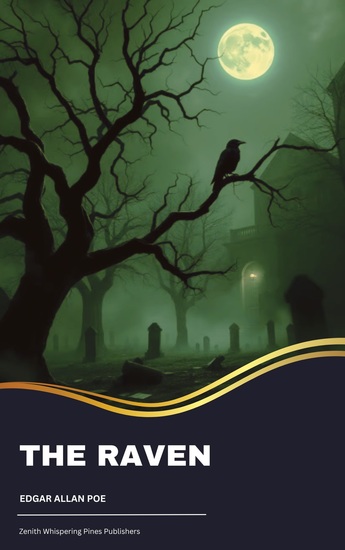
The Raven - cover

The Raven

Edgar Allan Poe

Editorial: Zenith Whispering Pines Publishers

  • 1
  • 0
  • 0

Sinopsis

"Quoth the Raven, 'Nevermore.'"

Few works of literature have captured the public imagination—or the chill of a winter's midnight—quite like Edgar Allan Poe's The Raven. First published in 1845, this hypnotic narrative poem remains the gold standard for atmospheric storytelling, tracing a grieving scholar's slow descent into insanity as he is visited by a mysterious, talking bird.

A Symphony of Dread and Beauty: The Raven is a masterclass in "The Philosophy of Composition." Poe meticulously engineered every stanza to evoke a singular effect: a beauty tinged with sadness. Through its rhythmic, driving meter and rich, classical allusions, the poem explores the universal human experience of grief and the terrifying realization that some losses are eternal. It is a work where the boundaries between the supernatural and the psychological blur, leaving the reader to wonder if the raven is a demonic messenger or a mere projection of a fractured mind.

From its "tapping" at the chamber door to the haunting shadow on the floor, The Raven continues to influence modern art, film, and music. This volume is an essential cornerstone for any library of classic poetry, horror fiction, and Dark Romanticism.

Open the door to the shadows. Buy "The Raven" today and experience the most famous poem in the English language.
Disponible desde: 24/12/2025.
Longitud de impresión: 81 páginas.

Otros libros que te pueden interesar

  • White Fang - cover

    White Fang

    Jack London

    • 0
    • 0
    • 0
    It was the she-wolf who had first caught the sound of men's voices and the whining of the sled-dogs; and it was the she-wolf who was first to spring away from the cornered man in his circle of dying flame. The pack had been loath to forego the kill it had hunted down, and it lingered for several minutes, making sure of the sounds, and then it, too, sprang away on the trail made by the she-wolf. Running at the forefront of the pack was a large grey wolf—one of its several leaders.    It was he who directed the pack's course on the heels of the she-wolf. It was he who snarled warningly at the younger members of the pack or slashed at them with his fangs when they ambitiously tried to pass him. And it was he who increased the pace when he sighted the she-wolf, now trotting slowly across the snow. She dropped in alongside by him, as though it were her appointed position, and took the pace of the pack. He did not snarl at her, nor show his teeth, when any leap of hers chanced to put her in advance of him.    On the contrary, he seemed kindly disposed toward her—too kindly to suit her, for he was prone to run near to her, and when he ran too near it was she who snarled and showed her teeth. Nor was she above slashing his shoulder sharply on occasion. At such times he betrayed no anger. He merely sprang to the side and ran stiffly ahead for several awkward leaps, in carriage and conduct resembling an abashed country swain. This was his one trouble in the running of the pack; but she had other troubles.    On her other side ran a gaunt old wolf, grizzled and marked with the scars of many battles. He ran always on her right side. The fact that he had but one eye, and that the left eye, might account for this. He, also, was addicted to crowding her, to veering toward her till his scarred muzzle touched her body, or shoulder, or neck. As with the running mate on the left, she repelled these attentions with her teeth; but when both bestowed their attentions at the same time she was roughly jostled, being compelled, with quick snaps to either side, to drive both lovers away and at the same time to maintain her forward leap with the pack and see the way of her feet before her.    At such times her running mates flashed their teeth and growled threateningly across at each other. They might have fought, but even wooing and its rivalry waited upon the more pressing hunger-need of the pack. After each repulse, when the old wolf sheered abruptly away from the sharp-toothed object of his desire, he shouldered against a young three-year-old that ran on his blind right side. This young wolf had attained his full size; and, considering the weak and famished condition of the pack, he possessed more than the average vigour and spirit. Nevertheless, he ran with his head even with the shoulder of his one-eyed elder. When he ventured to run abreast of the older wolf (which was seldom), a snarl and a snap sent him back even with the shoulder again.    Sometimes, however, he dropped cautiously and slowly behind and edged in between the old leader and the she-wolf. This was doubly resented, even triply resented. When she snarled her displeasure, the old leader would whirl on the three-year-old. Sometimes she whirled with him. And sometimes the young leader on the left whirled, too. At such times, confronted by three sets of savage teeth, the young wolf stopped precipitately, throwing himself back on his haunches, with fore-legs stiff, mouth menacing, and mane bristling. This confusion in the front of the moving pack always caused confusion in the rear. The wolves behind collided with the young wolf and expressed their displeasure by administering sharp nips on his hind-legs and flanks. He was laying up trouble for himself, for lack of food and short tempers went together; but with the boundless faith of youth he persisted in repeating the manoeuvre every little while, though it never succeeded in gaining anything for him but discomfiture.
    Ver libro

  • War and Peace (Book Fourteen: 1812) - cover

    War and Peace (Book Fourteen: 1812)

    Leo Tolstoy

    • 0
    • 0
    • 0
    War and Peace is a literary work mixed with chapters on history and philosophy by the Russian author Leo Tolstoy. It was first published serially, then published in its entirety in 1869. It is regarded as one of Tolstoy's finest literary achievements and remains an internationally praised classic of world literature.
    Book 14: 1812: The Battle of Borodinó, with the occupation of Moscow that followed it and the flight of the French without further conflicts, is one of the most instructive phenomena in history. All historians agree that the external activity of states and nations in their conflicts with one another is expressed in wars, and that as a direct result of greater or less success in war the political strength of states and nations increases or decreases.
    Ver libro
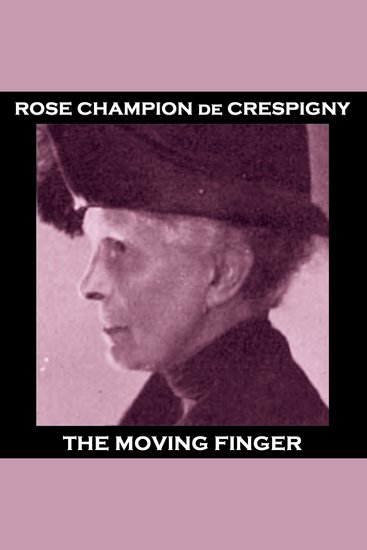
  • The Moving Finger - An detective story that brings mystery and revelation by occult means - cover

    The Moving Finger - An detective...

    Rose Champion de Crespigny

    • 0
    • 0
    • 0
    Annie Rose Charlotte Key was born on 9th November 1859 in Kensington, London. 
     
    With a privileged background—her father was an admiral, her mother a Lady, Rose began her creative life as a painter before a stab at writing local history settled her into popular fiction. 
     
    Her works were solidly written and often described as having a ‘certain graceful facility’. 
     
    Her marriage to Philip Augustus Champion de Crespigny in 1878 resulted in a family of 4 children and a name of status. 
     
    Rose was a leading member of the Ridley Art Club, the Lyceum Club in Piccadilly, and of the British College of Psychic Science.  Victorian society had a particular fascination with spiritualism and in ‘The Moving Finger’ Rose uses the theme as a background to introduce her popular occult detective Norton Vyse into her series of short stories.  
     
    Rose Champion de Crespigny died on 10th February 1935.  She was 75.
    Ver libro
  • Anne's House of Dreams - cover

    Anne's House of Dreams

    Lucy Maud Montgomery

    • 0
    • 0
    • 0
    "Anne's House of Dreams" is a delightful novel by Canadian author Lucy Maud Montgomery. Published in 1917, it is the fifth book in the beloved "Anne of Green Gables" series. Let's step into the world of Anne Shirley once again:Anne's own true love, Gilbert Blythe, is finally a doctor, and in the sunshine of the old orchard, among their dearest friends, they are about to speak their vows. Soon the happy couple will be bound for a new life together and their own dream house, on the misty purple shores of Four Winds Harbor.
    Ver libro
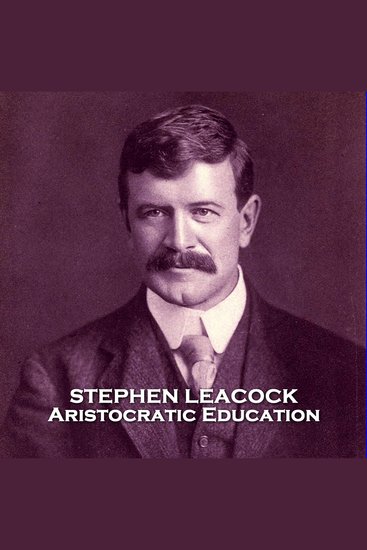
  • Aristocratic Education - From their pens to your ears genius in every story - cover

    Aristocratic Education - From...

    Stephen Leacock

    • 0
    • 0
    • 0
    Stephen P H Butler Leacock FRSC was born on the 30th December 1869 in Swanmore, near Southampton, England, the third of eleven children. 
    The family emigrated to Canada in 1876 to live on a 100-acre farm in Sutton, Ontario.  There Leacock was home-schooled and later enrolled into the elite private school Upper Canada College in Toronto.  Academically he was very strong and enrolled at the University of Toronto to study languages and literature.  He left there after his alcoholic father abandoned the family and finances were too stretched to continue his attendance.  He now enrolled in a three-month course at Strathroy Collegiate Institute to become a qualified high school teacher and with it a regular income. 
    Leacock published humorous articles in many Canadian and US magazines but his real passion was economics and political theory.  In 1899 he enrolled for postgraduate studies at the University of Chicago and earned his PhD in 1903. 
    His marriage to Beatrix Hamilton produced a single child 15 years later.  Over time father and son developed a love-hate relationship, partially caused by his son’s diminutive stature of only four feet.  
    He accepted a post at McGill University and kept it until he retired in 1936.  His work ‘Elements of Political Science’, was adopted as a standard textbook for two decades and was also his most profitable.  He now also began public speaking and lecturing.  
    In 1910, he privately printed some articles as ‘Literary Lapses’.  It was then released by a recognised publisher, and he became a commercially successful writer.  His collections of light-hearted whimsy, parody, nonsense, and satire were now frequently published along with biographies and several award-winning volumes on Canada. 
    Politically Leacock was a difficult creature.  He opposed women’s right to vote, was a champion of Empire but advocated social welfare legislation and wealth redistribution, but he often caused friction with his racist views. 
    Leacock has been forgotten as an economist, but it’s often said that in 1911 more people had heard of him than had heard of Canada.  For the decade after 1915 Leacock was the most popular humorist in the English-speaking world. 
    Stephen Leacock died on 28th March 1944 of throat cancer in Toronto, Canada.  He was 74.
    Ver libro
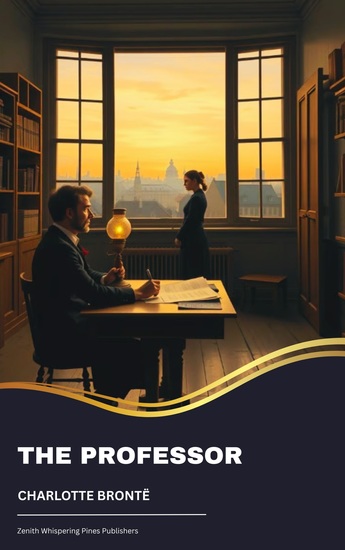
  • The Professor - cover

    The Professor

    Charlotte Brontë

    • 0
    • 0
    • 0
    A young man seeking purpose. A new life in a foreign city. A love that awakens everything he thought he knew about himself.
    In this intimate and often overlooked gem, William Crimsworth leaves behind a stifling life in England to teach at a boys' school in Brussels. There he confronts ambition, jealousy, and the struggle to prove his worth in a world that underestimates him. But when he meets Frances Henri—a quiet, determined young teacher—their connection grows into something tender, honest, and transformative.
    
    Praised as "a revealing portrait of Brontë's earliest voice," this novel offers sharp insight, heartfelt emotion, and themes of self-respect, independence, and the courage to choose one's own path. Readers treasure it for its subtle romance and the clarity of Brontë's developing brilliance.
    
    If you enjoy character-driven stories, slow-burning love, and the emotional intelligence of the Brontë tradition, this classic will resonate deeply.
    
    Open the book—and follow a journey of growth, love, and quiet determination.
    Ver libro