¡Acompáñanos a viajar por el mundo de los libros!
Añadir este libro a la estantería
Grey
Escribe un nuevo comentario Default profile 50px
Grey
Suscríbete para leer el libro completo o lee las primeras páginas gratis.
All characters reduced
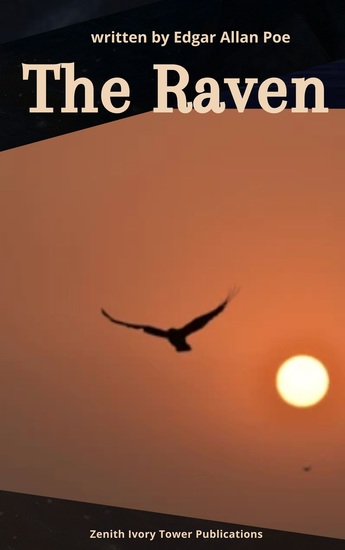
The Raven - The Iconic Gothic Poem of Love Loss and Lingering Madness - cover

The Raven - The Iconic Gothic Poem of Love Loss and Lingering Madness

Edgar Allan Poe, Zenith Ivory Tower Publications

Editorial: Zenith Ivory Tower Publications

  • 0
  • 0
  • 0

Sinopsis

"Once upon a midnight dreary…" begins the poem that has haunted readers for over 175 years.
The Raven is Edgar Allan Poe's most famous work—a dark, hypnotic, and deeply emotional journey into grief, longing, and the boundaries of sanity.

As a bereaved narrator mourns the loss of his beloved Lenore, a mysterious raven appears at his window. What follows is a chilling, rhythmic descent into obsession and despair. With its unforgettable refrain of "Nevermore," Poe's masterpiece blends lyrical beauty with psychological horror, solidifying his legacy as the master of the macabre.

First published in 1845, The Raven remains one of the most celebrated and quoted poems in English literature, praised for its haunting musicality, vivid imagery, and psychological depth.

"The most famous American poem ever written." — The New York Times
"Eerie, elegant, and eternal. Poe's genius in perfect form." — The Guardian
"A haunting masterpiece that echoes long after the final verse." — Goodreads Reviewer

Perfect for lovers of Gothic fiction, classic poetry, and the eerie beauty of the human soul, The Raven is a must-have for every literary collection.

Click 'Buy Now' and let Poe's immortal words echo in your mind—forevermore.
Disponible desde: 24/07/2025.
Longitud de impresión: 423 páginas.

Otros libros que te pueden interesar

  • First and Last Things (Unabridged) - cover

    First and Last Things (Unabridged)

    H. G. Wells

    • 0
    • 0
    • 0
    First and Last Things is a 1908 work of philosophy by H. G. Wells setting forth his beliefs in four "books" entitled "Metaphysics," "Of Belief," "Of General Conduct," and "Some Personal Things." Parts of the book were published in the Independent Magazine in July and August 1908. Wells revised the book extensively in 1917, in response to his religious conversion, but later published a further revision in 1929 that restored much of the book to its earlier form. Its main intellectual influences are Darwinism and certain German thinkers Wells had read, such as August Weismann. The pragmatism of William James, who had become a friend of Wells, was also an influence.
    Ver libro
  • Who's There? - cover

    Who's There?

    Arthur C. Clarke

    • 0
    • 0
    • 0
    "Who's There?" was first published in the November 1958 issue of New Worlds.In Arthur C. Clarke's "Who's There?" explores themes of the human connection to animals, especially in unusual environments, and the unexpected quirks of space travel.
    Ver libro
  • Sun-Dog Trail The (Unabridged) - cover

    Sun-Dog Trail The (Unabridged)

    Jack London

    • 0
    • 0
    • 0
    Jack London (born John Griffith Chaney, January 12, 1876 - November 22, 1916) was an American author, journalist, and social activist. He was a pioneer in the then-burgeoning world of commercial magazine fiction and was one of the first fiction writers to obtain
    worldwide celebrity and a large fortune from his fiction alone.
    THE SUN-DOG TRAIL: Sitka Charley smoked his pipe and gazed thoughtfully at the Police Gazette illustration on the wall. For half an hour he had been steadily regarding it, and for half an hour I had been slyly watching him.
    Ver libro
  • Samuel The Seeker - cover

    Samuel The Seeker

    Upton Sinclair

    • 0
    • 0
    • 0
    “Samuel the Seeker” by Upton Sinclair is a thought-provoking social and political satire. The novel follows the journey of Samuel Prescott, an idealistic young farm boy who strikes out on his own to strike it rich when his father dies shortly after losing all of his savings in a bad stock market investment. Samuel encounters a variety of characters, from the fiendish and jaded Capitalists to the sainted Socialists, with the righteous religious and the purchased politicians and police along the way. This rags-to-rags story examines every form of social injustice and societal ill through the eyes of Samuel.
    Ver libro
  • Lily and the Lion - Story Time Episode 16 (Unabridged) - cover

    Lily and the Lion - Story Time...

    Brothers Grimm

    • 0
    • 0
    • 0
    "Lily and the Lion" There is a man with three daughters. One day, he must leave on a journey and asks each of his daughters what they would like him to bring back. The oldest wants diamonds, the second pearls, and the youngest a singing, springing lark. The man is able to find diamonds and pearls, but he fails to find a lark. On his journey home, the man sees a lark in a tall tree, and orders his servant to catch it.
    Ver libro
  • Treasure Island (Part 5: My Sea Adventure) - cover

    Treasure Island (Part 5: My Sea...

    Robert Louis Stevenson

    • 0
    • 0
    • 0
    Part 5: My Sea Adventure from Treasure Island:
    "For sheer storytelling delight and pure adventure, Treasure Island has never been surpassed. From the moment young Jim Hawkins first encounters the sinister Blind Pew at the Admiral Benbow Inn until the climactic battle for treasure on a tropic isle, the novel creates scenes and characters that have fired the imaginations of generations of readers. Written by a superb prose stylist, a master of both action and atmosphere, the story centers upon the conflict between good and evil - but in this case a particularly engaging form of evil. It is the villainy of that most ambiguous rogue Long John Silver that sets the tempo of this tale of treachery, greed, and daring. Designed to forever kindle a dream of high romance and distant horizons, Treasure Island is, in the words of G. K. Chesterton, 'the realization of an ideal, that which is promised in its provocative and beckoning map; a vision not only of white skeletons but also green palm trees and sapphire seas.' G. S. Fraser terms it 'an utterly original book' and goes on to write: 'There will always be a place for stories like Treasure Island that can keep boys and old men happy.'
    Ver libro