

Join us on a literary world trip!
Add this book to bookshelf
Grey
Write a new comment Default profile 50px
Grey
Subscribe to read the full book or read the first pages for free!
All characters reduced
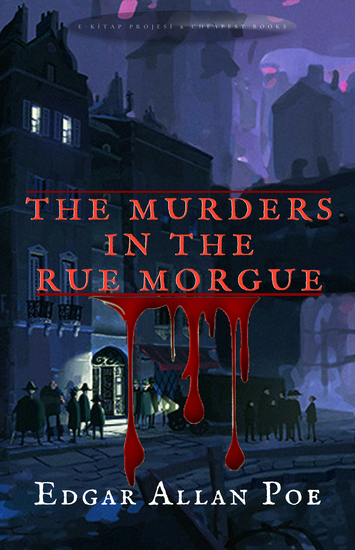
The Murders in the Rue Morgue - cover

The Murders in the Rue Morgue

Edgar Allan Poe

Publisher: E-Kitap Projesi & Cheapest Books

  • 0
  • 0
  • 0

Summary

The Murders in the Rue Morgue is a short story by Edgar Allan Poe published in Graham's Magazine in 1841. It has been recognized as the first modern detective story; Poe referred to it as one of his "tales of ratiocination".Two works that share some similarities predate Poe's stories, including Das Fräulein von Scuderi (1819) by E. T. A. Hoffmann and Zadig (1747) by Voltaire. C. Auguste Dupin is a man in Paris who solves the mystery of the brutal murder of two women.Numerous witnesses heard a suspect, though no one agrees on what language was spoken. At the murder scene, Dupin finds a hair that does not appear to be human. As the first fictional detective, Poe's Dupin displays many traits which became literary conventions in subsequent fictional detectives, including Sherlock Holmes and Hercule Poirot.Many later characters, for example, follow Poe's model of the brilliant detective, his personal friend who serves as narrator, and the final revelation being presented before the reasoning that leads up to it. Dupin himself reappears in "The Mystery of Marie Rogêt" and "The Purloined Letter".
Available since: 12/06/2023.
Print length: 100 pages.

Other books that might interest you

  • Waverley Volume 1 - cover

    Waverley Volume 1

    Walter Scott

    • 0
    • 0
    • 0
    "Waverley" by Walter Scott is an enthralling historical novel set during the Jacobite Rebellion in 1745. The protagonist, Edward Waverley, becomes embroiled in the conflict, torn between loyalty to his English roots and his growing affinity for the Highland clans. Scott masterfully captures the political and social turbulence of the time, blending romance, adventure, and historical realism. The novel paints a vivid picture of Scotland's landscapes, traditions, and the clash between two worlds. "Waverley" is a timeless exploration of identity, allegiance, and the impact of historical events on individual lives.
    Show book
  • Whisperer in Darkness The (Unabridged) - cover

    Whisperer in Darkness The...

    H. P. Lovecraft

    • 0
    • 0
    • 0
    The Whisperer in Darkness is a 26,000-word novella by American writer H. P. Lovecraft. Written February-September 1930, it was first published in Weird Tales, August 1931.[1] Similar to The Colour Out of Space (1927), it is a blend of horror and science fiction. Although it makes numerous references to the Cthulhu Mythos, the story is not a central part of the mythos, but reflects a shift in Lovecraft's writing at this time towards science fiction. The story also introduces the Mi-Go, an extraterrestrial race of fungoid creatures.
    Show book
  • The Red Badge of Courage - cover

    The Red Badge of Courage

    Stephen Crane

    • 0
    • 0
    • 0
    Stephen Crane's "The Red Badge of Courage" is a powerful exploration of the psychological and emotional toll of war. Set against the backdrop of the American Civil War, the novel follows the journey of Henry Fleming, a young and inexperienced soldier eager to prove his courage on the battlefield. Faced with the harsh realities of war, Henry grapples with fear, doubt, and the complexities of heroism.
    As Henry confronts the chaos and brutality of battle, he undergoes a profound internal struggle, questioning his own motives and struggling to reconcile his romanticized notions of warfare with the harsh truths he encounters. The narrative skillfully delves into the intricacies of human nature and the transformative impact of war on an individual.
    Crane's vivid and evocative prose captures the raw intensity of combat, immersing readers in the gritty details of soldier life. "The Red Badge of Courage" is a timeless examination of the human condition, offering a poignant reflection on courage, identity, and the cost of glory. This classic work continues to resonate with readers, providing a poignant and thought-provoking exploration of the complexities of war and the indomitable spirit of the individual.
    Show book
  • A Society - From their pens to your ears genius in every story - cover

    A Society - From their pens to...

    Virginia Woolf

    • 0
    • 0
    • 0
    Adeline Virginia Woolf was born on the 25th January 1882 in South Kensington in London. 
    Although lauded as a founder of modernist writing with such classics as ‘Orlando’, ‘Mrs Dalloway’ and ‘To the Lighthouse’ and, of course, many classic short stories, her background is filled with elements of tragedy that she somehow overcame to become such a revered writer.   Her mother died when she was 13, her half-sister Stella two years later and with it her first of several nervous breakdowns.  Appallingly it was later found that three of her half-brothers had sexually abused her so darkness must have seemed ever present.   
    She began writing professionally at age 20 but her father’s death two years later brought a complete mental collapse and she was briefly institutionalised.  Somehow she found within herself a literary career and with it great innovations in writing; she was a pioneer of “stream of consciousness”.    
    Her tight circle of friends were the founders of the Bloomsbury Group, a movement whose legacy still influences across the arts and society in many way to this day.   
    Whilst the dark periods continued to interrupt her emotional state her rate of work never ceased.  Until, on 28th March 1941, Woolf put on her overcoat, filled up its pockets with stones, and walked into the River Ouse, in Lewes, East Sussex and drowned herself.  Her body was not recovered until the 18th April.  She was 59. 
    She left behind a note which read in part “Dearest, I feel certain that I am going mad again.  I feel we can't go through another of those terrible times.  And I shan't recover this time.  I begin to hear voices, and I can't concentrate.  So I am doing what seems the best thing to do”.
    Show book
  • Russian Short Story The - Volume 6 - Alexander Kuprin to Isaac Babel - cover

    Russian Short Story The - Volume...

    Leonid Andreyev, Mikhail...

    • 0
    • 0
    • 0
    The Russian novel has a reputation that is immense, both in narrative and in length.  Unquestionably though the ideas, themes and characters make many novels rightly revered as world class, as icons of literature. 
     
    Perhaps an easier way to enjoy a wider selection of the Russian heritage, with its varied and glorious literary talents, is with the short story.  These gems sparkle and beguile the mind with their characters and narrative, exploring facets of society and the human condition that more Western authors somehow find more difficult to navigate, or to explore, explain and relate to.   
     
    The Russian short story is, in many respects, in a genre of its own.  It is at its captivating best whether it’s an exploration of real-life experiences, through fantasy and fables and on to total absurdity. 
     
    In a land so vast it is unsurprising that it is a world almost unto itself. Cultures and landscapes of differing hues are packed together bound only by the wilful bonds and force of Empire. 
     
    The stories in this collection traverse the decades where one might be a serf under an absolute monarch, and the reality of that was pretty near to slavery, into an emancipation of sorts in the fields, or towns under the despotic will of landowners and the rich into the upheavals of Empire and then the overthrow of the ruling class and its replacement by the communists, who promised equality for all and delivered a society where the down-trodden remained the lowest yet vital cog of the state machine and its will.  
     
    Whilst Tolstoy, Gogol, Dostoevsky, Pushkin and Chekhov are a given in any Russian collection we also explore and include Andreyev, Korolenko, Turgenev, Blavatsky and many others to create a world rich and dense across a sprawling landscape of diverse people, riddled with the class and unfairness in perhaps some of the most turbulent times that Russia has ever experienced. 
     
    01 - The Russian Short Story - Volume 6 - An Introduction 
    02 - Cain by Alexander Kuprin 
    03 - Anathema by Alexander Kuprin 
    04 - An Evening Guest by Alexander Kuprin 
    05 - Silence by Leonid Andreyev 
    06 - Lazarus by Leonid Andreyev 
    07 - The Lie by Leonid Andreyev 
    08 - The City by Leonid Andreyev 
    09 - The Republic of the Southern Cross by Valery Bryusov 
    10 - The Revolutionist by Mikhail Petrovich Artzybashev 
    11 - Light by Achmed Abdullah 
    12 - Morphine by Mikhail Bulgakov 
    13 - The Murderer by Mikhail Bulgakov 
    14 - The Blind Ones by Isaac Babel
    Show book
  • A Tale of One January - cover

    A Tale of One January

    Albert Maltz

    • 0
    • 0
    • 0
    Poland, January 1945. Two women and four men escape from a Nazi death march after enduring the horrors of imprisonment at Auschwitz. Despite their individual backgrounds and nationalities, they form their own family caught between the euphoria of freedom and the terror of their circumstances. This is a tale of exploding joy within a hothouse of fear, of human beings erupting into life after breaking free of death’s embrace – an unusual and moving tale that cements Albert Maltz’s reputation as a compassionate observer of character and one of the finest storytellers of his generation.
    Read by the versatile AudioFile Golden Voice, Rupert Degas, and including the music that features within the story.
    Show book
