Join us on a literary world trip!
Add this book to bookshelf
Grey
Write a new comment Default profile 50px
Grey
Subscribe to read the full book or read the first pages for free!
All characters reduced
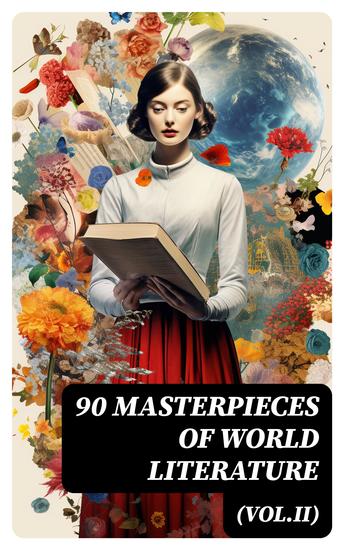
90 Masterpieces of World Literature (VolII) - Novels Poetry Plays Short Stories Essays Psychology & Philosophy - cover

90 Masterpieces of World Literature (VolII) - Novels Poetry Plays Short Stories Essays Psychology & Philosophy

Edgar Allan Poe, Pedro Calderón de la Barca, Charles Dickens, Jane Austen, Alexandre Dumas, Bram Stoker, Jonathan Swift, Joseph Conrad, Daniel Defoe, Washington Irving, Nathaniel Hawthorne, Henry James, Henrik Ibsen, Wilkie Collins, D. H. Lawrence, Friedrich Nietzsche, Harriet Beecher Stowe, Anthony Trollope, Laozi Laozi, Kate Chopin, James Fenimore Cooper, Ann Ward Radcliffe, Laurence Sterne, George MacDonald, Lewis Wallace, Robert Louis Stevenson, William Dean Howells, Honoré de Balzac, Émile Zola, Henry Fielding, George Bernard Shaw, Benjamin Franklin, Walter Scott, Theodor Storm, Willa Cather, Edith Wharton, Edgar Wallace, F. Scott Fitzgerald, Nikolai Leskov, Sinclair Lewis, Ivan Turgenev, G.K. Chesterton, J. M. Barrie, Virginia Woolf, John Buchan, Charlotte Perkins Gilman, Rabindranath Tagore, Jerome K. Jerome, W. B. Yeats, Kenneth Grahame, Kakuzo Okakura, Kurt Vonnegut, E. M. Forster, H. G. Wells, Nikolai Gogol, William Walker Atkinson, Elizabeth von Arnim, Victor Hugo, Fyodor Dostoyevsky, Cao Xueqin, Émile Coué, Johann Wolfgang von Goethe, Dante, Thomas Hardy, Válmíki, Kalidasa, Jules Verne, Bankim Chandra Chatterjee, Leo Tolstoy, Gaston Leroux, P. B. Shelley, John Milton, George Weedon Grossmith, Machiavelli, Stendhal, Confucius, W. Somerset Maugham, Gustave Flaubert, Ford Madox Ford, Homer Homer

Publisher: DigiCat

  • 0
  • 0
  • 0

Summary

In the collection '90 Masterpieces of World Literature (Vol. II)', readers are invited to embark on a literary odyssey through time and space, encountering an eclectic array of styles and genres that showcase the universal human experience. The anthology offers a sweeping panorama of world literature, featuring timeless narratives, profound philosophical inquiries, and groundbreaking artistic innovations. From the penetrating social critiques of Flaubert and Zola to the transformative mythologies of Homer and Kalidasa, this volume captures the breadth and depth of literary achievements across cultures and epochs. Though diverse in form, each piece contributes to the rich tapestry of themes exploring love, identity, existential dilemmas, and the enduring quest for meaning. The distinguished collective of authors in this volume represents a cross-section of the literary canon, bringing together the visionary ideas of avant-garde thinkers, Romantic poets, and Enlightenment philosophers, among others. It juxtaposes Confucian ethics with the satirical genius of Swift and Nietzsche's provocations with the introspective narratives of Austen and Wharton. Together, they encapsulate the spirit of movements such as Romanticism, Realism, and Modernism, marrying the geographical and cultural diversity of the world's great storytellers. This global mosaic invites readers to transcend boundaries and engage with the philosophies that have shaped literary thought. This anthology is a treasure trove for any reader with a keen interest in literature, offering an unparalleled opportunity to explore myriad perspectives within a single tome. By traversing the vast spectrum of literary traditions and thought, '90 Masterpieces of World Literature (Vol. II)' not only enriches the reader's understanding of individual authorship but also fosters a dialogue that reverberates across different epochs and societies. Dive into this exceptional volume to appreciate the wealth of insights and knowledge it bestows, ensuring an enlightening experience that is both challenging and deeply rewarding.
Available since: 11/16/2023.
Print length: 27947 pages.

Other books that might interest you

  • Think and Grow Rich - cover

    Think and Grow Rich

    Napoleon Hill

    • 0
    • 0
    • 0
    The bestselling success book of all time—now revised and updated for the 21st century.Think and Grow Rich has been called the "Granddaddy of All Motivational Literature." It was the first book to boldly ask, "What makes a winner?" The man who asked and listened for the answer, Napoleon Hill, is now counted in the top ranks of the world's winners himself. The most famous of all teachers of success spent "a fortune and the better part of a lifetime of effort" to produce the "Law of Success" philosophy that forms the basis of his books and that is so powerfully summarized in this one.In the original Think and Grow Rich, published in 1937, Hill draws on stories of Andrew Carnegie, Thomas Edison, Henry Ford, and other millionaires of his generation to illustrate his principles. In the updated version, Arthur R. Pell, Ph.D., a nationally known author, lecturer, and consultant in human resources management and an expert in applying Hill's thought, deftly interweaves anecdotes of how contemporary millionaires and billionaires, such as Bill Gates, Mary Kay Ash, Dave Thomas, and Sir John Templeton, achieved their wealth. Outmoded or arcane terminology and examples are faithfully refreshed to preclude any stumbling blocks to a new generation of readers.Provides valuable insights into navigating dynamic and unpredictable environments in various domainsDelves into the qualities of successful leadersOffers practical advice on how to gain advantages and outmanoeuvre opponents
    Show book
  • Les Misérables: Volume 4: The Idyll in the Rue Plumet and the Epic in the Rue St Denis - Book 3: The House in the Rue Plumet (Unabridged) - cover

    Les Misérables: Volume 4: The...

    Victor Hugo

    • 0
    • 0
    • 0
    Victor-Marie Hugo (26 February 1802 - 22 May 1885) was a French poet, novelist, essayist, playwright, and dramatist of the Romantic movement. During a literary career that spanned more than sixty years, he wrote abundantly in an exceptional variety of genres: lyrics, satires, epics, philosophical poems, epigrams, novels, history, critical essays, political speeches, funeral orations, diaries, and letters public and private, as well as dramas in verse and prose.
    BOOK 3: THE HOUSE IN THE RUE PLUMET: About the middle of the last century, a chief justice in the Parliament of Paris having a mistress and concealing the fact, for at that period the grand seignors displayed their mistresses, and the bourgeois concealed them, had "a little house" built in the Faubourg Saint-Germain, in the deserted Rue Blomet, which is now called Rue Plumet, not far from the spot which was then designated as Combat des Animaux.
    Show book
  • Lost Hearts - cover

    Lost Hearts

    M. R. James

    • 0
    • 0
    • 0
    Title: The Damned Thing 
    Author: Ambrose Bierce 
    Narrator: Jonathan Dunne 
    Original Publication: 1893 
    Public Domain: Yes 
    Series Placement: Number 13 in the Timeless Terrors series 
    Description: 
    The Damned Thing by Ambrose Bierce is a chilling tale of the unseen and the unknown. First published in 1893 in Tales from New York Town Topics, it presents the strange account of a man’s violent death and the mysterious force believed to be responsible. 
    Told through a coroner’s inquest, the story unfolds in stark fragments—testimony, diary entries, and grim observation—revealing hints of an invisible creature that moves through the natural world, stalking its prey. Bierce masterfully blends psychological dread with cosmic horror, leaving readers to confront the terrifying possibility of forces beyond human perception. 
    This recording, narrated by Amazon bestselling horror author Jonathan Dunne, captures the eerie tension and stark fatalism that defines Bierce’s writing. While the text is in the public domain, this performance is an original work and copyright © 2025 Jonathan Dunne. 
    Listeners should be prepared for a haunting meditation on mortality, fear, and the unseen horrors that may lurk just beyond the reach of human senses.
    Show book
  • Crime and Punishment - cover

    Crime and Punishment

    Fyodor Dostoyevsky

    • 0
    • 0
    • 0
    Crime and Punishment is a novel by the Russian author Fyodor Dostoevsky. It was first published in the literary journal The Russian Messenger in twelve monthly installments during 1866. It was later published in a single volume. It is the second of Dostoevsky's full-length novels following his return from ten years of exile in Siberia. Crime and Punishment is considered the first great novel of his mature period of writing. The novel is often cited as one of the supreme achievements in world literature.Crime and Punishment follows the mental anguish and moral dilemmas of Rodion Raskolnikov, an impoverished ex-student in Saint Petersburg who plans to kill an unscrupulous pawnbroker, an old woman who stores money and valuable objects in her flat. He theorises that with the money he could liberate himself from poverty and go on to perform great deeds, and seeks to convince himself that certain crimes are justifiable if they are committed in order to remove obstacles to the higher goals of 'extraordinary' men. Once the deed is done, however, he finds himself racked with confusion, paranoia, and disgust. His theoretical justifications lose all their power as he struggles with guilt and horror and confronts both the internal and external consequences of his deed.
    Show book
  • Dream of the Red Chamber - A Tale Of Betrayal - cover

    Dream of the Red Chamber - A...

    Cao Xueqin

    • 0
    • 0
    • 0
    The Dream of the Red Chamber (also known as The Story of the Stone) is one of the Four Great Classical Novels of China, and considered the greatest of them all. Almost 40 main characters and some 500 minor characters tell the fortunes of the Chia family; the book details mainly the life of Chia Pao-yü, the heir apparent, who is described as very intelligent, but also as carefree and self-indulging. The already wealthy Chia family rises to new heights when Pao-yü's elder sister becomes an imperial consort. On her first visit home, a lush garden is built, where much of the rest of the story takes place. The intrigues surrounding Pao-yü and his cousins, especially Lin Tai-yü who he loves, and Hsüeh Pao-ch'ai who he is finally tricked into marrying, make up a large part of the story. The decline of the Chia family begins with the death of the imperial consort, and when they fall into disfavour with the emperor, their mansions and the garden are eventually destroyed. 
     
    The whole book has 120 chapters, only 80 of which were written by Cao Xueqin before his death in 1764. Cheng Weiyuan and Gao E claimed to have access to Cao's papers, and published what is now known as the Cheng-Gao version in 1791. Henry Bencraft Joly translated only part of the book written by Cao. Book I contains the first 24 chapters, Book II ends abruptly with chapter 56; a Book III was never published.
    Show book
  • The Raven - A Robin Reads Audiobook - cover

    The Raven - A Robin Reads Audiobook

    Edgar Allan Poe

    • 0
    • 0
    • 0
    Edgar Allan Poe's peerless narrative poem about a forlorn lover who is visited by a mysterious raven. 
    First published in 1845. Narrated by Robin Reads.
    Show book