Join us on a literary world trip!
Add this book to bookshelf
Grey
Write a new comment Default profile 50px
Grey
Subscribe to read the full book or read the first pages for free!
All characters reduced
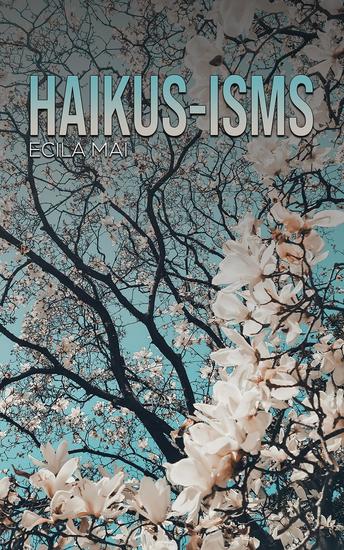
Haikus-isms - cover

Haikus-isms

Ecila Mai

Publisher: Austin Macauley Publishers

  • 0
  • 0
  • 0

Summary

This expansive collection features Ecila Mai's observations on existence distilled into emotive works of poetry, prose and haiku. Drawing from diverse life experiences and poignant personal memories, these thoughtful writings invite self-reflection on both the trials and triumphs woven into the human experience.
As she delves into her rich interior landscape, Ecila's raw ruminations examine the people, places and pivotal moments that collectively shaped her perspective. By confronting the fraught, the fanciful and even the mundane, her flowing verses illuminate the ebb and flow of life in all its dynamic complexity.
Ecila offers this diverse array of poetic pieces in hopes they will resonate with readers' own winding paths, sparking intimate considerations about personal progression versus stagnation. Through contemplative language and keen emotional insights, Poetic Reflections serves as a stirring reminder that we each possess the power to transform our futures as we see fit – no matter the perils of the past.
Available since: 10/11/2024.
Print length: 24 pages.

Other books that might interest you

  • The Robbers - cover

    The Robbers

    Friedrich Schiller

    • 0
    • 0
    • 0
    The Robbers is a powerful and dramatic play by German writer Friedrich Schiller, first published in 1781. Widely regarded as one of the most influential works of the German Sturm und Drang (Storm and Stress) movement, the play explores themes of freedom, rebellion, morality, betrayal, and justice. Through intense characters and emotional conflict, Schiller presents a gripping story about two brothers whose opposing choices lead them down drastically different paths.
    
    At the center of the drama are Karl Moor and Franz Moor, brothers who embody two contrasting visions of human nature. Karl, the elder son, is passionate, charismatic, and idealistic, but also impulsive. After being deceived by his manipulative younger brother Franz, Karl believes he has been rejected by his father. Feeling betrayed and cast out from society, he joins a band of outlaws and eventually becomes their leader. Under Karl's command, the robbers claim to fight injustice and corruption, but their actions gradually blur the line between justice and crime.
    
    Meanwhile, Franz Moor represents cold ambition and calculated cruelty. Driven by jealousy and greed, Franz schemes to seize control of his father's estate and eliminate Karl from the inheritance. Through manipulation and deception, Franz creates chaos within the Moor family, revealing the darker side of human ambition and the destructive power of envy.
    
    As Karl leads the robbers through acts of rebellion and violence, he struggles with the moral consequences of his choices. What began as a quest for freedom and justice slowly turns into a tragic journey of guilt and realization. Karl finds himself torn between his ideals and the brutal reality of the life he has chosen. The play builds toward an emotional climax as Karl confronts the consequences of his rebellion and the devastating impact it has had on those he loves.
    
    One of the most compelling aspects of The Robbers is its exploration of moral conflict. Schiller questions whether rebellion against an unjust society can ever truly be righteous if it leads to suffering and destruction. The play forces readers and audiences to consider difficult questions about authority, justice, revenge, and the limits of freedom.
    
    The character of Amalia, Karl's devoted love, adds emotional depth to the story. Her unwavering loyalty highlights themes of love, sacrifice, and tragic fate. As the story unfolds, Amalia becomes a symbol of purity and hope in a world consumed by corruption and violence.
    
    When The Robbers premiered on stage, it caused a sensation across Europe. Its raw emotional intensity, rebellious spirit, and critique of authority resonated strongly with young audiences. The play's themes challenged traditional social structures and reflected the restless spirit of the late 18th century. Today, it remains one of Schiller's most famous works and an important milestone in the development of modern European drama.
    
    Rich with passion, philosophical depth, and dramatic tension, The Robbers is a timeless exploration of human ambition, moral struggle, and the search for justice in an imperfect world. Schiller's vivid characters and powerful storytelling continue to captivate readers and audiences, making this classic tragedy as relevant today as it was more than two centuries ago.
    Show book

  • Selected Poems of Calvin C Hernton - cover

    Selected Poems of Calvin C Hernton

    Calvin C. Hernton

    • 0
    • 0
    • 0
    This volume promises to be the definitive guide to Calvin C. Hernton's unparalleled poetic career, re-introducing readers to a major voice in American poetry. Hernton was a cofounder of the Umbra Poets Workshop; a participant in the Black Arts Movement, R. D. Laing's Kingsley Hall, and the Antiuniversity of London; and a teacher at Oberlin College who counted amongst his friends bell hooks, Toni Morrison, and Odetta. As a pioneer in the field of Black Studies, Hernton developed a theoretical and practical pedagogy with lasting impact on generations of students. He may be best known as an anti-sexist sociologist, following in the footsteps of W.E.B. Du Bois, but Hernton viewed himself, above all, as a poet. This volume includes a generous selection of Hernton's previously published poems, from classics like the often anthologized "The Distant Drum" to the visionary epic The Coming of Chronos to the House of Nightsong, reprinted in full for the first time since 1964, alongside uncollected and unpublished material from the Calvin C. Hernton papers at Ohio University, a new critical introduction, and detailed notes, chronology, and bibliography.[sample poem]The Distant DrumI am not a metaphor or symbol.This you hear is not the wind in the trees.Nor a cat being maimed in the street.I am being maimed in the streetIt is I who weep, laugh, feel pain or joy.Speak this because I exist.This is my voiceThese words are my words, my mouthSpeaks them, my hand writes.I am a poet.It is my fist you hear beatingAgainst your ear.
    Show book
  • The Prayer Beads - Poems for the Seasons of Life - cover

    The Prayer Beads - Poems for the...

    Barry Hunt

    • 0
    • 0
    • 0
    Prayer is universal. It is common to all cultures and all religions. It is the way we reach out to the Divine. 
    I think of prayer as a clay urn we lower hand over hand into the well of our hearts, the well that opens to the unlimited water table of blessings. 
    There are different reasons we go the well. There are dark times when we face doubt and loss. There are times when the fire of inspiration lifts our minds and hearts to a new possibility. And there are times when we celebrate the feeling of being at one with all around us. 
    The Prayer Beads is divided into three sections: Poems for the Dark Night; Poems for Renewal; and Poems for the Harvest. 
    I encourage you to linger on each poem as if it were a prayer bead, to linger on each poem until you feel it in your fingertips. 
    Show book
  • On the Subject of Fallen Things - cover

    On the Subject of Fallen Things

    James Kearns

    • 0
    • 0
    • 0
    "you start every new day with an inventory: a moth, a cape, a parachute, a coffin, a gun, the wall you built to mount the gun."
    On the Subject of Fallen Things is an addictive, Chekhovian metanarrative: phenomenological, absurd, and dripping with black humour. James Kearns' speaker keeps company with Lazarus, an inept psychic, and a deceased superhero, but finds himself increasingly alone—lost in dialogue with mortality, both personal and anthropological. Permanence, culpability, the function and corruption of human storytelling: all come into play in a surge of momentum that grips the reader, even as it breaks apart: a lean explosion, a gunshot in the distance.
    "On the Subject of Fallen Things weaves whimsy into narrative epiphanies that you never see coming. Each line aggregating weight like the lightness of snowflakes gathering into an avalanche. Hugely enjoyable. Get it now." Roger Robinson, A Portable Paradise, Winner of the 2019 T.S. Eliot Prize
    "This is a really brilliant sequence of poems. Like Ponge, or Herbert, or Steger, or Simic, it manages to be both serious and fleeting, weighty and funny. It's hopeful, actually." S.J. Fowler, 3:AM Magazine
    Show book
  • Voyager - cover

    Voyager

    Heather Riches

    • 0
    • 0
    • 0
    This poetry anthology provides reflections on a variety of topics ranging from nature, family, and transformative experiences. The experiences contained are not earth-shattering or unique, but everyday stories that could be told by everybody. Heather Riches has encapsulated these in a thoughtful but respectful way, and they will strike a chord with all who absorb them.
    Show book
  • Love Poems and other Stuff - cover

    Love Poems and other Stuff

    E. R. Vogel

    • 0
    • 0
    • 0
    This is a collection of what has brought me to who I am today, always reminding me of where I should be going. I do hope it helps you more.
    Show book