Join us on a literary world trip!
Add this book to bookshelf
Grey
Write a new comment Default profile 50px
Grey
Subscribe to read the full book or read the first pages for free!
All characters reduced
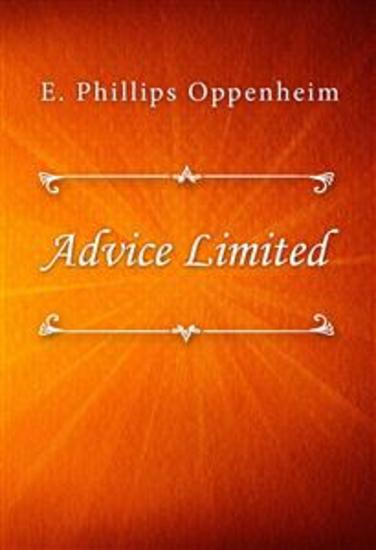
Advice Limited - cover

Advice Limited

E. Phillips Oppenheim

Publisher: Classica Libris

  • 0
  • 0
  • 0

Summary

Clara, Baroness Linz, a young Englishwoman lately widowed by the death of her Austrian aristocrat husband, sets up in London as ADVICE LIMITED, resolving family and other difficulties. Eleven cases: “Thirty-Nine Wooden Boxes,” “An Olympian Debacle,” “Broken Engagements,” “Too Many Dukes,” “The Ritz Hotel Conference,” “Between The 8th Green And The 9th Tee,” “Help For Mr. Goldman,” “The Lonely Man,” “A Family Misunderstanding,” “The Listening Lady” and “A Gift From The Gods.”
Available since: 09/30/2022.
Other books that might interest you

  • Great Expectations - cover

    Great Expectations

    Charles Dickens

    • 0
    • 0
    • 0
    Great Expectations is the thirteenth novel by Charles Dickens and his penultimate completed novel. It depicts the education of an orphan nicknamed Pip (the book is a bildungsroman; a coming-of-age story). It is Dickens' second novel, after David Copperfield, to be fully narrated in the first person. The novel was first published as a serial in Dickens's weekly periodical All the Year Round, from 1 December 1860 to August 1861. In October 1861, Chapman and Hall published the novel in three volumes.The novel is set in Kent and London in the early to mid-19th century and contains some of Dickens's most celebrated scenes, starting in a graveyard, where the young Pip is accosted by the escaped convict Abel Magwitch. Great Expectations is full of extreme imagery – poverty, prison ships and chains, and fights to the death – and has a colourful cast of characters who have entered popular culture. These include the eccentric Miss Havisham, the beautiful but cold Estella, and Joe, the unsophisticated and kind blacksmith.Dickens's themes include wealth and poverty, love and rejection, and the eventual triumph of good over evil. Great Expectations, popular with readers and literary critics, has been translated into many languages and adapted numerous times into various media.
    Show book
  • Children Aren’t the Only Ones Who Know Where the Presents Are Hidden - From THE DARKEST NIGHT horror anthology - cover

    Children Aren’t the Only Ones...

    Josh Malerman

    • 0
    • 0
    • 0
    Lydia Rabinowitz hates the holidays. Not just some holidays—all holidays. The people in her life want to know where this deep hatred of all things festive came from, but Lydia doesn't have answers. Just the image of a closet's sliding doors and the words "WHERE IS SHE?" 
     
    As Lydia desperately tries to avoid any reminder of the holidays, this image and phrase continue to haunt her. Alone on a desert road, she will be forced to confront her real reason for hating the holidays in the murky depths of her childhood memories.
    Show book
  • 3 Stories - Prostitutes - A trio of classic tales perfect for a commute walk or quiet night in - cover

    3 Stories - Prostitutes - A trio...

    Guy de Maupassant, Vincente...

    • 0
    • 0
    • 0
    There is something about the number 3.    
     
    The Ancient Greeks believed 3 was the perfect number, and in China 3 has always been a lucky number, and they know a thing or two.   
     
    Most religions also have 3 this and 3 that and, of course, in these more modern times, three’s a crowd may be too many, except when it’s a ménage à trois.  It seems good things usually come in threes. 
     
    Whatever history and culture says WE think 3, a hat-trick of stories, is a great number to explore themes and literary avenues that classic authors were so adept at creating. 
     
    From their pens to your your ears. 
     
    01 - 3 Stories - Prostitutes 
    02 - The Maison Tellier by Guy de Maupassant 
    03 - Luxury by Vicente Blasco Ibanez 
    04 - Cordelia the Crude by Wallace Thurman
    Show book
  • Once Upon The Future - Everyday Adventures that Change the World - cover

    Once Upon The Future - Everyday...

    Marta Nieto Romero, Lorena...

    • 0
    • 5
    • 1
    Once Upon the Future is an anthology of fictional stories written for children age 7-12 inspired by the research of six sustainability scientists. Each story is sprinkled with humor and magical realism, enlivened with beautiful illustrations, and complemented by educational resources. Using simple yet vibrant language, the stories convey insights on circular food economies, rural development and cultural textile traditions, forest commoning practices, biodiversity conservation and regeneration, youth in urban governance, and the importance of values and imagination for sustainability leadership.
    Close your eyes. Imagine you're sitting around the fire in the forest. Firelight dances over your face, sparks float in the darkness, and the magic of storytelling begins...
    Join Charlie, a big nosed carrot, as he battles the gang of plastic bottles and searches for the great compost heap. [The Magic Jumble by Anastasia Papangelou]
    Follow Alma and Helio as they discover magical creatures and secret natural realms, while searching for the Skunk Cabbage, rare plant that can save their forest from destruction. [Alma in the Woods by Angela Moriggi]
    Meet Olivia who never spends time outdoors until a new classmate from a distant land shows her the joy of street play. [The City's Heartbeat by Lorena Axinte]
    Gather around the campfire to hear one-eyed Aunt Bloom tell stories of a secret society - the Cosmos Mariners - who battle the Hungry Ghosts destroying our planet. [The Legend of the Cosmos Mariners by Kelli Rose Pearson]
    Go through a magic portal into the Wood Wide Web with Brunaia - a girl who has fused with a young oak tree to restore the lost equilibrium between humans and forests. [Brunaia by Marta Nieto Romero]
    Attend a fashion show with young Jaime, who has put his reputation on the line to show off his grandmother's traditional linen.[Fashionista Jamie by Alessandro Vasta]
    Show book
  • A Scene from the Ghetto of Venice - From their pens to your ears genius in every story - cover

    A Scene from the Ghetto of...

    Rainer Maria Rilke

    • 0
    • 0
    • 0
    René Karl Wilhelm Johann Josef Maria Rilke was born into a troubled marriage on the 4th December 1875 in Prague, then part of the Austro-Hungarian Empire.  His mother, having previously lost a baby girl, would dress the young boy up in girl’s clothing.   
    Later his father dispatched him to a military academy at age 10 but after a miserable 5 years the young Rilke left due to illness and instead entered first Prague and then Munich and finally Berlin university to study art history, philosophy and literature. 
    His initial forays into literature was in poetry.  His intense, mystical and lyrical style was much admired and over time inspired many in succeeding generations.    
    His short prose collection ‘Stories of God’, written in an impassioned burst over several nights was published in 1900 and offers a beguiling view of much of Rilke’s influences and outlook.  
    The following year he married the pioneering sculptor and artist Clara Westhoff.  The union produced one child, a daughter Ruth.   
    He lived in Paris for most of the Century’s first decade where he mixed with many great minds of the time.  Although he continued to write he also worked as a secretary to the sculptor, Rodin.   
    It was only after they settled in Switzerland in 1919 that his writing output was in full flow.  Here he wrote profusely in both German and French, which included much on his previous travels, his left-wing sympathies, his religious and existential thoughts, all part of a unique and consummate style. 
    From 1923 on, Rilke increasingly struggled with his health which was now in constant decline and often spent time rehabilitating at a sanatorium.   
    Rainer Maria Rilke died of leukaemia on the 29th December 1926 in Montreux, Switzerland.  He was 51.
    Show book
  • Fascist as Author The - A Short Story Collection - Celebrated war era authors who had questionable political leanings… - cover

    Fascist as Author The - A Short...

    Knut Hamsun, Luigi Pirandello,...

    • 0
    • 0
    • 0
    Authors are authors and we are drawn to their works because of their style, their narrative, and their characters and how each part is assembled into the arc of the whole. 
     
    But are we?  Do social conventions, or fashion or other influences decide what we read or what we listen to? 
     
    Its famously said that everyone has a story, everyone should be heard. 
     
    So, when we discover a particular author has a dark past, a difficult character, what do we do?   
     
    Europe was in the last century riven by two catastrophic world wars and a myriad of other local ones.  And like good citizens everywhere our thoughts are stilled by the word ‘Fascist’.  This word which originally meant many strands held together to make a stronger whole is now a one word response to evil and work done in its name. 
     
    In this volume our approach has been to take authors of then great renown, two of whom won the Nobel Prize, and compile a work from each which is seen in a literary context rather than in the heinous shadow of their political and social beliefs.   
     
    We are taught that authors write of their own experiences, but is that really true?  Can an author be separated from their nihilistic approach to politics and actually be a good writer who adds to our knowledge and experience rather than taint us with their reprehensible beliefs on their fellow man. 
     
    Its an ongoing argument.  Perhaps both sides are right.  Perhaps both sides are wrong.
    Show book