¡Acompáñanos a viajar por el mundo de los libros!
Añadir este libro a la estantería
Grey
Escribe un nuevo comentario Default profile 50px
Grey
Suscríbete para leer el libro completo o lee las primeras páginas gratis.
All characters reduced
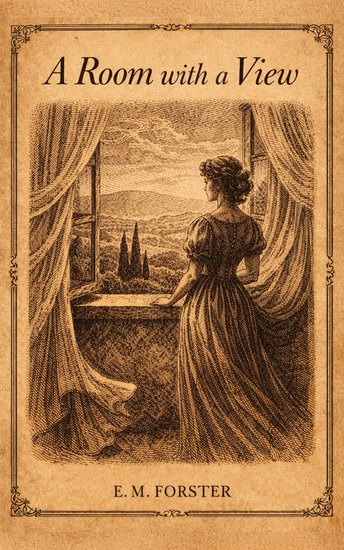
A Room with a View - cover

A Room with a View

E. M. Forster

Editorial: CLXBX

  • 0
  • 0
  • 0

Sinopsis

A Room with a View is a luminous and witty exploration of love, freedom, and self-discovery set against the vibrant landscapes of Italy and the restrained society of Edwardian England. In this beloved classic, E.M. Forster crafts a story that delicately examines the tension between social convention and personal desire.

The novel follows Lucy Honeychurch, a young Englishwoman touring Florence with her prim and proper cousin, Charlotte Bartlett. At the Pension Bertolini, Lucy encounters an unconventional father and son duo, Mr. Emerson and his passionate, free-spirited son, George. A simple room exchange—offering Lucy a room with a view of the Arno—becomes symbolic of a much larger awakening. Through her interactions with George and exposure to the beauty and spontaneity of Italy, Lucy begins to glimpse a life beyond the rigid expectations imposed by her upbringing.

Returning to England, Lucy finds herself engaged to the refined and socially acceptable Cecil Vyse. Yet her experiences in Italy linger in her heart, challenging the carefully constructed values of propriety, class consciousness, and emotional restraint that define her world. As Lucy struggles between the safety of convention and the authenticity of true feeling, she must ultimately decide whether to conform to societal expectations or follow her own heart.

Forster's prose sparkles with irony, warmth, and keen social observation. With subtle humor and deep emotional insight, he critiques the hypocrisy and artificiality of Edwardian society while celebrating passion, individuality, and the courage to live truthfully. The "room with a view" becomes more than a literal space—it represents openness, clarity, and the possibility of a fuller, more honest existence.

Tender, thought-provoking, and enduringly relevant, A Room with a View is a timeless romantic novel that reminds readers of the transformative power of love and the importance of embracing life without fear.
Disponible desde: 14/02/2026.
Longitud de impresión: 236 páginas.

Otros libros que te pueden interesar

  • Her Lover - From their pens to your ears genius in every story - cover

    Her Lover - From their pens to...

    Maxim Gorky

    • 0
    • 0
    • 0
    Alexei Maximovich Peshkov was born on 28th March 1868, in Nizhny Novgorod, Russia. 
    Better known as Maxim Gorky he was orphaned at 11 and ran away from home at 12.  At 19 he had already attempted suicide and thereafter travelled, by foot, across the Russian Empire for 5 years. 
    His first book ‘Essays & Stories’ in 1898 was a sensation and so began a long career as an author of short stories, novels and plays.  Gorky saw writing as a moral and political act that would help to change the unjust world around him.  He was an ardent early advocate of the emerging Marxist movement and publicly opposed the Tsarist regime leading several times to his arrest.  
    In 1904 he began his own theatre but the censor banned every play and Gorky was forced to abandon the project. 
    But Gorky was a financially successful author, editor, and playwright and gave monies to political parties as well as for civil rights and social reform.  The brutal shooting of workers, which set in motion the Revolution of 1905, pushed Gorky more decisively toward radical solutions.  
    In 1906 he went to the United States to raise funds for the Bolsheviks. Those experiences including a scandal over travelling with his lover and not his wife deepened his contempt for the ‘bourgeois soul.’ 
    Gorky now moved to Capri in Italy, both for health reasons and to escape the increasingly repressive times in Russia.  
    An amnesty for the 300th anniversary of the Romanov dynasty saw him return to Russia in 1914. His politics remained close to the Bolshevik cause.  But soon, after the 1918 revolution, his essays referred to Lenin as a tyrant for his senseless arrests and repression.  He was soon appealing to the outside world for food aid after the catastrophic crop failure. 
    In October 1921 Gorky returned to Italy, now in Fascist hands, and settled in Sorrento until 1932.  His health worsened with the onset of tuberculosis. 
    He wrote several successful books there but now decided to find an understanding with the communist regime. Stalin invited him home and his return was hailed as a major propaganda victory.  He was decorated with the Order of Lenin, and a province, a park, and various streets re-named in his honour. 
    But he had his faults too.  In 1933, Gorky co-edited a book on the White Sea-Baltic Canal and denied even a single prisoner died during its construction, but thousands had. As well, knowing that some Nazis were homosexual, a phrase was attributed to him that said ‘exterminate all homosexuals and fascism will vanish’.  Although he was himself was quoting another he was decidedly homophobic. 
    With the increase of Stalinist repression in 1935 Gorky was placed under unannounced house arrest. 
    Maxim Gorky died on the 18th June 1936 from pneumonia.  He was 68. 
    Stalin and Molotov were among those who carried Gorky's urn of ashes at his funeral.
    Ver libro
  • A Little Cloud - From their pens to your ears genius in every story - cover

    A Little Cloud - From their pens...

    James Joyce

    • 0
    • 0
    • 0
    James Augustine Aloysius Joyce was born on the 2nd February 1882 in Dublin into a middle-class family, and the eldest of ten surviving siblings 
    Admired as a brilliant student he briefly attended the Christian Brothers-run O'Connell School before excelling at the Jesuit schools of Clongowes and Belvedere.  From there he went on to attend University College Dublin from 1898, studying English, French and Italian 
    In 1902, Joyce was now in his early twenties, and went to Paris to study Medicine but soon abandoned his teachings.  Back in Dublin to attend to his dying Mother he met Nora Barnacle. They bonded immediately into a life-long match. Together they decided to emigrate to Europe.  The couple lived in Trieste, Rome, Paris, and finally Zürich where Joyce pursued a variety of jobs and ventures to supplement his literary pursuits but none of these paid off.  
    After publishing a poetry volume, ‘Chamber Music’, in 1907, his short story collection ‘The Dubliners’, in 1914, helped establish his talent in the rapidly changing world.  
    Although far from home Joyce’s literary heart and works were set in his recollections of Dublin.  Characters are close resemblances of family and friends and indeed enemies.  His landmark work ‘Ulysses’, published in 1922, is set in the streets and alleyways of the city as it parallels Homer’s Odyssey in a variety of styles including its famed stream of consciousness. 
    His pen continued to produce classics of the order of ‘A Portrait of the Artist as A Young Man’ and ‘Finnegan’s Wake’ together with several volumes of poetry and a play ‘The Exiles, in 1918.   
    On the 11th January 1941, Joyce underwent surgery in Zürich for a perforated duodenal ulcer. The next day he fell into a coma. On the 13th after a brief period of lucidity in which he called for his wife and son he passed.  He was 58.
    Ver libro
  • MS Found In A Bottle - cover

    MS Found In A Bottle

    Edgar Allan Poe

    • 0
    • 0
    • 0
    MS. Found In A Bottle is an adventure short story by Edgar Allan Poe that first appeared in the May 1833 edition of Baltimore Saturday Visiter. The plot follows an unnamed narrator at sea who finds himself in a series of harrowing circumstances. As he nears his own disastrous death while his ship drives ever southward, he writes an "MS.", or manuscript, telling of his adventures which he casts into the sea. Some critics believe the story was meant as a satire of typical sea tales.
    Ver libro
  • David Copperfield - cover

    David Copperfield

    Charles Dickens

    • 0
    • 0
    • 0
    A coming-of-age masterpiece filled with heart, hardship, and hope.
    
    Widely regarded as Charles Dickens's most personal and beloved novel, David Copperfield chronicles the remarkable journey of a young boy as he navigates the trials of childhood, the struggles of adulthood, and the quest to find his place in the world.
    
    Told in the first person, the story follows David from his early years of innocence through hardship, betrayal, friendship, love, and ambition. Along the way, he encounters some of Dickens's most unforgettable characters—both virtuous and villainous—including the sinister Uriah Heep, the tragic Steerforth, the eccentric yet wise Aunt Betsey Trotwood, the ever-optimistic Mr. Micawber, and the gentle Agnes Wickfield.
    
    Set against the vivid backdrop of Victorian England, David Copperfield explores timeless themes of:
    
    Resilience in the face of adversity
    
    The power of personal growth and education
    
    The importance of integrity, love, and belonging
    
    With its rich storytelling, emotional depth, and cast of vividly drawn characters, David Copperfield is not just a tale of one man's life—it is a celebration of the human spirit and its ability to endure and flourish.
    
    Often considered Dickens's own favorite work, this novel is a literary treasure that continues to resonate with readers around the world.
    Ver libro
  • The Second Customer and the Amber Beads - cover

    The Second Customer and the...

    Fergus Hume

    • 0
    • 0
    • 0
    Written in the Victorian era, a smart, attractive and resourceful Gypsy pawn shop owner named Hagar, clears an innocent person framed for murder.
    Ver libro
  • The Cossacks - cover

    The Cossacks

    Leo Tolstoy

    • 0
    • 0
    • 0
    "The Cossacks live not by the dictates of the world but by a code woven from their own history and way of life."
    
    Published in 1883 and set in the Caucasus, The Cossacks follows the journey of Dmitry Andreich Olenin, a young nobleman who, disillusioned with his privileged life and a failed love affair, leaves Moscow on a quest to find meaning and serenity among the people of the Caucasus. He embarks on a journey southward and eventually joins a regiment stationed in mountainous Cossack country, where he takes part in the daily life of a Cossack village and encounters cultural tensions between the Russian troops and the local Cossacks, who have a complex relationship marked by historical enmity.
    
    The novel explores themes of love, identity, and the stark contrasts between different ways of life, inviting the audience to reflect on the complexities of human relationships and cultural understanding.
    Leo Tolstoy (1828–1910) was a Russian novelist, philosopher, and social reformer, widely regarded as one of the greatest writers of all time. He is best known for his epic novels War and Peace and Anna Karenina, both celebrated for their intricate character development and profound exploration of moral dilemmas and human nature. In his later years, Tolstoy experienced a spiritual awakening which led him to reject materialism and embrace a life of simplicity, seeking to align his life with his beliefs about non-violence and compassion. Tolstoy's legacy endures not only through his literary masterpieces but also through his profound impact on literature and philosophy.
    Ver libro