Join us on a literary world trip!
Add this book to bookshelf
Grey
Write a new comment Default profile 50px
Grey
Subscribe to read the full book or read the first pages for free!
All characters reduced
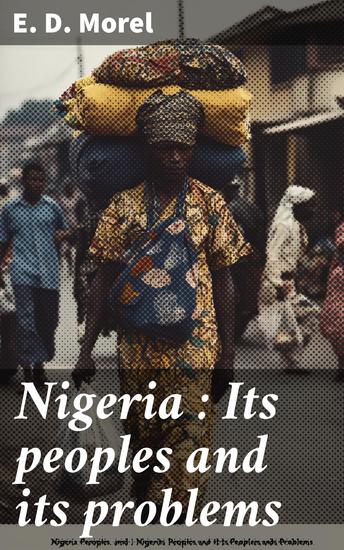
Nigeria : Its peoples and its problems - cover

Nigeria : Its peoples and its problems

E. D. Morel

Publisher: Good Press

  • 0
  • 0
  • 0

Summary

In "Nigeria: Its Peoples and Its Problems," E. D. Morel offers a penetrating analysis of the multifaceted issues surrounding Nigeria's diverse ethnic groups and the socio-political dynamics that have shaped the nation's trajectory. Written in an incisive and accessible prose style, Morel intertwines historical context with contemporary observations, shedding light on the complexities of colonial legacies, resource management, and national identity. This work stands as a critical examination of how varying interests converge and clash, reflecting a broader narrative of postcolonial challenges faced by many African nations. E. D. Morel was an influential British journalist, author, and social reformer, renowned for his passionate activism against exploitation in colonized territories. His firsthand experiences and scholarly commitment to social justice inspired him to delve into Nigeria's plight, as he sought to illuminate the injustices related to British colonial policies. Morel's keen insights are rooted in his broader critique of imperialism, making his perspectives profoundly relevant and historically significant. I wholeheartedly recommend "Nigeria: Its Peoples and Its Problems" to anyone interested in understanding the intricate tapestry of Nigerian society. Morel's work not only serves as a historical document but also invites readers to reflect on the enduring implications of colonialism, making it essential reading for students, historians, and global citizens alike.
Available since: 03/02/2025.
Print length: 210 pages.
Other books that might interest you

  • How Can We Stop Fighting - The Right Help At The Right Time - cover

    How Can We Stop Fighting - The...

    Dee Tozer

    • 0
    • 0
    • 0
    It’s normal for couples to fight – isn’t it? When is a fight just a difference of opinion or a mild disagreement and when does it become an argument which leads to a destructive, hurtful fight? Should we stop the fight before it starts? 
    “How Can We Stop Fighting” is all about stopping the nasty accusations and hostility. Couples in thriving affectionate relationships do fight – however they fight in constructive ways which don’t harm their relationship. This book shows you the difference. Fights usually start with a difference of opinion, then escalate to a disagreement which is more animated, then to an argument with greater hostility. An argument typically has three stages of hostile oppositional strength.Hostility at stage one comprises of nasty attacking or defending words with throat tension and a raised voice. In Stage two both partners are yelling at each other, with facial expressions and body language clearly expressing heightened anger and frustration. When Stage two escalates to Stage three one or both partners start screaming nasty accusations at the other, threatening to divorce, using extremely vile language. This book shows you what to do instead..
    Show book
  • The Book of Rosy \ El libro de Rosy - La historia de una madre separada de sus hijos en la frontera - cover

    The Book of Rosy \ El libro de...

    Anonymous

    • 0
    • 0
    • 0
    «Una autobiografía perturbadora e inolvidable [...] Esta desgarradora historia narra la lucha a la que se enfrentan muchas familias que son separadas en la frontera entre Estados Unidos y México». —Publisher's Weekly  
    «La inquietante y elocuente historia de una guatemalteca en búsqueda de una vida mejor». —Kirkus  
    «Un libro profundamente conmovedor e importante […] que debería ser leído por todo aquel que se considere estadounidense. Por todo ciudadano del mundo». —John Perkins, autor de Confessions of an Economic Hitman y Touching the Jaguar 
     
    Una historia conmovedora sobre dos madres marcadas por la crisis migratoria: una guatemalteca que ha sido separada de sus hijos y la estadounidense que la ayuda a reunirse con su familia. 
    Cuando Rosayra Pablo Cruz tomó la desgarradora decisión de buscar asilo en Estados Unidos con sus dos hijos, Fernando, de cinco años y Yordy, de quince, sabía que la travesía sería difícil, peligrosa y probablemente mortal. Pero la violencia rampante en Guatemala era insostenible; Rosy sabía que su familia sólo sobreviviría si migraba al norte. 
    Tras un peligroso viaje que los deja deshidratados, hambrientos y exhaustos, Rosy, Fernando y Yordy logran llegar a Arizona. Pero casi inmediatamente son separados a la fuerza por los oficiales gubernamentales del Departamento de Seguridad Nacional bajo la política «tolerancia cero». 
    Rosy y Julie Schwietert Collazo, la fundadora de Immigrant Families Together (Familias Inmigrantes Juntas), la organización comunitaria creada para reunir a madres con sus hijos, cuentan su historia y desvelan las crueles condiciones de los centros de detención, la insoportable ansiedad que padeció Rosy al ser separada de sus hijos y cómo la Fe y el amor la ayudaron a sobrellevar sus momentos más oscuros. 
    Un retrato insólito y cautivante de las consecuencias que las políticas inhumanas infligen sobre los inmigrantes que cruzan la frontera estadounidense y de los lazos inquebrantables de la familia, la Fe y la comunidad. 
    ROSAYRA PABLO CRUZ es la madre de cuatro hijos. Fue dueña de una pequeña tienda de ropa en Guatemala antes de llegar a Estados Unidos. En la actualidad, vive en Nueva York, es copresidenta de la Asociación de Padres y Maestros de su hijo mayor y miembro activo de su comunidad e iglesia.  
    JULIE SCHWIETERT COLLAZO es escritora, editora, traductora bilingüe (inglés-español) y exterapeuta de artes creativas. Ha escrito para varios medios y es coautora de un libro sobre el Papa Francisco que ha sido traducido a más de una docena de idiomas. Vive en Nueva York. 
    Show book
  • Duncan's Ritual of Freemasonry - cover

    Duncan's Ritual of Freemasonry

    Malcolm C. Duncan

    • 0
    • 0
    • 0
    Duncan's Ritual of Freemasonry* by Malcolm C. Duncan is a classic and comprehensive guide that explores the intricate rituals and symbols of Freemasonry. Originally published in the 1860s, this book presents a detailed account of Masonic ceremonies across various degrees, including the Entered Apprentice, Fellow Craft, and Master Mason, as well as the higher degrees of the York Rite. Richly illustrated with symbols and hand signals, *Duncan's Ritual* offers insights into the fraternity’s age-old traditions, oaths, and allegorical teachings. Aimed at both Masons and curious readers, it provides a glimpse into the secretive world of Freemasonry, serving as a valuable historical reference on Masonic customs and the organization's spiritual and moral symbolism.
    Show book
  • Unified Theory of Evolution A (2nd Edition) - Natural Mental and Social - cover

    Unified Theory of Evolution A...

    Wang Dongyue, Translated by...

    • 0
    • 0
    • 0
    "Human nature is the expression of all beings; a human being is the miniature of the universe." 
    The author devoted more than 20 years to this book, proving a philosophical principle and making several critical comments on different theories regarding social problems we are now facing: what is the natural foundation of human subsistence or human phenomena? Why is the progression of civilization and its social development inevitably moving toward an endangering destination? And why are the mental attributes and knowledge system ultimately proved unhelpful or even appear negative? In sum, it rings the alarm through an insightful mode of ultimate investigation for the self-important humanity, and it also foresees the coming of the cloud for the described bright future. 
    Compared with Newton's theory of gravity, Einstein's theory of relativity applies to a more extensive range of space; similarly, Dongyue's theory of weakening compensation applies to a more comprehensive range of human cognition compared with Darwin's theory of biological evolution. In other words, Einstein's theory of relativity is a massive expansion of Newton's theory of gravitation, and Dongyue's theory of weakening compensation is also a tremendous expansion of Darwin's theory of biological evolution. This philosophical monograph is in a demonstrative method with a unique style of language that is quite different from other works in this field, which makes the reading a challenge to many.
    Show book
  • The Cancel Culture Panic - How an American Obsession Went Global - cover

    The Cancel Culture Panic - How...

    Adrian Daub

    • 0
    • 0
    • 0
    In this incisive new work, Adrian Daub analyzes the global spread of cancel culture discourse as a moral panic, showing that, though its object is fuzzy, talk of cancel culture in global media has become a preoccupation of an embattled liberalism. There are plenty of conservative voices who gin up worries about cancel culture to advance their agendas. But more remarkable perhaps is that it is centrist, even left-leaning, media that have taken up the rallying cry and really defined the outlines of what cancel culture is supposed to be. 


    From French crusades against "le wokisme" via British fables of the "loony left" to a German obsession with campus anecdotes to a global revolt against "gender studies": countries the world over have developed culture war narratives in conflict with the US, and, above all, its universities—narratives that they themselves borrowed from the US. 


    Who exactly is afraid of cancel culture? To trace how various global publics have been so quickly convinced that cancel culture exists and that it poses an existential problem, Daub compares the cancel culture panic to moral panics past, investigating the powerful hold that the idea of "being cancelled" has on people around the world.
    Show book
  • Portuguese Made Easy - Beginner - Volume 2 of 3 - cover

    Portuguese Made Easy - Beginner...

    Lingo Wave

    • 0
    • 0
    • 0
    We broke our new series on learning Portuguese down into different learning stages. Start with the "Lower Beginner" books followed by the "Beginner" and "Upper Beginner" books. Next, progress to the "Intermediate" series, then test and reinforce your knowledge with the "Conversations" series. 
    This audiobook is divided into units.While it provides different learning patterns and accommodates various needs, this audiobook focuses on helping you improve your ability to understand, speak, and memorise Portuguese.  
    In Unit 1 you will hear Portuguese decoded with each syllable spoken very slowly and clearly with repetition. Immediately before each sentence is spoken, you will hear the translation, so you will always understand what is being said. 
    Unit 2 focuses solely on increasing your listening ability, which will improve your abilities to engage in dialogue with a native Portuguese speaker. This chapter requires you to listen very carefully to nuances in the language. 
    By Unit 3 you will already notice progress in your abilities to speak and understand Portuguese. The spoken translation is followed by two repetitions in Portuguese at a completely natural speed. While you are learning to process naturally spoken Portuguese, Units 3 and 4 will help you memorise new vocabulary and full sentences. 
    In Unit 5 you can test yourself on how much you have learned. If you are having difficulties, we suggest you revisit the listening, speaking, or memorisation section of Units 1, 2 3 or 4, according to what you need more help with. 
    Topics covered in this book: 
    1. Asking about family 
    2. Asking about relationship status 
    3. Expressing frequency 
    4. Talking about spare time activities and hobbies 
    5. Using quantifiers/determiners 
    6. Talking about preference 
    7. Talking about abilities 
    8. Talking about location of places 
    9. Describing appearance 
    10. Talking about personality 
    ...
    Show book