Join us on a literary world trip!
Add this book to bookshelf
Grey
Write a new comment Default profile 50px
Grey
Subscribe to read the full book or read the first pages for free!
All characters reduced
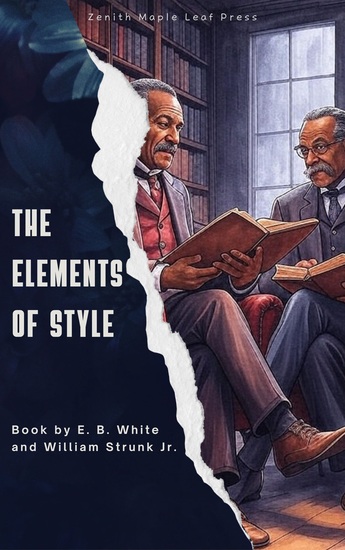
The Elements of Style - cover

The Elements of Style

E. B. White, William Strunk Jr., Zenith Maple Leaf Press

Publisher: Zenith Maple Leaf Press

  • 0
  • 0
  • 0

Summary

✍️ Want to write with elegance, clarity, and impact? This small book has guided millions of writers to do just that.

First published in 1918 and later revised by E. B. White, The Elements of Style remains the most influential guide to English usage, grammar, and composition. Compact yet powerful, this handbook has shaped the writing of students, professionals, and authors for over a century.

Inside you'll find practical advice on:

The rules of usage and grammar every writer must know

Principles of clear, concise, and effective style

Common errors and how to avoid them

Guidance that applies to essays, articles, fiction, and beyond

Stephen King, Dorothy Parker, and countless bestselling authors have praised this work for its unmatched clarity and timeless wisdom. Whether you're a student writing essays, a professional crafting reports, or a creative writer shaping your story, this book is your indispensable companion.

👉 Master the art of writing today. Click Buy Now and keep this classic reference at your side for every page you write.
Available since: 08/21/2025.
Print length: 71 pages.

Other books that might interest you

  • HOW TO DEAL WITH DIFFICULT PEOPLE - Navigating Conflict and Building Stronger Relationships with Difficult People - cover

    HOW TO DEAL WITH DIFFICULT...

    Jessica Winston

    • 0
    • 0
    • 0
    In various aspects of life, we are all forced to deal with the common obstacle of having to deal with difficult individuals. For instance, difficult coworkers or bosses at work might contribute to an unfavorable work environment, reduce productivity, and even impact happiness at work. Personal connections can be strained, stressful, and filled with conflict when difficult friends or family members are involved. It is possible to improve the quality of our lives as well as the lives of those who are close to us by becoming more skilled at navigating difficult social encounters. 
    One of the most crucial skills for one's own personal growth and development is the capacity to deal with difficult people. In order for us to learn how to deal with difficult people, we need to develop abilities such as active listening, empathy, assertiveness, and the ability to resolve conflicts. These abilities not only make it easier for us to deal with difficult people, but they also make it possible for us to become better communicators as well as more efficient leaders. 
    The capacity to concentrate on what the other person is saying without interrupting or becoming distracted is an essential component of active listening. This ability allows us to understand the perspective and feelings of the other person, which is critical for developing empathy and trust for one another. 
    Show book
  • The Dandy - A People's History of Sartorial Splendour - cover

    The Dandy - A People's History...

    Peter K. Andersson

    • 0
    • 0
    • 0
    The historical figure of the dandy has commonly been described as an upper-class gentleman. But there is a broader history to be told about the dandy—one that incorporates unknown men from the lower strata of society.The Dandy: A People's History constitutes the first history of those dandies who emanated from the less privileged layers of the populace—the lowly clerks, shop assistants, domestic servants, and laborers who increasingly during the modern age have emerged as style-conscious men about town.A series of fascinating in-depth studies of the wide variety of dandy subcultures that have surfaced around the world in the last two centuries tell the story of how the shaping of fashions and the image of men became increasingly democratized, with the arbiters of taste increasingly coming from the other end of the social spectrum. We encounter such long-forgotten groups as the mashers, the knuts, the Paris gandins and the Berlin transgender dandies, alongside unexplored figures like the zoot suiter, the teddy boy, and the New Romantic.This is a story of how fundamental aspects of modern culture such as fashion, style, and conduct have been shaped from below just as much as from above.
    Show book
  • Sociology of Everyday Life - Exploring Daily Interactions and Experiences (3 in 1) - cover

    Sociology of Everyday Life -...

    Fred Grandsen

    • 0
    • 0
    • 0
    This book offers a compelling examination of the everyday social processes that shape our lives, interactions, and personal identities. 
    The Sociology of Everyday Life looks at the seemingly mundane aspects of our daily routines, uncovering the social structures, behaviors, and practices that govern how we engage with others in everyday settings. This book explores the impact of culture, class, and social norms on routine activities like work, leisure, and family life, offering a deeper understanding of the dynamics that shape how we live, communicate, and relate to one another. 
    The Sociology of Religion explores how religion influences individual and collective behavior, social interactions, and societal structures. This book examines the role of religious beliefs and practices in shaping communities, values, and social norms. It delves into topics such as religious identity, rituals, secularism, and the ways in which religion intersects with politics, economics, and culture in different societies. 
    The Sociology of Families in Flux focuses on the evolving nature of family structures and relationships in the modern world. It looks at how families adapt to social, economic, and cultural changes, exploring themes such as divorce, single parenting, same-sex families, and the impact of globalization. This book provides insights into the ways families are redefined and how their roles continue to change in contemporary society. 
    Together, these three books offer a comprehensive understanding of how social structures influence our daily lives, interactions, and familial relationships. Through the lens of sociology, they reveal how religion, family dynamics, and everyday routines shape our experiences and interactions within the broader context of society.
    Show book
  • Norse Mythology - Explore Viking History Myths Gods and Legends - cover

    Norse Mythology - Explore Viking...

    Charlotte Clark

    • 0
    • 0
    • 0
    Step into the enchanting universe of Norse gods, valiant heroes, and formidable Vikings! 
    Are you captivated by the lore of Norse gods and eager to unravel its mysteries? Are you a student seeking a comprehensive compendium on Norse mythology and history? Do you crave insight into the intriguing saga of the Vikings? 
    If so, journey deeper into this enthralling guide on Norse mythology! Crafted to academic standards yet presented in a simple, accessible style, this audiobook appeals to all! 
    With meticulous attention to detail, Amy Hughes has curated a treasure trove of stories, myths, legends, and sagas recounting pagan Scandinavian rituals, deities, and champions. Narrated with vivid imagery, these tales transport you to a bygone era, where you'll bear witness to the remarkable history of the Vikings! 
    Here's what awaits you within this audiobook: 
    An exploration of the Vikings' origins, encompassing their language, calendar, societal structure, and military conquests 
    Fascinating accounts of Viking customs, artistic expressions, and shipbuilding prowess 
    A deep dive into Norse creation myths 
    A vivid depiction of the Norse pantheon 
    A detailed exposition of numerous Norse gods and heroes 
    And much, much more! 
    What sets this audiobook apart is the author's exhaustive research, enabling the presentation of the intricate, multifaceted world of the mighty Vikings. 
    Beyond being an educational resource for students and mythology enthusiasts, it serves as captivating entertainment for children. They'll be enthralled by tales of valiant warriors, steadfast shield-maidens, majestic longships, and epic clashes of the divine! 
    Immerse yourself in the mythic tapestry, unearth fascinating historical insights, and dazzle others with your Viking lore! 
    Get your copy today to embark on your auditory odyssey today.
    Show book
  • Strangers and Scapegoats - Extending God's Welcome to Those on the Margins - cover

    Strangers and Scapegoats -...

    Matthew S. Vos

    • 0
    • 0
    • 0
    We live in a world of oppositional relationships and increasing in-group/out-group divisions. Christian sociologist Matthew Vos explains how the problem of the stranger lies at the root of many problems humanity faces, such as racism, sexism, and nationalism. He applies classic sociological theory on "the stranger" to matters of faith and social justice, showing that an identity in Christ frees us to love strangers as neighbors and friends. The book also includes two guest chapters, one on intersex persons and the church and one on stranger-making in the "correctional" system.
    Show book
  • The Art of Egyptian Papyrus - Writing and Illustrations in Ancient Times - cover

    The Art of Egyptian Papyrus -...

    Omar Khalil

    • 0
    • 0
    • 0
    Papyrus, one of the most important inventions of ancient Egypt, was central to the development of writing and documentation in the ancient world. The history of papyrus dates back to the early dynastic periods of Egypt, around 3000 BCE, when the first examples of papyrus usage were recorded. This plant, which grew abundantly along the Nile River, was harvested for its stalks, which were then processed into sheets that served as a writing surface. The creation of papyrus revolutionized communication in the ancient world, providing a portable, durable, and practical alternative to other materials like stone or clay tablets. 
    The origins of papyrus as a writing material can be traced to the need for a flexible and lightweight medium that could be used for documentation, record-keeping, and artistic purposes. Ancient Egyptians discovered that the inner pith of the papyrus plant could be cut into strips and laid in a crisscross pattern, pressed together, and dried to form sheets. These sheets were then smoothed and polished, making them suitable for inscribing with hieroglyphs, hieratic script, or later, the demotic script. Over time, the process of papyrus production became more refined, and its use spread to neighboring regions, influencing other ancient civilizations. 
    Early uses of papyrus were predominantly for religious and administrative purposes. Royal decrees, religious texts, and tomb inscriptions were often written on papyrus scrolls. As Egyptian society advanced, the role of papyrus expanded to include personal letters, legal documents, and works of literature, cementing its place as the primary medium for writing in the ancient world. The papyrus scroll became the preferred format for long documents, with scrolls of varying lengths used to record everything from medical texts to astronomical observations.
    Show book