Join us on a literary world trip!
Add this book to bookshelf
Grey
Write a new comment Default profile 50px
Grey
Subscribe to read the full book or read the first pages for free!
All characters reduced
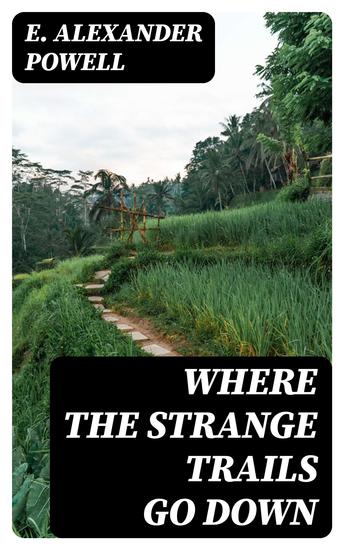
Where the Strange Trails Go Down - Sulu Borneo Celebes Bali Java Sumatra Straits Settlements Malay States Siam Cambodia Annam Cochin-China - cover

Where the Strange Trails Go Down - Sulu Borneo Celebes Bali Java Sumatra Straits Settlements Malay States Siam Cambodia Annam Cochin-China

E. Alexander Powell

Publisher: DigiCat

  • 0
  • 0
  • 0

Summary

In "Where the Strange Trails Go Down," E. Alexander Powell crafts a richly woven tapestry of adventure and introspection, capturing the essence of exploration in the early 20th century. Through a vivid narrative style that employs both lyrical prose and detailed imagery, Powell immerses the reader in a world where landscapes become characters and the thrill of the unknown reigns supreme. This literary work not only recounts personal journeys but also reflects the zeitgeist of a period marked by exploration and cultural encounters, making it a significant contribution to travel literature of its time. E. Alexander Powell, an intrepid traveler and renowned journalist, embarked on numerous explorations that profoundly influenced his writing. His firsthand experiences in far-flung regions, encompassing diverse cultures and terrains, impart an authenticity and passion to his work. Powell's background in journalism and his keen observations allowed him to capture not just the physical journey but also the emotional landscapes traversed along the way. Recommended for readers who crave adventure and insight, "Where the Strange Trails Go Down" invites you to traverse uncharted territories, both geophysical and psychological. Powell's unique perspective is sure to resonate with modern adventurers and armchair travelers alike, providing a timeless glimpse into the spirit of exploration.
Available since: 09/15/2022.
Print length: 198 pages.


Other books that might interest you

  • Satavahana Empire - Buddhism Trade and the Power of the Deccan - cover

    Satavahana Empire - Buddhism...

    Rolf Hedger

    • 0
    • 0
    • 0
    The Satavahana Empire, one of the earliest and most influential dynasties in ancient India, emerged in the Deccan region after the decline of the Mauryan Empire. The origins of the Satavahanas remain a subject of historical debate, but they are believed to have belonged to the Andhra region, gaining prominence as local chieftains before consolidating their rule into a powerful dynasty. Their rise marked a significant transition in Indian history, bridging the gap between the Mauryan administration and later regional powers. 
    The early history of the Satavahanas is primarily reconstructed through inscriptions, numismatic evidence, and references in ancient texts. The Puranas mention them as the Andhra dynasty, while inscriptions such as the Naneghat and Nasik inscriptions provide valuable insights into their rulers and governance. The first known ruler of the dynasty, Simuka, is credited with establishing Satavahana rule by overthrowing remnants of Mauryan authority in the Deccan and expanding his control over parts of present-day Maharashtra, Telangana, and Andhra Pradesh. His successors continued to strengthen the empire, laying the foundation for centuries of Satavahana dominance. 
    Following Simuka, his brother and successor Krishna further expanded the territory, but it was under the reign of Satakarni I that the empire gained considerable power. Satakarni I led successful military campaigns, extending his influence northward to the Narmada region and challenging the Shunga and Kshatrapa rulers. His achievements were commemorated in inscriptions and coins, some of which depict him performing Vedic sacrifices such as the Ashvamedha, indicating his aspirations for imperial legitimacy. This period also saw the Satavahanas emerging as key players in trade, administration, and culture, integrating diverse communities into their governance system.
    Show book
  • Lady Barker in New Zealand - cover

    Lady Barker in New Zealand

    Mary-Anne Barker, Amberley Ember

    • 0
    • 0
    • 0
    ***NEW ZEALAND’S LITTLE HOUSE ON THE PRAIRIE*** 
    Two New Zealand Classics—now available with an introduction by Amberley Ember. 
    The year is 1865. 34-year-old Annie, freshly married, sets sail for New Zealand where she will serve as a helpmeet for her second husband, Fred. They live in Christchurch until they can build their house in the sheep-farming Canterbury High Country. Soon, Lady Annie Barker is tending to dogs and chickens, learning how to boil potatoes and galloping side-saddle on her horse through the fresh, miasma-free air. Just when the newlyweds begin to feel settled, they are caught in a great snowstorm, and swindled in a land deal. 
    This is two books in one: Station Life in New Zealand (1870) and Station Amusements (1873).
    Show book
  • The Art of Getting Lost - cover

    The Art of Getting Lost

    Reece Davis

    • 0
    • 0
    • 0
    In an age where every destination is pinned, reviewed, and photographed, what does it mean to truly get lost? 
    In The Art of Getting Lost, acclaimed travel writer Reece Davis invites readers to step off the grid and wander into the unknown — not to escape, but to rediscover the joy of uncertainty. Through journeys across hidden trails, unmarked villages, and moments of profound stillness, Davis explores how losing our way can bring us closer to the world, and to ourselves. 
    Part memoir, part meditation, this book celebrates the beauty of disorientation — the quiet thrill of discovery when plans unravel, maps blur, and wonder takes the lead. 
    Wise, lyrical, and deeply human, The Art of Getting Lost reminds us that sometimes the greatest adventures begin the moment we stop knowing where we are.
    Show book
  • The Adventurer's Handbook - From surviving an anaconda attack to finding a way out of a desert - cover

    The Adventurer's Handbook - From...

    Mick MickConefrey

    • 0
    • 0
    • 0
    Combining The Worst-Case Scenario Survival Handbook and Into Thin Air, award-winning documentarian Mick Conefrey's The Adventurer's Handbook draws lessons from the glory days of exploration. 
    What makes a good explorer? Adaptability, ambition, stamina, self-confidence, curiosity, optimism, authority—and fundraising ability. Though few of us will ever have to face a charging elephant, or survive solely on penguin stew, when it comes to project management, crisis aversion, or any number of everyday problems, there is much we can learn from the larger-than-life tales of the world's most famous adventurers. 
    Here, award-winning documentarian Mick Conefrey pulls practical advice from their original diaries and logs, like how to survive an anaconda attack (wait until it has swallowed your legs, then reach down and cut its head off), and how to keep morale up (according to Ernest Shackleton, "A good laugh doesn't require any additional weight"). In addition to the wonderful characters and stories, this book offers many lessons on how to set sail without a clear path home. 
    Answers to some important questions, courtesy of The Adventurer's Handbook: 
    * How many corpses are believed to be on Mt. Everest? 
    Answer: 120 
    * How is polar bear meat best prepared? 
    Answer: Raw and frozen. 
    * What do you do if attacked by a charging lion? 
    Answer: Stand very still and stare it down. 
    * What should you wear when crossing a desert? 
    Answer: Lots of layers—fabric absorbs sweat and prolongs its cooling action.
    Show book
  • What If ? - Finding New Adventures Through Life’s Obstacles - cover

    What If ? - Finding New...

    Roberta E. Sawatzky

    • 0
    • 0
    • 0
    What does retirement mean to you? 
    Do you feel you’ve seen enough of the world? 
    As you approach this later stage in life, the thought of travel can feel beyond intimidating—especially for those of us handling chronic medical conditions. 
    In What If . . . ?, author Roberta Sawatzky highlights the importance of seizing the day when it comes to seeing the world, even and especially as one approaches retirement age. She recounts her personal experience taking a study leave to travel Europe with her husband, focusing on the seven months they spent living in Portugal and Spain as she completed research on leadership in remote and hybrid teams. In a dramatic turn, her husband is diagnosed with end stage renal failure while they are preparing for their trip, resulting in them travelling with a dialysis machine, among other medical supplies. 
    Despite this and other challenges, from language barriers to locating medical services, Sawatzky and her husband immerse themselves thoroughly in the enriching experience of long-term travel, reaping the benefits of an expanded perspective and deeper self-belief for a long time to come. 
    In the end, What If . . . ? testifies to the importance of rising to the challenges you meet in realizing your travel dreams—especially as you reach this next stage of life—and just how vital it is not to let anything stop you.
    Show book
  • The Tang Dynasty - Cultural Flourishing and Expansion - cover

    The Tang Dynasty - Cultural...

    Jun Liu

    • 0
    • 0
    • 0
    The Tang Dynasty (618–907 CE) emerged after the collapse of the short-lived Sui Dynasty, which had failed due to internal strife, heavy taxation, and forced labor projects that drained the empire’s resources. The fall of the Sui created a power vacuum, allowing various factions to vie for control. Amid this turmoil, Li Yuan, a former Sui general, led a successful rebellion and established the Tang Dynasty in 618 CE, taking the throne as Emperor Gaozu. His leadership set the foundation for one of China’s most influential and prosperous dynasties. 
    Emperor Gaozu focused on stabilizing the empire by reforming the government, lowering excessive taxes, and restoring order to a nation weakened by years of misrule. However, his reign was relatively short-lived as his son, Li Shimin, proved to be a more capable leader. In 626 CE, Li Shimin forced his father to abdicate and took the throne as Emperor Taizong. His ascension marked the true consolidation of Tang power and the beginning of an era of expansion, reform, and cultural advancement. 
    Under Emperor Taizong’s rule, the Tang Dynasty established a strong centralized government based on Confucian principles. He refined the imperial examination system, ensuring that officials were chosen based on merit rather than birthright. This system allowed for the creation of a competent and efficient bureaucracy, which would become a hallmark of Tang governance. Additionally, Taizong worked to solidify China’s borders by engaging in strategic military campaigns. His army pushed westward into Central Asia, securing control over key trade routes and strengthening the empire’s influence along the Silk Road. These military victories, combined with diplomatic relations with neighboring states, positioned the Tang Dynasty as a dominant force in East Asia.
    Show book