Join us on a literary world trip!
Add this book to bookshelf
Grey
Write a new comment Default profile 50px
Grey
Subscribe to read the full book or read the first pages for free!
All characters reduced
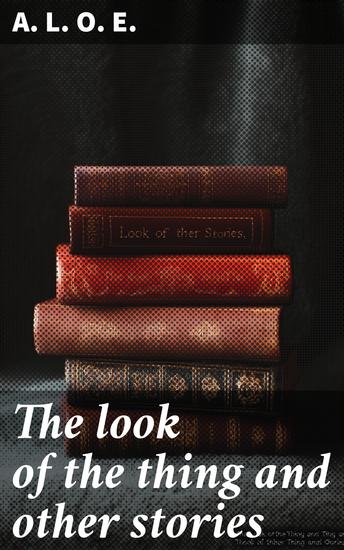
The look of the thing and other stories - cover

The look of the thing and other stories

E. A. L. O.

Publisher: Good Press

  • 0
  • 0
  • 0

Summary

In "The Look of the Thing and Other Stories," A. L. O. E. weaves together a collection of short tales that deftly blend moral conviction with poignant observation. The literary style is characterized by its elegant simplicity and underlying complexity, often infused with allegorical elements and social commentary that reflect the Victorian era's values and challenges. Each story delves into the human experience, examining themes of identity, societal norms, and personal agency, while showcasing A. L. O. E.'s ability to create vivid characters within richly drawn settings. A. L. O. E., the pseudonym of Charlotte Mary Yonge, was a prominent figure in Victorian literature with a profound understanding of moral education and women's roles in society. Her religious convictions and advocacy for women's issues profoundly influenced her writing, leading her to explore topics that resonate with both the domestic sphere and broader social contexts. This collection is a testament to her commitment to showcasing the intricate details of everyday life and the individual's place within it. This insightful collection is highly recommended for readers interested in Victorian literature and those who appreciate stories that provoke thoughtful reflections on moral and social issues. "The Look of the Thing and Other Stories" invites readers to engage with the complexities of human nature while enjoying the craft of a master storyteller.
Available since: 03/02/2025.
Print length: 200 pages.

Other books that might interest you

  • Fascist as Author The - A Short Story Collection - Celebrated war era authors who had questionable political leanings… - cover

    Fascist as Author The - A Short...

    Knut Hamsun, Luigi Pirandello,...

    • 0
    • 0
    • 0
    Authors are authors and we are drawn to their works because of their style, their narrative, and their characters and how each part is assembled into the arc of the whole. 
     
    But are we?  Do social conventions, or fashion or other influences decide what we read or what we listen to? 
     
    Its famously said that everyone has a story, everyone should be heard. 
     
    So, when we discover a particular author has a dark past, a difficult character, what do we do?   
     
    Europe was in the last century riven by two catastrophic world wars and a myriad of other local ones.  And like good citizens everywhere our thoughts are stilled by the word ‘Fascist’.  This word which originally meant many strands held together to make a stronger whole is now a one word response to evil and work done in its name. 
     
    In this volume our approach has been to take authors of then great renown, two of whom won the Nobel Prize, and compile a work from each which is seen in a literary context rather than in the heinous shadow of their political and social beliefs.   
     
    We are taught that authors write of their own experiences, but is that really true?  Can an author be separated from their nihilistic approach to politics and actually be a good writer who adds to our knowledge and experience rather than taint us with their reprehensible beliefs on their fellow man. 
     
    Its an ongoing argument.  Perhaps both sides are right.  Perhaps both sides are wrong.
    Show book
  • Ghost House - cover

    Ghost House

    Sarah Connell

    • 0
    • 0
    • 0
    In this first collection by bestselling author Sara Connell the "madwomen" are out of the attic and roaming the streets in a phantasmagoric world of psychedelic frogs, maniacal therapists, talking neon signs and suffocating mothers. A newlywed couple purchase a much desired haunted house with disastrous results, a young woman may lose her job, and her mind on the way to Alaska, and a group of high school girls attempt immortality in a last resort to save a friend. 
    
    Connell takes on patriarchy and culture with a singular voice that will make you think, laugh and shiver long after you finish reading.
    Show book
  • Love in Tempest Tides - cover

    Love in Tempest Tides

    Ella Stories

    • 0
    • 0
    • 0
    A socially awkward marine biologist falls head over heels for a confident and vivacious storm chaser. With each whirlwind meeting orchestrated to align with the storms they both find fascinating; their mutually dangerous passion becomes the perfect backdrop for an unexpected love story. Will their love weather the storm or dissolve in the ocean's depths?
    Show book
  • The Witch Caprusche - cover

    The Witch Caprusche

    Elizabeth F. Ellet

    • 0
    • 0
    • 0
    What must Ruscha do to secure the magic word that kills when it’s uttered? Taken from a Danish folk tale, and spiced up with lively characters and murky atmosphere, this short tale delivers some wonderful chills.  
     
    Elizabeth Ellet wrote for the magazines, or periodicals in the mid-1800s, and the name of Mrs. Ellet was recognized in literary circles. In 1848, she published her most important work: “The Women of the American Revolution”. Today, Ellet is perhaps known best for the scandal she leaked about Edgar Allan Poe’s rumored affair with Frances Sargent Osgood when both were married to other people. Poe maligned her in the press, knocked her writings, accused her of plagiarism, and even referred to her as “short and fat”. In print.
    Show book
  • After the Race - From their pens to your ears genius in every story - cover

    After the Race - From their pens...

    James Joyce

    • 0
    • 0
    • 0
    James Augustine Aloysius Joyce was born on the 2nd February 1882 in Dublin into a middle-class family, and the eldest of ten surviving siblings 
    Admired as a brilliant student he briefly attended the Christian Brothers-run O'Connell School before excelling at the Jesuit schools of Clongowes and Belvedere.  From there he went on to attend University College Dublin from 1898, studying English, French and Italian 
    In 1902, Joyce was now in his early twenties, and went to Paris to study Medicine but soon abandoned his teachings.  Back in Dublin to attend to his dying Mother he met Nora Barnacle. They bonded immediately into a life-long match. Together they decided to emigrate to Europe.  The couple lived in Trieste, Rome, Paris, and finally Zürich where Joyce pursued a variety of jobs and ventures to supplement his literary pursuits but none of these paid off.  
    After publishing a poetry volume, ‘Chamber Music’, in 1907, his short story collection ‘The Dubliners’, in 1914, helped establish his talent in the rapidly changing world.  
    Although far from home Joyce’s literary heart and works were set in his recollections of Dublin.  Characters are close resemblances of family and friends and indeed enemies.  His landmark work ‘Ulysses’, published in 1922, is set in the streets and alleyways of the city as it parallels Homer’s Odyssey in a variety of styles including its famed stream of consciousness. 
    His pen continued to produce classics of the order of ‘A Portrait of the Artist as A Young Man’ and ‘Finnegan’s Wake’ together with several volumes of poetry and a play ‘The Exiles, in 1918.   
    On the 11th January 1941, Joyce underwent surgery in Zürich for a perforated duodenal ulcer. The next day he fell into a coma. On the 13th after a brief period of lucidity in which he called for his wife and son he passed.  He was 58.
    Show book
  • Caliburn's Fight - cover

    Caliburn's Fight

    Christopher Cartwright

    • 0
    • 0
    • 0
    The video was everywhere – a viral sensation sweeping across social media. 
    A golden retriever puppy in Bilbao, Spain. It was placed on a series of different rugs, its fur shifting in real time to match the colors and even the intricate patterns woven into the fabric. The internet was in a frenzy, with hundreds of thousands of comments debating whether it was an elaborate hoax, a genetic anomaly, or something else entirely. 
    But Sam Reilly knew the truth the moment he saw it. 
    This wasn’t a trick. 
    Caliburn, his dog, shared the same genetic trait. 
    The golden retriever was an engineered chimera infused with human and octopus DNA. He was originally designed as a classified military experiment rooted in the legendary craftsmanship of the blacksmith Merlin, who designed King Arthur’s greatest weapons – Excalibur and Caliburn. 
    If the puppy was real, then so too was the danger that followed it. 
    The hunt for Caliburn’s offspring leads Sam into the depths of a forgotten cave – where he stumbles upon an antique Basque Astrolabe that shouldn’t exist. The discovery sets off a chain reaction, dragging Sam into a deadly conflict with a Secret Society that has been protecting a hidden truth since the Lewis and Clark expedition of 1804. Meriwether Lewis was murdered to keep the secret buried. 
    The question remains, can Sam work out what to do with the truth, before it gets him killed too?
    Show book