Join us on a literary world trip!
Add this book to bookshelf
Grey
Write a new comment Default profile 50px
Grey
Subscribe to read the full book or read the first pages for free!
All characters reduced
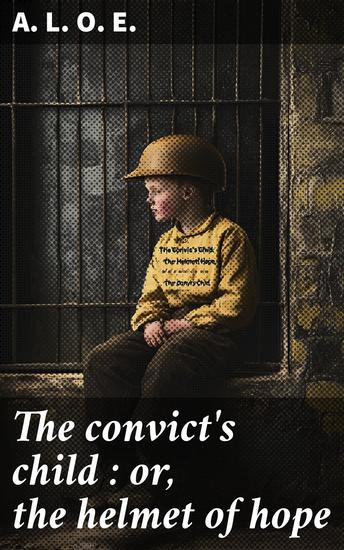
The convict's child : or the helmet of hope - cover

The convict's child : or the helmet of hope

E. A. L. O.

Publisher: Good Press

  • 0
  • 0
  • 0

Summary

In "The Convict's Child: or, The Helmet of Hope," A. L. O. E. presents a poignant narrative that explores themes of redemption, social justice, and the innocence of childhood amidst the grim realities of penal servitude. Written in a melodramatic style characteristic of 19th-century moral tales, the book unfolds the life of a young protagonist burdened by the legacy of a convict parent. The vivid descriptions and engaging dialogue effectively draw readers into a world rife with both despair and hope, showcasing A. L. O. E.'s capacity to weave compelling narratives that interrogate societal norms and ethics. A. L. O. E., the pseudonym of the author Charlotte Maria Tucker, was a prolific writer known for her moralistic literature aimed at young people. Her background as a devout Christian and her experiences in Victorian society, which grappled with issues of crime and rehabilitation, heavily influenced her literary work. Tucker's commitment to advocating for the underprivileged is apparent throughout the text, as she seeks to illuminate the struggles faced by the marginalized, echoing her deep humanitarian concerns. This enchanting tale serves not only as an entertaining read but also as an enlightening exploration of compassion and understanding within a flawed society. Readers who appreciate narratives steeped in moral lessons and social commentary will find "The Convict's Child" a compelling testament to the resilience of the human spirit, making it a worthy addition to any literary collection.
Available since: 03/02/2025.
Print length: 200 pages.

Other books that might interest you

  • Tarzan and the Golden Lion - cover

    Tarzan and the Golden Lion

    edgar rice burroughs

    • 0
    • 0
    • 0
    The iconic jungle hero faces a new threat when the mysterious and powerful Golden Lion begins to prey on the people of the African jungle. Tarzan, along with his loyal friends and allies, including the brave warrior, Hei, and the intelligent ape, Opi, must uncover the truth behind the Golden Lion's reign of terror. As they delve deeper into the dangerous jungle, they discover a hidden civilization and an ancient prophecy that foretells the rise of the Golden Lion. With the fate of the jungle hanging in the balance, Tarzan and his allies must race against time to fulfill the prophecy and put an end to the Golden Lion's reign of terror. This thrilling adventure showcases Tarzan's unmatched courage and his unwavering dedication to protecting the people and creatures of the African jungle.
    Show book
  • Ethan Frome - cover

    Ethan Frome

    Edith Wharton

    • 0
    • 0
    • 0
    A masterpiece by Edith Wharton, author of The Age of Innocence.Winter in a Massachusetts village serves as a backdrop to Edith Wharton' s masterpiece about a man with little hope of escaping his bleak future. Married to an older woman named Zeena, Ethan Frome finds himself drawn to his wife' s cousin, Mattie. Although he dreams of fleeing his loveless marriage and stealing away with Mattie, Ethan has neither the means nor the will. Mattie offers another solution, a desperate act borne out of despair that may result in even greater tragedy.
    Show book
  • Jane Eyre - cover

    Jane Eyre

    Jane Eyre

    • 0
    • 0
    • 0
    "Jane Eyre" is a novel written by Charlotte Bronte and first published in 1847. It is a Bildungsroman that follows the life of the titular character, Jane Eyre, from her childhood in an abusive household to her years as a governess and, ultimately, to her love for Mr. Rochester, the brooding master of Thornfield Hall. The novel is known for its themes of religion, morality, women's independence, and social criticism, and it incorporates elements of social realism, melodrama, and gothic horror.
    Show book
  • Straw the Coal and the Bean The - Story Time Episode 50 (Unabridged) - cover

    Straw the Coal and the Bean The...

    Brothers Grimm

    • 0
    • 0
    • 0
    An old woman has some beans that she intends to cook over her fire. Being in a hurry, she grabs some straw to make the fire light faster. She pours the beans in the pot and, being in a hurry, she drops one on the floor which lands next to a piece of straw.
    Show book
  • Mother Holle - Story Time Episode 18 (Unabridged) - cover

    Mother Holle - Story Time...

    Brothers Grimm

    • 0
    • 0
    • 0
    A rich widow lived with her daughter and her stepdaughter. The widow favored her younger biological daughter, allowing her to become spoiled and idle while her older stepdaughter was left to do all the work. Every day the stepdaughter would sit outside the cottage and spin beside the well. One day, she pricked her finger on the point of the spindle. As she leaned over the well to wash the blood away, the spindle fell from her hand and sank out of sight. The stepdaughter feared that she would be punished for losing the spindle, and in panic she leapt into the well after it.
    Show book
  • Gabriel-Ernest - From their pens to your ears genius in every story - cover

    Gabriel-Ernest - From their pens...

    Saki Saki

    • 0
    • 0
    • 0
    Hector Hugh Munro, more familiarly known by his pen-name ‘Saki’ was born in what was then Akyab in British Burma on 18th December 1870. His father was an Inspector General for the Indian Imperial Police, and his mother the daughter of a Rear Admiral. 
    When he was 2 his mother died and he and his siblings were sent back to England to be raised by their grandmother and paternal maiden aunts in a strict, puritanical household near Barnstaple, Devon. Educated by governesses Saki used many of these women as character models for his later writing. 
    At 17 his father retried and returned to England and then embarked on a series of European travels with Saki and his siblings. 
    After a short stint working in Burma with the Indian Imperial Police Saki decided to move to London to make a living as a writer. Initially he wrote as a journalist for a number of newspapers and magazines before attempting an historical study, ‘The Rise of the Russian Empire’, whose real value lay in directing him to writing short stories instead, the first of which, ‘Dogged’, he published in 1899. 
    From here it was a short stab of the pen to writing political satire before in 1902 he became the foreign correspondent for The Morning Post, first in the Balkans, then Russia, Paris and back to London in 1908, where 'the agreeable life of a man of letters with a brilliant reputation awaited him.'  
    Collections of his short stories full of witty, mischievous and often macabre stories that satirized Edwardian society and two novels now appeared in the years up to the Great War.  At its’ outbreak he was 43 but managed to join as an ordinary trooper. More than once he returned to the battlefield when officially too sick or injured.  
    On 14th November 1916 Hector Hugh Munro was sheltering in crater during the Battle of the Ancre, when he was shot and killed by a German sniper. According to several sources, his last words were "Put that bloody cigarette out!"
    Show book