¡Acompáñanos a viajar por el mundo de los libros!
Añadir este libro a la estantería
Grey
Escribe un nuevo comentario Default profile 50px
Grey
Suscríbete para leer el libro completo o lee las primeras páginas gratis.
All characters reduced
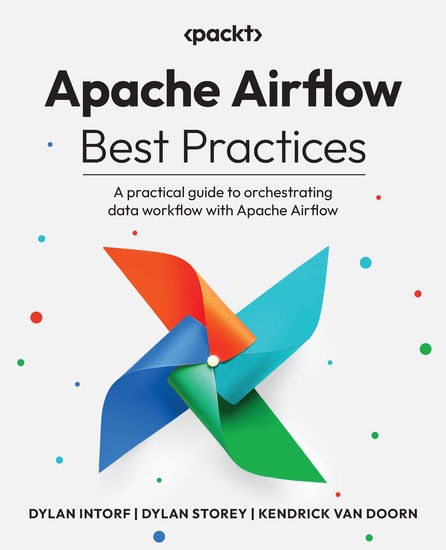
Apache Airflow Best Practices - A practical guide to orchestrating data workflow with Apache Airflow - cover

Apache Airflow Best Practices - A practical guide to orchestrating data workflow with Apache Airflow

Dylan Intorf, Dylan Storey, Kendrick van Doorn

Editorial: Packt Publishing

  • 0
  • 0
  • 0

Sinopsis

Data professionals face the challenge of managing complex data pipelines, orchestrating workflows across diverse systems, and ensuring scalable, reliable data processing. This definitive guide to mastering Apache Airflow, written by experts in engineering, data strategy, and problem-solving across tech, financial, and life sciences industries, is your key to overcoming these challenges. Covering everything from Airflow fundamentals to advanced topics such as custom plugin development, multi-tenancy, and cloud deployment, this book provides a structured approach to workflow orchestration. You’ll start with an introduction to data orchestration and Apache Airflow 2.x updates, followed by DAG authoring, managing Airflow components, and connecting to external data sources. Through real-world use cases, you’ll learn how to implement ETL pipelines and orchestrate ML workflows in your environment, and scale Airflow for high availability and performance. You’ll also learn how to deploy Airflow in cloud environments, tackle operational considerations for scaling, and apply best practices for CI/CD and monitoring.By the end of this book, you’ll be proficient in operating and using Apache Airflow, authoring high-quality workflows in Python, and making informed decisions crucial for production-ready Airflow implementations.
Disponible desde: 31/10/2024.
Longitud de impresión: 188 páginas.

Otros libros que te pueden interesar

  • Reversing Polycystic Kidney Disease - The PKDproof program: a low-carb high-nutrient approach to kidney health - cover

    Reversing Polycystic Kidney...

    Felix Mueller

    • 0
    • 0
    • 0
    WITH A FOREWORD FROM DAVE ASPREY, founder of Bulletproof 360, Inc and New York Times bestselling author  
    The practical guide to how to reverse polycystic kidney diseases, usually considered chronic and progressive, through a ketogenic diet and biohacker principles. 
    A unique guide to the strategies developed by Felix Mueller, expert patient, influencer and author, over the past nine years to reverse his own polycystic kidney disease, as well as that of numerous clients and followers. The book shows the simple and easy diet and lifestyle changes that PKD patients – written off as ‘incurable’ – can make to radically prolong their time to, or even completely stave off, dialysis or transplant, and explains the scientific backgrounds of why this approach works according to emerging, as well as long-established, science. The audiobook includes practical tips, daily routines, recipes, and a whole week meal plan as well as survival strategies for traveling and eating out without sacrificing kidney health in the process. Listeners will learn that, contrary to popular belief, having PKD does not mean living in constant nutrient deficiency, but that food abundance can also lead to better health and even achieving the ultimate goal: drastically improving their kidney function and even size. 
    "Felix’s story is a vivid illustration of how the principles of biohacking can be tailored to improve even genetic conditions which some people believe to be incurable. By harnessing a state of intermittent ketosis and fasting combined with highly nutritious foods, he has uncovered a profound truth: our genetic destiny is not a script that is set in stone but a narrative that we can rewrite with the right diet, lifestyle and supplementation."―Dave Asprey, author of The New York Times Bestseller The Bulletproof diet
    Ver libro
  • The Shocking Truth about Digital Privacy - cover

    The Shocking Truth about Digital...

    Zoey Fraisers

    • 0
    • 0
    • 0
    In today’s hyper-connected world, privacy is often taken for granted—or worse, dismissed as an outdated concern. We live in an era where our personal data is treated as currency, constantly collected, analyzed, and monetized by corporations, governments, and cybercriminals alike. Every search query, online purchase, and social media interaction contributes to a vast digital profile that shapes how businesses market to us, how financial institutions assess us, and even how law enforcement monitors us. But how much do we really understand about who is collecting our data and for what purpose?  
      
    Most people assume that their digital activities are relatively private—secured by passwords, encryption, and privacy settings. Yet, the reality is far more unsettling. Companies track our browsing habits even when we’re in “incognito” mode, apps request permissions far beyond what’s necessary, and smart devices listen in on conversations, all in the name of “improving user experience.” Governments worldwide deploy mass surveillance programs under the justification of national security, while hackers exploit weak security measures to access personal and financial information. Even when we willingly share details about our lives, such as through social media, we rarely consider the long-term consequences of this exposure.  
      
    Perhaps the most alarming aspect of digital privacy erosion is how seamlessly it has integrated into our daily lives. From social media giants like Facebook and TikTok to search engines like Google, nearly every digital service we rely on operates under a business model that thrives on harvesting user data. The more these companies know about us—our habits, preferences, and even emotions—the better they can predict and manipulate our behavior. This is the foundation of surveillance capitalism, an industry built on turning our personal lives into profit. 
    Ver libro
  • Fields of Grace - Sharing Faith from the Horse Farm - cover

    Fields of Grace - Sharing Faith...

    Cara Whitney, Michael Rossi,...

    • 0
    • 0
    • 0
    From her horse farm in Nebraska, Cara Whitney--wife of Dan Whitney (aka "Larry the Cable Guy")--shares down-to-earth stories about how ordinary people can share their faith in extraordinary ways. 
    In the midst of uncertain and sometimes frightening times, sharing God's love with others gives us hope and purpose. With her humorous and often touching stories--many featuring horses, cows, and rascally dogs--Cara Whitney delightfully reminds us that it's always a good time to share the love of Jesus with your neighbor. 
    In Fields of Grace, Cara passes on lessons from her amazing animal teachers, such as . . .What a barnyard horse brawl shows us about how God uses us in our weaknessesHow caring for baby calves teaches us the value of letting goWhy a carriage-pulling pack horse motivates us to be our best selvesHow a dance class inspires us to embrace our identity in ChristWhat a floppy-eared dog tells us about loving our neighbor 
    Fields of Grace is a perfect gift for: People who love Cara's previous book, Unbridled FaithFans of Larry the Cable GuyAnyone fascinated by the "simpler life" of farming in rural AmericaAnimal lovers and photography loversSpiritual seekers interested in a gentle approach to learning more about God 
    These charming yet powerful stories encourage us to care for others as we grow in our own spiritual journeys. No matter what times we live in, the love of Christ can transform lives--and help each of us to draw closer to Him.
    Ver libro
  • The AI Mirror - How to Reclaim Our Humanity in an Age of Machine Thinking - cover

    The AI Mirror - How to Reclaim...

    Shannon Vallor

    • 0
    • 0
    • 0
    For many, technology offers hope for the future—that promise of shared human flourishing and liberation that always seems to elude our species. Artificial intelligence (AI) technologies spark this hope in a particular way. They promise a future in which human limits and frailties are finally overcome—not by us, but by our machines. Yet rather than open new futures, today's powerful AI technologies reproduce the past. Forged from oceans of our data into immensely powerful but flawed mirrors, they reflect the same errors, biases, and failures of wisdom that we strive to escape. Our new digital mirrors point backward. They show only where the data say that we have already been, never where we might venture together for the first time. 


    To meet today's grave challenges to our species and our planet, we will need something new from AI, and from ourselves. 


    Shannon Vallor makes a wide-ranging, prophetic, and philosophical case for what AI could be: a way to reclaim our human potential for moral and intellectual growth, rather than lose ourselves in mirrors of the past. Rejecting prophecies of doom, she encourages us to pursue technology that helps us recover our sense of the possible, and with it the confidence and courage to repair a broken world. Vallor calls us to rethink what AI is and can be, and what we want to be with it.
    Ver libro
  • The Origin of Politics - How Evolution and Ideology Shape the Fate of Nations - cover

    The Origin of Politics - How...

    Nicholas Wade

    • 0
    • 0
    • 0
    Societies that ignore social disintegration and collapsing birth rates are putting their future in peril. So why are we ignoring the signs? 
    ?In The Origin Of Politics, Nicholas Wade explains how our political systems compete with a more ancient set of rules for organizing society—those developed by evolution. Modern ideologies are in constant tension with structures inherent in human social behavior, such as the family, the tribe, and male-dominated institutions.  
    This tension plays out in various ways. Sometimes nature prevails over politics, as in the proposal by Marx and Engels to eliminate the family, the basic unit of society. The founders of the kibbutz movement put this radical idea into practice, only to find that the conflict with human nature was unsustainable. In other cases, culture has successfully modified evolutionary behaviors, replacing polygamy with monogamy and dissolving the bonds of tribalism to make way for modern states.  
    But the evolutionary framework of human societies is not infinitely flexible. The nation-state, especially in the case of the United States, is prone to disintegration if disruptive ideologies are allowed to undermine the cohesive affinities that hold its disparate cultures together.  
    The worldwide decline in fertility in most countries except those in Africa signals a severe derangement in the behaviors evolution has devised for ensuring that a population will maintain itself. If the causes of this disruption cannot be understood and reversed, human societies will embark on an unsought path to extinction.  
    Other fraught issues in which human biology and politics conflict include the innate specializations of the sexes, the stratification of society by ability, and the mismatch between the inequalities of wealth-creating societies and the egalitarian ethic inherited from our hunter-gatherer ancestors. 
    We live in an iridescent bubble, the intoxicating richness of modern culture. Shielded from the natural world, we have lost our awareness of the evolutionary forces that still guide our motivations and shape the foundations of our societies. The Origin of Politics explores the risks of underestimating evolution’s fundamental role in human affairs. 
      
     
    Ver libro
  • Hunting Monsters - Cryptozoology and the Reality Behind the Myths - cover

    Hunting Monsters - Cryptozoology...

    Darren Naish

    • 0
    • 0
    • 0
    The Loch Ness Monster, Bigfoot, and the yeti have long held a fascination for people the world over. Debates about their actual existence or what they might really be have continued for decades, if not centuries. Known also as cryptids, they have spawned a body of research known as cryptozoology. This entertaining book looks at the evidence of these mysterious monsters and others and explores what they might really be (if they exist at all), why they have been represented as they have, and the development of cryptozoology and how it has collected data to discover more about these unknown creatures.
    Ver libro