Join us on a literary world trip!
Add this book to bookshelf
Grey
Write a new comment Default profile 50px
Grey
Subscribe to read the full book or read the first pages for free!
All characters reduced
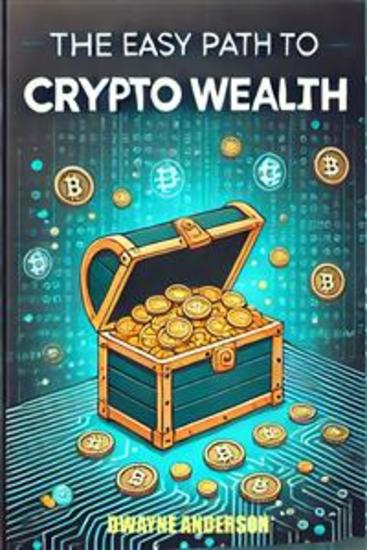
The Easy Path to Crypto Wealth - Crypto Buzz Ready to Rise - cover

The Easy Path to Crypto Wealth - Crypto Buzz Ready to Rise

Dwayne Anderson

Publisher: Publisher s21598

  • 0
  • 0
  • 0

Summary

"The Easy Path to Crypto Wealth: Crypto Buzz Ready to Rise" is a comprehensive guide designed to navigate the rapidly evolving world of cryptocurrency investing. As the financial landscape shifts due to central bank rate cuts, liquidity injections, and emerging technological innovations, this book provides the insights and strategies needed to capitalize on the next big opportunities in the crypto market.
In a time when global economic policies are driving investors toward higher-risk assets, this book dives deep into the forces propelling Bitcoin and altcoins to new highs. It explores the impact of Federal Reserve rate cuts and China’s massive economic stimulus, highlighting how these factors are creating a perfect storm for a crypto resurgence. Readers will gain an understanding of how these macroeconomic shifts are reshaping the market, positioning Bitcoin for another bull run and setting the stage for the much-anticipated altseason.
The book also delves into the dynamic between Bitcoin dominance and altcoins, showing how the ebb and flow of funds between these assets can create lucrative opportunities for savvy investors. With practical advice on identifying potential breakout altcoins, "The Easy Path to Crypto Wealth" equips readers with the tools needed to navigate market volatility and capitalize on the next wave of digital asset growth.
This guide emphasizes the importance of timing and strategy, offering a detailed look at how to ride the momentum of Bitcoin’s price movements and strategically invest in emerging altcoins. By analyzing market trends, technological advancements, and new investment tools like ETFs and options, the book provides a clear and engaging roadmap for both new and seasoned investors.
"The Easy Path to Crypto Wealth" is not just about theory; it’s about action. Packed with expert forecasts, real-world examples, and actionable insights, this book empowers readers to make informed decisions in a fast-paced, ever-changing market. Whether you're looking to build a diversified portfolio, spot the next big altcoin, or simply understand the forces driving today’s crypto market, this book is your essential guide to thriving in the new age of digital finance.
Available since: 09/28/2024.

Other books that might interest you

  • The Physics of Sound - Understanding the Science of Sound Waves - cover

    The Physics of Sound -...

    Mark Hedges

    • 0
    • 0
    • 0
    Sound waves are a fundamental aspect of physics, representing mechanical vibrations that travel through a medium. Unlike electromagnetic waves, which can propagate through the vacuum of space, sound waves require a material medium such as air, water, or solid substances. These waves are generated when an object vibrates, causing nearby particles in the medium to oscillate. As these particles move back and forth, they transfer energy to adjacent particles, creating a propagating wave of compression and rarefaction. This process continues outward from the source, allowing sound to travel over distances. 
    The two primary types of waves in physics are transverse and longitudinal waves. Sound waves fall into the category of longitudinal waves, meaning that the oscillations of the particles occur parallel to the direction of wave propagation. In contrast, transverse waves, such as water waves and electromagnetic waves, involve oscillations perpendicular to their direction of movement. In a sound wave, regions of compression correspond to areas where particles are densely packed together, while regions of rarefaction represent areas where the particles are spread apart. This alternating pattern of compression and rarefaction allows the wave to carry energy without transporting matter itself.
    Show book
  • The Future of Robotics - Trends and Innovations - cover

    The Future of Robotics - Trends...

    Craig Dames

    • 0
    • 0
    • 0
    The story of robotics begins long before the first programmable machines. Ancient myths and early mechanical inventions hinted at humanity’s fascination with artificial beings. However, the real journey started during the Industrial Revolution, when mechanized tools began to change how humans worked. These early systems weren’t true robots, but they laid the groundwork for what would come. As electricity, computing, and engineering advanced in the 20th century, robotics emerged as a distinct and rapidly growing field. 
    The first generation of robots were largely industrial machines—mechanical arms programmed to perform repetitive tasks in factories. Introduced in the 1950s and 60s, these robots revolutionized manufacturing. They worked tirelessly on assembly lines, improving productivity and safety. Though not intelligent by today’s standards, they marked a turning point by taking on tasks traditionally done by human hands. This era showcased the robot as a tool—precise, consistent, and dependable in controlled environments. 
    The late 20th and early 21st centuries saw major breakthroughs that transformed robotics from rigid machines into adaptive systems. The rise of microprocessors, sensors, and more sophisticated programming enabled robots to interact with their environment. No longer confined to factory floors, they began to appear in fields like space exploration, surgery, and even homes. The introduction of AI brought a fundamental shift. Robots could now learn from data, recognize patterns, and make decisions. This leap allowed them to handle complex, dynamic tasks—like navigating unknown terrain or assisting in delicate operations.
    Show book
  • Black Holes - The Key to Understanding the Universe - cover

    Black Holes - The Key to...

    Professor Brian Cox, Professor...

    • 0
    • 0
    • 0
    By the star physicist and author of multiple #1 Sunday Times bestsellers, a major and definitive narrative work on black holes and how they can help us understand the universe.  
    At the heart of our galaxy lies a monster so deadly it can bend space, throwing vast jets of radiation millions of light years out into the cosmos. Its kind were the very first inhabitants of the universe, the black holes. 
    Today, across the universe, at the heart of every galaxy, and dotted throughout, mature black holes are creating chaos. And in a quiet part of the universe, the Swift satellite has picked up evidence of a gruesome death caused by one of these dark powers. High energy X-ray flares shooting out from deep within the Draco constellation are thought to be the dying cries of a white dwarf star being ripped apart by the intense tides of a supermassive black hole – heating it to millions of degrees as it is shredded at the event horizon. 
    They have the power to wipe out any of the universe’s other inhabitants, but no one has ever seen a black hole itself die. But 1.8 billion light years away, the LIGO instruments have recently detected something that could be the closest a black hole gets to death. Gravitational waves given off as two enormous black holes merge together. And now scientists think that these gravitational waves could be evidence of two black holes connecting to form a wormhole – a link through space and time. It seems outlandish, but today’s physicists are daring to think the unthinkable – that black holes could connect us to another universe. 
    At their very heart, black holes are also where Einstein’s Theory of General Relativity is stretched in almost unimaginable ways, revealing black holes as the key to our understanding of the fundamentals of our universe and perhaps all other universes. 
    Join Professors Brian Cox and Jeff Forshaw in exploring our universe’s most mysterious inhabitants, how they are formed, why they are essential components of every galaxy, including our own, and what secrets they still hold, waiting to be discovered. 
    Supplemental enhancement PDF accompanies the audiobook.
    Show book
  • CompTIA A+ & Security+ Certification Study Guide - 2-in-1 Exam Prep for 220-1101 220-1102 & SY0-701 | All-in-One Masterclass with Practice Tests IT Fundamentals & Career Growth Strategies - cover

    CompTIA A+ & Security+...

    Josh Russell

    • 0
    • 0
    • 0
    This ultimate combo includes: 
    ✅ Complete Coverage of CompTIA A+ Exams 220-1101 & 220-1102 ✅ Full Masterclass for CompTIA Security+ SY0-701 ✅ Pro-Level Practice Tests with Detailed Explanations ✅ Hands-On Concepts, Real-World Scenarios & Career Tips 
    Written by certified tech experts and instructional designers, this guide makes complex IT concepts fun, approachable, and crystal clear. You'll go from “What’s an IP address?” to “Hire me now” without the overwhelm. 
    🧠 What's Inside:All-in-One Learning System: Tailored for busy learners with streamlined content that focuses on what actually shows up on the exams.Up-to-Date with 2025 Exam Objectives: No outdated fluff—just what you need, nothing you don’t.Memory Boosters & Exam Hacks: Learn faster with clever analogies, tech humor, and bite-sized breakdowns.Career-Ready Skills: Includes practical security skills, troubleshooting tactics, and resume-ready vocabulary to land your dream role. 
    💼 Perfect For:Career changers jumping into techStudents preparing for job-ready certificationsIT support, helpdesk, or cybersecurity hopefulsAnyone tired of boring, bloated textbooks 
    📈 Start Smart, Study Smarter, Win Big 
    Don’t just pass—own your certifications and stand out in the tech crowd. With this 2-in-1 masterclass, you’re not just prepping for exams... you’re launching your future. 
    Get your copy now and let your IT journey begin.
    Show book
  • The Rise of Quantum Computing - A New Era in Technology - cover

    The Rise of Quantum Computing -...

    Craig Dames

    • 0
    • 0
    • 0
    Quantum computing is one of the most exciting and transformative areas in modern technology. To understand what quantum computing is, it's important to first grasp the fundamentals of quantum mechanics, the science that underpins it. Classical computers, which most of us are familiar with, process information in binary form, using bits that can be either 0 or 1. However, quantum computing operates on the principles of quantum mechanics, where quantum bits, or qubits, can represent both 0 and 1 simultaneously due to a phenomenon called superposition. 
    In classical systems, information is processed in a linear and sequential manner. However, quantum computers harness the power of quantum mechanics to perform calculations in parallel. This is largely due to two key phenomena: superposition and entanglement. Superposition allows qubits to exist in multiple states at once, enabling quantum computers to perform complex computations much faster than classical computers. Entanglement, another quantum phenomenon, allows qubits that are entangled to influence each other, regardless of the distance between them, which further enhances the computational power of quantum systems. 
    The potential for quantum computing to revolutionize industries and fields like cryptography, medicine, and artificial intelligence is immense. For example, quantum algorithms can solve problems in minutes that would take classical computers millennia to complete. This ability to tackle complex problems more efficiently makes quantum computing a game-changer in the quest for faster and more powerful technologies.
    Show book
  • Cosmos Issue 98 - Beyond the Palaeo - cover

    Cosmos Issue 98 - Beyond the Palaeo

    The Royal Institution of Australia

    • 0
    • 0
    • 0
    This is Issue 98 of Cosmos, a quarterly science magazine. Produced by The Royal Institution of Australia, Cosmos aims to inspire curiosity in 'The Science of Everything' and make the world of science accessible to everyone.
    Show book