Join us on a literary world trip!
Add this book to bookshelf
Grey
Write a new comment Default profile 50px
Grey
Subscribe to read the full book or read the first pages for free!
All characters reduced
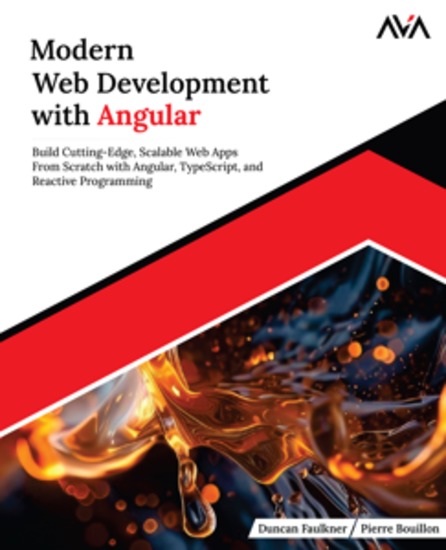
Modern Web Development with Angular - Build Cutting-Edge Scalable Web Apps from Scratch with Angular TypeScript and Reactive Programming - cover

Modern Web Development with Angular - Build Cutting-Edge Scalable Web Apps from Scratch with Angular TypeScript and Reactive Programming

Duncan Faulkner, Pierre Bouillon

Publisher: Orange Education Pvt Ltd

  • 0
  • 0
  • 0

Summary

Learn modern Angular development and jumpstart your web development journey

Key Features
● Learn Angular from scratch, starting with setup and basic application structure to advanced topics like component communication and unit testing.
● Practical examples and step-by-step instructions to build multi-page reactive and real-world applications.
● Learn best practices for unit testing Angular components to ensure quality and maintainability.

Book Description
Angular is one of the most popular and powerful frameworks for building dynamic, scalable web applications. With its robust ecosystem, it’s widely used to create high-performance, enterprise-level applications.

This book offers a hands-on approach to mastering Angular, guiding you from setting up your development environment to exploring advanced topics like unit testing. You’ll start by learning how to set up Angular and create your first application, followed by gaining a solid understanding of TypeScript, enhancing your ability to work with Angular’s strongly typed features.

The book covers core building blocks like components, directives, pipes, and services, providing a strong foundation for robust applications. You’ll also explore Angular’s reactivity system and how to handle asynchronous data to build dynamic UIs. It dives into component communication, data flow, and both Reactive and Template-Driven forms, helping you implement form validation and handle user input effectively.

Additionally, you’ll master Angular’s routing system, use Jest for unit testing, and explore new features like control flow syntax, Standalone components, and Signals. By the end, you’ll be confident in building and managing Angular applications.

What you will learn
● Set up your development environment and create your first Angular app.
● Master TypeScript fundamentals and its role in enhancing Angular development.
● Learn Angular's core components, directives, pipes, and services.
● Explore Angular's reactive programming model for handling asynchronous data and building dynamic UIs.
● Pass data between components using input/output properties, event emitters, and services.
● Understand Angular’s routing system for seamless navigation in single-page applications.

Table of Contents
1. Setting up Angular
2. Angular Application
3. Introduction to Typescript
4. Components, Directives, Pipes, and Services
5. Getting Started with Reactivity
6. Component Communication and Data Flow
7. Reactive and Template-driven Forms
8. Form Validation
9. Routing
10. Unit Testing
       Index

About the Authors
Duncan has been a software developer for over twenty years and has developed applications across various industries, from Hedge Fund and Investment Management to Satellite Communication Management. He was introduced to AngularJS by a colleague around version 1.3 and shifted from full-stack developer to front-end development using Angular. Duncan was an early adopter of Angular (formerly, Angular 2) and has spent more than eight years learning Angular. He has authored several short books and numerous articles on Angular and Angular Material (called Shooks).

Pierre has been working with Angular as a Full Stack Software Engineer for six years in various domains. Since then, he has written several articles on the framework and been involved in open-source projects and communities.
Available since: 11/28/2024.
Print length: 292 pages.

Other books that might interest you

  • Our Last Best Act - Planning For the End of Our Lives to Protect the People and Places We Love - cover

    Our Last Best Act - Planning For...

    Mallory McDuff

    • 0
    • 0
    • 0
    As we begin to contemplate death and to embark on practical planning for life's end, many of us long to leave a legacy beyond a transfer of money and property—one that ensures a sustainable earth for our loved ones, our communities, and generations to come. But where do we even begin? 


    With the sudden deaths of both of her parents, Mallory McDuff found herself in a similar position. Utterly unprepared both emotionally and practically, she began to research sustainable practices around death and dying. For McDuff, an educator and environmentalist, what started as a highly personal endeavor expanded into a yearlong exploration and assessment of green burials, aquamation, green cemeteries, home funerals, and human composting. 


    In Our Last Best Act, McDuff bridges the gap between environmental action and religious faith by demonstrating that when the two are combined, they become a powerful force for the greater good. Full of practical information, this book equips listeners to make decisions for their own end-of-life planning. In a world experiencing a climate crisis and a culture that avoids discussions about death and dying, this book opens the conversation about the choices we make—and how it's possible for our death to honor our values, create a sustainable legacy, and help to heal the earth.
    Show book
  • Root Cause - Stories and Lessons from Two Decades of Backend Engineering Bugs - cover

    Root Cause - Stories and Lessons...

    Husein Nasser

    • 0
    • 0
    • 0
    The Software Engineering industry often evaluates engineers based on how many lines of code they write, how many years of experience they have, or how many features they ship. But I think a more powerful metric is the number of bugs they encountered, reproduced, traced to their root cause and fixed. Those experiences shape an engineer far more than raw output or time served in my opinion, let me elaborate. 
     
    Bugs hinder the stability of software, which affects the user experience. You may have a feature-complete product, but if it has bugs preventing users from completing tasks, the user experience suffers. You may have a modern software stack, but if the system isn’t performing or stable, that too indirectly affects the user experience. 
     
    Root Cause is a collection of dozens of real-world software bugs drawn from nearly two decades of my personal backend engineering experience. Each chapter is centered on a specific failure, the observable effect experienced by users, and follows the investigative journey toward uncovering its root cause. These bugs span a wide range of systems and failure modes, from intermittent API timeouts and performance degradation to subtle state corruption and distributed system edge cases. I also introduce a fundamental backend engineering concept in each chapter that is related to the bug to make book can be picked up by any can be picked up and read by anyone without prior experience 
     
    Perhaps the biggest value you will learn from this book is the joy of pursuing bugs, I think there is an inherent deterrence when working with bugs, almost like its a chore or in some cases failure if you own the area where the bug was found. However, if you push through, detach from the bug and approach it as if you are approaching a new puzzle that has nothing to do with you, the rewards are plenty. 
     
    I hope you enjoy it.
    Show book
  • Essay Towards A New Theory Of Vision An - cover

    Essay Towards A New Theory Of...

    George Berkeley

    • 0
    • 0
    • 0
    This audiobook is narrated by an AI Voice. State-of-the-art voice generation technology, combined with careful human editing, has been employed in this production of "An Essay Towards A New Theory Of Vision" by George Berkeley in order to make this important text more widely accessible to modern audiences. Listeners are invited to explore the audio sample and judge the quality for themselves. 
     
    First published in 1709, Berkeley’s Essay is a landmark in the philosophy of perception. Its central claim is that we do not immediately see distance, depth, or three-dimensional space. Instead, vision presents signs (colors, lights, shapes, and appearances) that we learn to connect with touch, movement, and bodily action. What seems obvious to sight is, for Berkeley, the result of habit, association, and interpretation. 
     
    Before developing his immaterialism in the "Principles of Human Knowledge" and the "Three Dialogues", Berkeley uses vision to question what is truly given in perception. The work prepares his critique of abstract ideas, his challenge to mind-independent matter, and his idea that the natural world functions like a language through which God guides human beings. 
     
    Although modern vision science has moved far beyond Berkeley’s specific explanations, the questions he raises remain deeply relevant. His view of perception as learned, practical, and action-oriented anticipates later concerns in pragmatism, where meaning is tied to use and experience, and in phenomenology, where perception is understood through embodiment and our lived relation to the world. His emphasis on the coordination of sight, touch, and movement also resonates with contemporary cognitive science and theories of embodied perception. For listeners interested in philosophy, psychology, or the history of ideas, "An Essay Towards A New Theory Of Vision" remains a concise and provocative starting point for thinking about how we come to experience the world.
    Show book
  • Elegant Python - Simplifying Complex Solutions - cover

    Elegant Python - Simplifying...

    Michael Huang

    • 0
    • 0
    • 0
    Python, often regarded as the Swiss Army knife of programming languages, uniquely blends simplicity and power. "Elegant Python: Simplifying Complex Solutions" is your comprehensive guide to harnessing this dynamic language's full potential. 
    Unlock the art of writing code that solves problems and does so with grace and sophistication. This book takes you on a captivating journey through the realm of Python programming, where you'll master the skills required to craft elegant solutions to complex challenges. 
    Explore the principles of Pythonic coding, emphasizing clarity, efficiency, and maintainability. From data manipulation and web development to machine learning and automation, "Elegant Python" covers a broad spectrum of topics, all with a central focus on creating code that stands out for its elegance and ingenuity. 
    Whether you're a seasoned developer looking to refine your Python skills or a newcomer eager to learn the best practices from the start, this book has you covered. You'll gain a deep understanding of Python's capabilities and how to leverage them to create code that works and impresses with its simplicity and beauty. 
    "Elegant Python" is your passport to Python mastery. Dive in and embark on a journey that will transform your programming skills and enable you to craft solutions that are not just functional but truly elegant. Elevate your Python programming game with this essential guide, and let your code shine with sophistication and grace.
    Show book
  • Welcome to AI - A Human Guide to Artificial Intelligence - cover

    Welcome to AI - A Human Guide to...

    David L. Shrier

    • 0
    • 0
    • 0
    A fascinating guide to the rapidly advancing world of artificial intelligence and how this powerful technology will impact our lives, our careers, and our world. 


    Artificial intelligence is driving workforce disruption on a scale not seen since the Industrial Revolution. 


    In schools and universities AI technology has forced a reevaluation of the way students are taught and assessed. Meanwhile, ChatGPT has become a cultural phenomenon, reaching a hundred million users and attracting a reputed $1 trillion investor interest in its parent company, OpenAI. 


    The race to dominate the generative AI market is accelerating at breakneck speed, inspiring breathless headlines and immense public interest. 


    Welcome to AI provides a rare view into a frontier area of computer science that will change everything about how you live and work. Listen to this book and better understand how to succeed in the AI-enabled future.
    Show book
  • The Uncanny Muse - Music Art and Machines from Automata to AI - cover

    The Uncanny Muse - Music Art and...

    David Hajdu

    • 0
    • 0
    • 0
    The Uncanny Muse explores the history of automation in the arts and delves into one of the most momentous and controversial aspects of AI: artificial creativity. The adoption of technology and machinery has long transformed the world, but as the potential for artificial intelligence expands, David Hajdu examines the new, increasingly urgent questions about technology's role in culture. 


    Hajdu traces the fascinating, varied ways in which inventors and artists have sought to emulate mental processes and mechanize creative production. For decades, machines and artists have engaged in expressing the human condition—along with the condition of living with machines—through player pianos, broadcasting technology, electric organs, digital movie effects, synthesizers, and motion capture. By communicating and informing human knowledge, the machines have exerted considerable influence on the history of art—and often more influence than humans have been willing to recognize. As Hajdu proclaims: "before machine learning, there was machine teaching." With thoughtful and surprising turns from Berry Gordy and George Harrison to Andy Warhol and Stevie Wonder, David Hajdu takes a novel and contrarian approach: he sees how machines through the ages have enabled creativity, not stifled it—and The Uncanny Muse sees no reason why this shouldn't be the case with AI today.
    Show book