
Join us on a literary world trip!
Add this book to bookshelf
Grey
Write a new comment Default profile 50px
Grey
Subscribe to read the full book or read the first pages for free!
All characters reduced
Ultimate Laravel for Modern Web Development - Build Robust and Interactive Enterprise-Grade Web Apps using Laravel's MVC Authentication APIs and Cloud Deployment - cover

Ultimate Laravel for Modern Web Development - Build Robust and Interactive Enterprise-Grade Web Apps using Laravel's MVC Authentication APIs and Cloud Deployment

Drishti Jain

Publisher: Orange Education Pvt Ltd

  • 0
  • 0
  • 0

Summary

Unlock the Power of Laravel: Elevate Your Web Development Game!Book DescriptionThe “Ultimate Laravel for Modern Web Development” is a comprehensive journey through Laravel, the PHP framework revolutionizing web development. This practical guide ensures a fluid progression from fundamentals to advanced techniques, making you a seasoned Laravel expert. The book begins with the fundamentals, seamlessly transitioning into the core of Laravel's MVC architecture. It then navigates through routers, views, controllers, and Blade templates, building a strong foundation for your projects.As you progress, the book will uncover the power of Eloquent ORM and Query Builder, mastering efficient data handling. You will implement seamless authentication and authorization processes to ensure the security of your applications and develop robust APIs to enhance your application's functionality and connectivity.The book will dive into the art of testing and debugging, refining your Laravel projects for optimal performance. It will delve into email and notifications, adding dynamic communication to your applications. Finally, you will learn the ins and outs of deploying your Laravel app to the cloud, bringing your creations to a global audience.Table of Contents1. Getting Started with Laravel2. MVC Architecture in Laravel3. Routers and Views in Laravel4. Building Controllers and Blade Templates5. Working with Eloquent ORM and Query Builder6. Implementing Authentication and Authorization in Laravel7. Developing APIs with Laravel8. Testing and Debugging your Laravel Application9. E-mail and Notifications in Laravel10. Deploying your Laravel App to CloudIndex
Available since: 01/20/2024.
Print length: 280 pages.

Other books that might interest you

  • The Universe in Verse - 15 Portals to Wonder through Science & Poetry - cover

    The Universe in Verse - 15...

    Maria Popova

    • 0
    • 0
    • 0
    In this audiobook Maria Popova, creator of The Marginalian, presents a celebration of the human search for truth and beauty through the lenses of science and poetry. Poetry and science, as Popova writes in her introduction, "are instruments for knowing the world more intimately and loving it more deeply." In 15 short essays on subjects ranging from the mystery of dark matter and the infinity of pi to the resilience of trees and the intelligence of octopuses, Popova tells the stories of scientific searching and discovery. These stories are interwoven with details from the very real and human lives of scientists—many of them women, many underrecognized—and poets inspired by the same questions and the beauty they reveal. Each essay is paired with a poem reflecting its subject by poets ranging from Emily Dickinson, W. H. Auden, and Edna St. Vincent Millay to Maya Angelou, Diane Ackerman, and Tracy K. Smith. Together, they wake us to a "reality aglow with wonder."
    Show book
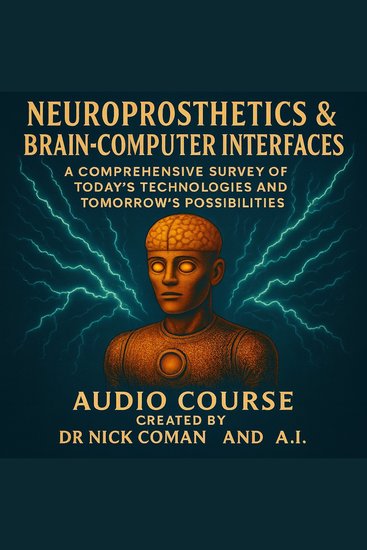
  • Neuroprosthetics and Brain-Computer Interfaces - A Comprehensive Survey of Today’s Technologies and Tomorrow’s Possibilities - cover

    Neuroprosthetics and...

    Dr. Nick Coman, I. A.I.

    • 0
    • 0
    • 0
    Welcome to the frontier where mind meets machine. 
    This 48-lecture audio course delivers a sweeping, PhD-level exploration of neuroprosthetics and brain–computer interfaces (BCIs), tracing the arc from early electrical experiments to the latest breakthroughs in neural decoding, cortical stimulation, and cognitive enhancement. It weaves together foundational neuroscience, cutting-edge engineering, landmark clinical use cases, and the emerging societal implications of brain–machine integration. 
    Listeners will journey through the biology of neurons and networks, the physics of electrodes and wireless implants, the clinical realities of stroke, ALS, and Parkinson’s disease, and the technological future of memory prosthetics, speech decoding, and real-time brain–AI symbiosis. Along the way, the course tackles the deepest questions: What happens when a mind is routed through a machine? Who owns neural data? And what does it mean to be augmented? 
    Rigorous, narrative-driven, and designed for the intellectually ambitious, this course is an essential guide to one of the most transformative domains in science and technology.
    Show book
  • Pipe Dreams - Secret Diaries of a Neighbourhood Plumber - cover

    Pipe Dreams - Secret Diaries of...

    Nicholas James

    • 0
    • 0
    • 0
    ‘Warm, insightful . . . hilarious and at times heartbreaking! A modern-day Dickens’ Abi Morgan‘Original, funny, and heart-warming’ Lucy Searle, Homes & GardenEver wondered what really goes on behind closed doors? 
    Over more than twenty years working as a plumber, Nick has shared thousands of mugs of tea with hundreds of fascinating people. Here he gives his plumber’s-eye view of society in a series of entertaining, amusing and outrageous beneath-the-kitchen-sink dramas. 
    While fixing pipes, Nick was also looking for characters to write about. In his toolbox, in addition to spanners, he had a notebook, which wasn’t just for jotting down measurements. And ‘the secret plumber’ has some great stories to tell, about people who might just be your friends, family or neighbours. 
    There’s the frankly terrifying high-court judge, whose wife calls the shots; the divorcing woman, using him to help her build a rather bizarre botox business; and all the wonderful people he meets when his number is posted on Grindr as an LGBTQ+-friendly plumber. 
    This book is Tales of the Unexpected – in overalls. It shows London as it really is: one of the most diverse places on the planet, ranging from downright dangerous to preposterously posh. To Nick, London is a melting pot, filled with an extraordinary variety of fascinating people, who have one thing in common – they all need a plumber!
    Show book
  • Environmental Science - Challenges and Solutions for a Healthier Planet - cover

    Environmental Science -...

    Jeron Iris

    • 0
    • 0
    • 0
    Environmental Science is an interdisciplinary field that integrates various scientific disciplines to study the natural world and the impact of human activities on it. This branch of science explores the complex interactions between living organisms, their physical surroundings, and the broader ecosystems they form. The primary goal of environmental science is to understand how natural systems function, identify environmental problems, and develop strategies for addressing these issues. 
      
    At its core, environmental science seeks to answer fundamental questions about the earth's resources, how they are used, and how human actions influence the balance of ecosystems. It draws from biology, chemistry, physics, geology, and social sciences to provide a comprehensive understanding of the environment. For example, ecology, the study of living organisms and their relationships to each other and their surroundings, is a central component of environmental science. By examining the dynamics of ecosystems, scientists can assess the health of the environment and predict the effects of human activities such as urbanization, deforestation, and pollution. 
    One of the primary focuses of environmental science is resource management. As the global population continues to grow, the demand for natural resources such as water, energy, and food increases. Environmental scientists work to ensure that these resources are used sustainably, balancing the needs of current populations with the preservation of resources for future generations. This includes studying renewable resources, such as solar and wind energy, and nonrenewable resources, like fossil fuels, to understand their availability and impact on the environment.
    Show book
  • Gardening - Greenhouses Horticulture and Irrigation Systems - cover

    Gardening - Greenhouses...

    Maria Garrets

    • 0
    • 0
    • 0
    This book consists of 3 titles: 
    Greenhouse: Greenhouse gardening offers numerous benefits beyond extending the growing season. It provides a controlled environment that protects plants from pests, diseases, and extreme weather conditions, creating an ideal microclimate for optimal growth. With precise control over temperature, humidity, and light levels, gardeners can cultivate a wide range of plants that might not thrive in their local climate otherwise. Greenhouses also allow for efficient use of space, enabling vertical gardening, hydroponic systems, and other innovative cultivation techniques. Additionally, greenhouse gardening promotes sustainability by reducing water consumption, minimizing the need for chemical pesticides, and enabling year-round production of fresh, locally grown produce. 
    Horticulture: Horticulture encompasses a wide range of disciplines, including plant biology, genetics, soil science, entomology, plant pathology, and environmental science. It involves understanding the specific needs of different plant species, such as their preferred growing conditions, nutritional requirements, and pest and disease management strategies. 
    Irrigation Systems: An irrigation system is a method used to supply water to crops or landscapes in a controlled manner, typically to assist with crop growth or maintain landscapes. There are various types of irrigation systems, including drip irrigation, sprinkler systems, and flood irrigation, each with its own advantages and applications.
    Show book
  • Invisible Worlds - Discovering the Universe's Hidden Matter - cover

    Invisible Worlds - Discovering...

    Dirk Fallon

    • 0
    • 0
    • 0
    The universe we observe with our naked eyes or through telescopes is only a fraction of the total cosmos. The rest of the universe, a vast portion, remains invisible and hidden from our view. This hidden matter is known as dark matter, dark energy, and other mysterious entities that make up the majority of the universe. Though we cannot directly observe these hidden components, their existence is inferred through indirect evidence, such as their gravitational effects on visible matter. The study of these hidden aspects of the universe is an ongoing effort to understand what makes up the majority of the cosmos. 
    One of the most significant mysteries in modern physics is the nature of dark matter. This form of matter doesn't emit, absorb, or reflect light, making it completely invisible to conventional instruments. Yet, its presence is essential for explaining the structure and behavior of galaxies. Without dark matter, galaxies would not have enough mass to hold themselves together. The gravitational influence of dark matter helps galaxies maintain their shape and stability, preventing them from being torn apart by their own rotational forces. Though we can't see dark matter, we can detect its effects on visible matter, such as the way galaxies rotate. 
    In addition to dark matter, dark energy is another invisible force that plays a crucial role in the universe. Dark energy is responsible for the accelerated expansion of the universe, a discovery that has stunned astronomers since the late 1990s. Unlike dark matter, which exerts a gravitational pull, dark energy pushes galaxies apart, counteracting the forces that would otherwise slow the expansion of the universe. This mysterious force is thought to make up about 68% of the universe's total energy density, yet little is known about its true nature. Understanding dark energy is one of the greatest challenges in modern cosmology.
    Show book