Join us on a literary world trip!
Add this book to bookshelf
Grey
Write a new comment Default profile 50px
Grey
Subscribe to read the full book or read the first pages for free!
All characters reduced
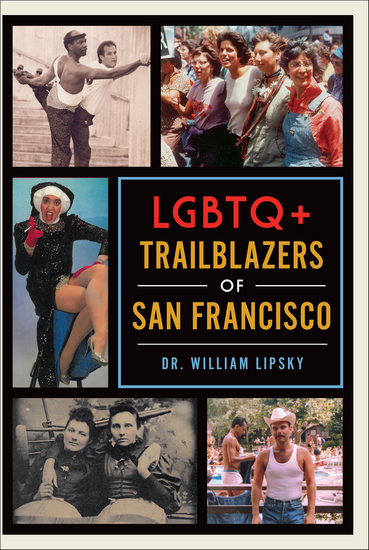
LGBTQ+ Trailblazers of San Francisco - cover

LGBTQ+ Trailblazers of San Francisco

Dr. William Lipsky

Publisher: The History Press

  • 0
  • 0
  • 0

Summary

Famous and forgotten, they're all our fabulous ancestors.  From Charles Warren Stoddard, the first openly gay San Franciscan, to Felicia "Flames" Elizondo, the exuberant transgender rights advocate, the LGBT community is integrally woven into the fabric of the city's history. Household names like Queen Califia, Charley Parkhurst, Elsa Gidlow, Jose Sarria and Harvey Milk are celebrated worldwide, while Bert LaRose, Mabel Edison and Clarence Lockett are now largely forgotten. Whether '49ers, bohemians, beatniks, boomers, hippies, clones or conformists, their fascinating stories contributed to the development of a vibrant community, many simply by being themselves.  Join Dr. William Lipsky as he recounts their struggles and achievements in the City by the Bay.
Available since: 05/29/2023.
Print length: 194 pages.

Other books that might interest you

  • Believe - A Memoir in Stories - cover

    Believe - A Memoir in Stories

    Christina H Wilson

    • 0
    • 0
    • 0
    At 36 years old, Christina had it all...two young and healthy boys, an uber successful husband, and a big house in a gated-golf course community. She was young, rich, and on top of the world. On the morning of September 11, 2000, a devastating call would up-end everything and life as she knew it. While this cataclysmic event didn't mark the beginning of end of her life, it would be the test of her character, agency and faith. This book offers insight to a life journey that is extraordinary yet profoundly human. It's the chronical of an evolution from a frail child into a woman shaped by intense love, incredible upheavals, and ultimately, deep personal wisdom. Beginning with a childhood marked by illness and solitude, books and fairytales became Christina's refuge and compass. These influences weave throughout her life and the stories, not as naive fantasies, but as emotional frameworks that conflict with the sharp edges of her reality. Life takes a dramatic turn when at 25, Christina meets Jeffrey, a Wall Street Titan, whose fast-paced existence is worlds away from her quiet, reflective nature. The connection is immediate and all-consuming. Their life becomes exhilarating, fantastical, and materially abundant. The heart of this memoir is the defining moment when an unexpected phone call changes everything. This moment acts as a fault-line in Christina's life, splitting everything into a before and after. From this point on, the story becomes less about the external events and more about the quiet but radical life-changing shifts in Christina's understanding about self, love, loss, and destiny. At it's core, this story is about transformation that only comes when we are challenged and stripped of control and what we know. It's about learning to let life present itself with patience and understanding. This book is a tapestry of life-lesson stories woven together by themes of self-discovery, unconditional love, tragedy, spirituality, family, inner-strength, and grief.
    Show book
  • Anatomy of Conversation - cover

    Anatomy of Conversation

    Emma Gibbens

    • 0
    • 0
    • 0
    Communicating with others is getting more and more complex every day. Many of us are anxious about how to navigate conversations – how do I approach someone? How can I create a safe and inviting space? What happens if someone gets offended? 
    Emma Gibbens understands conversations. She delights in their depth and is thrilled by their potential. Lit with an inner fire that comes from countless hours of witnessing the power of conversation, Emma facilitates complex conversations that many of us prefer to avoid. 
    Emma provides the Anatomy of Conversation so we can better understand, more confidently prepare for, and courageously facilitate complex conversations. 
    This generous and practical book sparks us to be curious about navigating our differences and finding meaningful connection
    Show book
  • China's Church Divided - Bishop Louis Jin and the Post-Mao Catholic Revival - cover

    China's Church Divided - Bishop...

    Paul P. Mariani

    • 0
    • 0
    • 0
    During the Cultural Revolution, the Chinese state sought to eradicate religious life throughout the country. But by 1978, two years after the death of Mao Zedong, the Communist Party under Deng Xiaoping cautiously embraced the revival of religion. At the same time, the newly elected Pope John Paul II made a point of renewing outreach to China. Paul P. Mariani tracks the fate of Chinese Catholicism in the wake of these transformative leadership changes, focusing on the influential Catholic community in Shanghai. 


    Earlier policies of the 1950s had fractured the Catholic community into a state-approved "patriotic" church that answered to the government and an underground church loyal to Rome. Even after the Cultural Revolution, Mariani shows, this divide remained firmly intact. The resulting tensions were on vivid display in Shanghai, owing to the leadership of the Jesuit priest Louis Jin Luxian. Bishop Jin used his position to revitalize the local Catholic community, but his cooperation with the party put him ever at odds with underground church leaders. 


    Sensitive to the ideals, compromises, and disappointments of Catholics on both sides of the rift, China's Church Divided reveals how the community navigated the irreconcilable differences between a worldwide Church centered in Rome and a regime wary of foreign spiritual authority.
    Show book
  • The Kubark Counterintelligence Interrogation Manual - cover

    The Kubark Counterintelligence...

    Central Intelligence Agency

    • 0
    • 0
    • 0
    Released by the Freedom of Information Act. This document is a thorough description of how the CIA recommends interrogating a subject. To get the information that is needed there is nothing withheld short of torture. For example in "Threats and Fears," the CIA authors note that "the threat of coercion usually weakens or destroys resistance more effectively than coercion itself. The threat to inflict pain, for example, can trigger fears more damaging than the immediate sensation of pain." Under the subheading "Pain," the guidelines discuss the theories behind various thresholds of pain, and recommend that a subject's "resistance is likelier to be sapped by pain which he seems to inflict upon himself" such rather than by direct torture. The report suggests forcing the detainee to stand at attention for long periods of time. A section on sensory deprivations suggests imprisoning detainees in rooms without sensory stimuli of any kind, "in a cell which has no light," for example.
    Show book
  • Noble Savage Deadbeat Dad - How Rousseau Invented Modern Society While Failing at Basic Human Decency - cover

    Noble Savage Deadbeat Dad - How...

    Sophia Blackwell

    • 0
    • 0
    • 0
    In this mercilessly funny takedown, Jean-Jacques Rousseau—history's most insufferable philosopher—gets the roasting he so richly deserves. "Noble Savage, Deadbeat Dad" exposes the spectacular hypocrisy of a man who abandoned five children at orphanages while writing the definitive guide to education, preached natural virtue while exposing himself to strangers, and railed against wealth while living off rich patrons. 
    Laugh out loud as we dissect Rousseau's greatest contradictions: his fetishization of indigenous cultures (without meeting any actual indigenous people), his belief that society corrupts natural goodness (while engaging in deeply unnatural bedroom activities), and his conviction that he alone understood true freedom (while being pathologically dependent on others for basic survival). 
    This savagely irreverent guide reveals how a paranoid, chronically constipated Swiss misanthrope somehow managed to inspire both democracy AND totalitarianism between bouts of accusing everyone he met of conspiring against him. With brutal honesty and razor-sharp wit, we explore how Rousseau's complete disaster of a personal life somehow produced philosophical insights that still haunt us today—especially when we complain about technology ruining society while scrolling through social media. 
    Perfect for philosophy students in desperate need of comic relief, or anyone who enjoys watching narcissistic geniuses get thoroughly eviscerated. Warning: Reading this book in public may cause uncontrollable laughter and concerned looks from serious academics.
    Show book
  • How to Lose the Hounds - Maroon Geographies and a World Beyond Policing - cover

    How to Lose the Hounds - Maroon...

    Celeste Winston

    • 0
    • 0
    • 0
    In How to Lose the Hounds Celeste Winston explores marronage—the practice of flight from and placemaking beyond slavery—as a guide to police abolition. She examines historically Black maroon communities in the Maryland suburbs of Washington, DC, that have been subjected to violent excesses of police power from slavery until the present day. Tracing the long and ongoing historical geography of Black freedom struggles in the face of anti-Black police violence in these communities, Winston shows how marronage provides critical lessons for reimagining public safety and community well-being. These freedom struggles take place in what Winston calls maroon geographies—sites of flight from slavery and the spaces of freedom produced in multigenerational Black communities. Maroon geographies constitute part of a Black placemaking tradition that asserts life-affirming forms of community. Winston contends that maroon geographies operate as a central method of Black flight, holding ground, and constructing places of freedom in ways that imagine and plan a world beyond policing.
    Show book