Join us on a literary world trip!
Add this book to bookshelf
Grey
Write a new comment Default profile 50px
Grey
Subscribe to read the full book or read the first pages for free!
All characters reduced
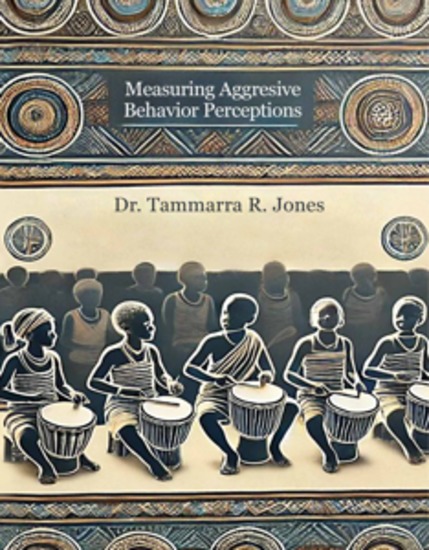
Measuring Aggresive Behavior Perceptions - cover

Measuring Aggresive Behavior Perceptions

Dr. R. Tammarra Jones

Publisher: Spines

  • 0
  • 0
  • 0

Summary

This book examines how African drumming can help African American boys in urban schools overcome aggression and disengagement. Through drumming, they connect with their heritage, fostering self-discovery and emotional control. The rhythm helps them build self-esteem and resilience, offering a therapeutic approach to combat the psychological impacts of racial oppression. The study blends rigorous research with personal stories, suggesting a fusion of cultural arts into education to promote harmony and success for marginalized youths.
Available since: 04/23/2025.
Print length: 84 pages.

Other books that might interest you

  • Mexico's Economic History - From Aztec Empire to Modern State - cover

    Mexico's Economic History - From...

    Anya Solace

    • 0
    • 0
    • 0
    Mexico’s economic history is a fascinating journey shaped by diverse influences, from the ancient Aztec empire to the complexities of the modern global economy. Over the centuries, Mexico has experienced dramatic transformations, driven by conquests, colonial rule, revolutions, and economic policies that have defined its growth and challenges. Understanding the evolution of Mexico’s economy requires examining its foundations, the role of geography and natural resources, and the early trade networks that set the stage for future economic systems.  
    The foundations of Mexico’s economy date back to the indigenous civilizations that thrived long before the Spanish conquest. The Aztecs, in particular, established a sophisticated economic system based on agriculture, trade, and tribute collection. Markets flourished in major cities like Tenochtitlán, where goods from across Mesoamerica were exchanged. The Aztec economy was not just a local system but a well-organized network that connected distant regions, allowing the movement of resources such as cacao, textiles, and obsidian. This structure provided a strong economic base, but it also made the region vulnerable to external forces, particularly the arrival of the Spanish.  
    Geography and natural resources have played a crucial role in shaping Mexico’s economic development. The country’s vast landscapes include fertile valleys, mineral-rich mountains, and long coastlines, all of which have influenced economic activities throughout history. The presence of silver, for example, turned Mexico into one of the most important centers of global trade during the colonial period. However, while natural resources have been a source of wealth, they have also led to economic dependency and external exploitation, shaping Mexico’s economic struggles even in modern times. 
    Show book
  • Secession and State Creation - What Everyone Needs to Know - cover

    Secession and State Creation -...

    Mikulas Fabry, James Ker-Lindsay

    • 0
    • 0
    • 0
    What makes a state? This question has attracted more and more attention in recent years with Catalan's illegal vote for independence from Spain and Palestine's ongoing search for international recognition. And while Scotland chose to remain with the United Kingdom, discussions of independence have only continued as the ramifications of the Brexit vote begin to set in. Kosovo, South Sudan, and the situation in Ukraine—each in its way reveals the perils of creating a nation separate from neighbors who have dominated it. 


    As James Ker-Lindsay and Mikulas Fabry show in this new addition to the What Everyone Needs to Know® series, the road to statehood never did run smooth. Declaring independence is only the first step; gaining both local and global acceptance is necessary before a state can become truly independent. The prospect of losing territory is usually not welcomed by the parent state. Beyond this immediate conflict, the international community often refuses to accept new states without proof of defined territory, a settled population, and effective government, which frequently translates to a democratic one with demonstrated respect for human rights. Covering the legal, political, and practical issues of secession and state creation, Ker-Lindsay and Fabry provide a sure-footed guide to a complex topic.
    Show book
  • Do the Birds Still Sing in Hell? - cover

    Do the Birds Still Sing in Hell?

    Horace Greasley

    • 0
    • 0
    • 0
    Even in the most horrifying places on earth, hope still lingers in the darkness, waiting for the opportunity to take flight. 


    When war was declared Horace Greasley was just twenty-years old. After seven weeks' training with the 2/5th Battalion, the Royal Leicestershire Regiment, Horace found himself facing the might of the German Army in a muddy field south of Cherbourg, in northern France, with just thirty rounds in his ammunition pouch. 


    Horace's war didn't last long . . . On May 25, 1940 he was taken prisoner and so began the harrowing journey to a prisoner-of-war camp in Poland. Those who survived the grueling ten-week march to the camp were left broken and exhausted, all chance of escape seemingly extinguished. 


    But when Horace met Rosa, the daughter of one of his captors, his story changed; fate, it seemed, had thrown him a lifeline. Horace risked everything in order to steal out of the camp to see his love, bringing back supplies for his fellow prisoners. In doing so he offered hope to his comrades, and defiance to one of the most brutal regimes in history.
    Show book
  • Digging Through the Bible - Understanding Biblical People Places and Controversies through Archaeology - cover

    Digging Through the Bible -...

    Richard A Freund

    • 0
    • 0
    • 0
    A “masterful and eminently readable” journey through the fascinating insights and revelations of Biblical archeology (Publishers Weekly, starred review). Many of our religious beliefs are based on faith alone, but archaeology gives us the opportunity to find evidence about what really happened in the distant past—evidence that can have a dramatic impact on what and how we believe. In Digging Through the Bible, archaeologist and rabbi Richard Freund takes readers through digs he has led in the Holy Land, searching for evidence about key biblical characters and events.  Digging Through the Bible presents overviews of the evidence surrounding figures such as Moses, Kings David and Solomon, and Mary the mother of Jesus, as well as new information that can help us more fully understand the life and times in which these people would have lived. Freund also presents new evidence about finding the grave of the Teacher of Righteousness mentioned in the Dead Sea Scrolls, and gives a compelling argument about how the Exodus of the Israelites may have taken place in three separate waves over time, rather than in a single event as presented in the Bible.
    Show book
  • I Hope We Choose Love - A Trans Girl's Notes from the End of the World - cover

    I Hope We Choose Love - A Trans...

    Kai Cheng Thom

    • 0
    • 0
    • 0
    What can we hope for at the end of the world? What can we trust in when community has broken our hearts? What would it mean to pursue justice without violence? How can we love in the absence of faith? 


    In a heartbreaking yet hopeful collection of personal essays and prose poems, blending the confessional, political, and literary, Kai Cheng Thom dives deep into the questions that haunt social movements today. With the author's characteristic eloquence and honesty, I Hope We Choose Love proposes heartfelt solutions on the topics of violence, complicity, family, vengeance, and forgiveness. Taking its cues from contemporary thought leaders in the transformative justice movement such as adrienne maree brown and Leah Lakshmi Piepzna-Samarasinha, this provocative book is a call for nuance in a time of political polarization, for healing in a time of justice, and for love in an apocalypse.
    Show book
  • Imperial Chinese Foundations - Uniting the Land (3 in 1) - cover

    Imperial Chinese Foundations -...

    Rolf Hedger

    • 0
    • 0
    • 0
    The story of China's imperial unification represents one of history's most consequential political transformations. "Imperial Chinese Foundations: Uniting the Land" explores the three dynasties that forged China's imperial system—a political structure that would endure for over two millennia. 
    The brief but revolutionary Qin Dynasty (221-206 BCE) ended centuries of warring states by conquering all rivals under the leadership of the First Emperor, Qin Shi Huang. Through military might, standardized writing, currency, measurements, and a unified legal code, the Qin created China's first centralized bureaucratic empire—though their harsh Legalist policies triggered rebellion after the emperor's death. 
    The Western Han Dynasty (206 BCE-9 CE) consolidated imperial rule through a more pragmatic blend of Confucian ideology and centralized governance. Under Emperor Wu's dynamic leadership, the Han expanded Chinese territory, opened the Silk Road, established the civil service examination system, and created cultural and political institutions that would define Chinese civilization for millennia. 
    As power shifted to the Eastern Han (25-220 CE), the dynasty initially flourished before facing mounting challenges from natural disasters, court intrigues, and the Yellow Turban Rebellion. Yet even as political cohesion weakened, this period saw remarkable innovations—including paper, the seismograph, and advances in mathematics and medicine—while Buddhism began its profound influence on Chinese civilization. 
    Through examining these three foundational dynasties, we witness the birth and evolution of the imperial Chinese state that would serve as a template for governance across East Asia and continue to influence Chinese identity into the modern era.
    Show book