Join us on a literary world trip!
Add this book to bookshelf
Grey
Write a new comment Default profile 50px
Grey
Subscribe to read the full book or read the first pages for free!
All characters reduced
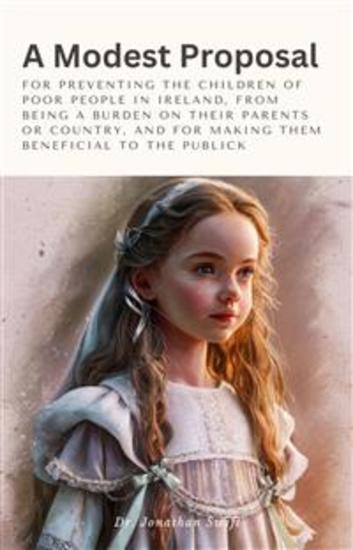
A Modest Proposal - cover

A Modest Proposal

Dr. Jonathan Swift

Publisher: POST Service & Consulting Limited 2RS28195X2143763S@post.sc Independence Ave. 1523 00000 Victoria, Mahé, Seychelles

  • 0
  • 0
  • 0

Summary

For preventing the children of poor people in Ireland, from being a burden on their parents or country, and for making them beneficial to the publick

The book you are referring to is actually an essay titled "A Modest Proposal" written by Jonathan Swift. It was first published anonymously in 1729. The essay is a satirical work in which Swift suggests that the impoverished Irish should sell their children as food to the rich in order to alleviate their economic troubles. The proposal is meant to criticize the British government's harsh economic policies towards Ireland and highlight the plight of the poor in the country. "A Modest Proposal" is considered a classic work of English literature and a prime example of political satire. It has been widely studied and analyzed for its dark humor and social commentary.
Available since: 04/11/2024.
Print length: 20 pages.
Other books that might interest you

  • Heart of Darkness - cover

    Heart of Darkness

    Joseph Conrad

    • 0
    • 0
    • 0
    "Heart of Darkness" is a novella written by Polish-English author Joseph Conrad, first published in 1902. The narrative follows Charles Marlow, a sailor and ivory transporter, as he travels up the Congo River into the African interior to meet the enigmatic and infamous ivory trader, Kurtz. The novella explores themes of imperialism, colonization, racism, and the darkness within human nature. It presents a stark and critical view of European colonialism and the exploitation of Africa and its people. "Heart of Darkness" is considered a significant work of English literature and has inspired numerous adaptations and critical discussions on its themes
    Show book
  • A Complete Recovery - From their pens to your ears genius in every story - cover

    A Complete Recovery - From their...

    Barry Pain

    • 0
    • 0
    • 0
    Barry Eric Odell Pain was born at 3 Sydney Street in Cambridge on 28th September 1864. He was one of 4 children. 
    He was educated at Sedbergh School and then Corpus Christi College, Cambridge. 
    In 1889, Cornhill Magazine published his short story ‘The Hundred Gates’.  This opened the way for Pain to advance his literary career on several fronts. He became a contributor to Punch and The Speaker, as well as joining the staff of both the Daily Chronicle and Black and White.  
    Pain was also a noted and prominent contributor to The Granta and from 1896 to 1928 a regular contributor to the Windsor Magazine. 
    It is often said that Pain was discovered by Robert Louis Stevenson, who compared his work to that of Guy de Maupassant.  It’s an apt comparison. Pain was a master of disturbing prose but was also able to inject parody and light comedy into many of his works.  A simple premise could in his hands suddenly expand into a world very real but somehow emotionally fraught and on the very edge of darkness. 
    Barry Pain died on 5th May 1928 in Bushey, Hertfordshire.
    Show book
  • The Original Dracula - cover

    The Original Dracula

    Bram Stoker

    • 0
    • 0
    • 0
    Dracula is a novel by Bram Stoker, published in 1897. As an epistolary novel, the narrative is related through letters, diary entries, and newspaper articles. It has no single protagonist but opens with solicitor Jonathan Harker taking a business trip to stay at the castle of a Transylvanian nobleman, Count Dracula. Harker escapes the castle after discovering that Dracula is a vampire, and the Count moves to England and plagues the seaside town of Whitby. A small group, led by Abraham Van Helsing, hunt Dracula and, in the end, kill him. 
     
    Dracula was mostly written in the 1890s. Stoker produced over a hundred pages of notes for the novel, drawing extensively from Transylvanian folklore and history. Some scholars have suggested that the character of Dracula was inspired by historical figures like the Wallachian prince Vlad the Impaler or the countess Elizabeth Báthory, but there is widespread disagreement. Stoker's notes mention neither figure. He found the name Dracula in Whitby's public library while holidaying there, picking it because he thought it meant devil in Romanian.
    Show book
  • A Lady's Story - cover

    A Lady's Story

    Anton Chekhov

    • 0
    • 0
    • 0
    Natalya was once a happy and radiant young woman. Now an older woman, she reflects about her youth. In particular, she thinks about the heavy emphasis she put on her wealth and the relationships and experiences that it cost her. One man, Pyotr, loved her, but they both let their different statuses in society prevent their love from having a chance. After years of unhappiness and regret, Pyotr comes to visit Natalya.
    Show book
  • Emma - cover

    Emma

    Jane Austen

    • 0
    • 0
    • 0
    "Emma" is a novel by Jane Austen, first published in 1815. The story revolves around Emma Woodhouse, a well-off young woman who prides herself on her matchmaking abilities. Despite her best intentions, her meddling often leads to misunderstandings and complications. As Emma navigates the challenges of friendships, romance, and social standings in her small English village, she also undergoes a journey of personal growth and self-discovery. The novel deals with themes of social class, marriage, and individual agency within the context of early 19th-century England.
    Show book
  • The Haunted Dolls' House and Other Ghost Stories - cover

    The Haunted Dolls' House and...

    M. R. James

    • 0
    • 0
    • 0
    This collection of three ghost stories, by master of the genre M. R. James, first appeared in "A Warning to the Curious" published in 1925. James wrote "The Haunted Dolls' House" in 1923 on a commission from Queen Mary who wanted miniature books from the most popular writers of the day to include in the library of her doll's house at Windsor Castle. Antique dealer Mr. Chittenden has an exquisite example of a doll's house in his shop. After a little haggling he manages to offload it onto one of his regular customers, a collector called Mr. Dillet. It becomes abundantly clear that Chittenden and his wife are all too glad to see the back of it, as whosoever owns the dolls' house is subject to supernatural visions every morning at one o'clock. Also included in this collection are "An Evening's Entertainment" and "A Neighbour's Landmark".
    Show book