Join us on a literary world trip!
Add this book to bookshelf
Grey
Write a new comment Default profile 50px
Grey
Subscribe to read the full book or read the first pages for free!
All characters reduced
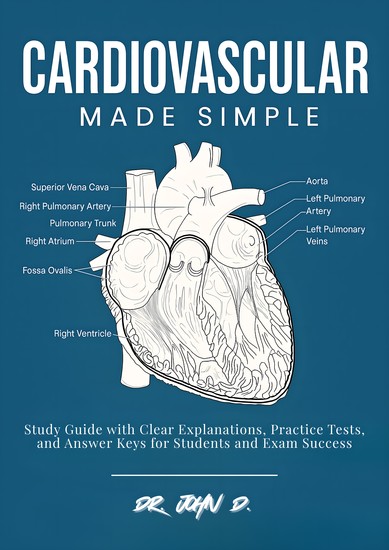
Cardiovascular Made Simple - Study Guide with Clear Explanations Practice Tests and Answer Keys for Students and Exam Success - cover

Cardiovascular Made Simple - Study Guide with Clear Explanations Practice Tests and Answer Keys for Students and Exam Success

Dr. John D.

Publisher: Publishdrive

  • 0
  • 0
  • 0

Summary

Are you preparing for exams in cardiovascular physiology and pathology?

 
This comprehensive study guide and workbook is designed to help students, nursing candidates, and medical learners master essential concepts with clarity and confidence.

 
Inside you will find:
 
 -Complete, easy-to-follow content review covering all major cardiovascular topics in a structured and accessible way.

 
 -Practice questions with detailed answer keys  
 
Test your understanding immediately and learn from clear explanations.

 
 -Exam-focused approach  
 
Every chapter highlights the most important knowledge points you need to succeed in tests and professional assessments.

 
 -Step-by-step learning from fundamentals to applied concepts, helping you build a strong foundation in cardiovascular systems.

 
 -Self-study friendly, ideal for revision, classroom support, or independent practice.

 
Whether you are a student preparing for classroom exams, a nursing or medical candidate studying for professional tests, or simply someone who wants to strengthen your knowledge of the human heart and circulatory system, this book is your perfect companion.

 
By combining concise explanations with practical exercises and full solutions, this guide ensures you don't just memorize facts, you understand them. With this resource at your side, exam success is not just possible, it's within reach.

 
Start mastering cardiovascular science today! Your exam-ready journey begins here!
Available since: 09/15/2025.
Print length: 100 pages.
Other books that might interest you

  • Weather Science - How Meteorology Has Gone from Folklore to High-Tech - cover

    Weather Science - How...

    Brian Clegg

    • 0
    • 0
    • 0
    Everyone has an interest in the weather, whether it's to check the prospects for a day out or to know when best to harvest a crop. The Earth's weather systems also provide some of the most dramatic forces of nature, from the vast release of energy in a lightning flash to the devastating impact of tornadoes and hurricanes.
    
    For centuries, our only real guide to future weather was folklore, but with the introduction of the first weather forecasts and maps in Victorian times, attempts were made to give some warning of the weather to come. Until relatively recently, these forecasts could be wildly inaccurate - think of Michael Fish's denial that there was a storm on the way the night before the UK's great storm of 1987. This was due to the mathematically chaotic nature of weather systems, first discovered in the 1960s, the understanding of which would transform forecasting from the 1990s and mean that meteorologists became some of the foremost users of supercomputers.
    
    From the crystalline perfection of the snowflake to the transfer of energy from the Sun, science lies at the heart of the weather and our understanding of it. In recent years, weather science has moved to the leading edge with advanced modelling, versatile use of satellite data and a better understanding of mathematical chaos. This is a true example of hot science at work.
    Show book
  • Technology and Cities - The Role of Technology in Shaping Urban Futures - cover

    Technology and Cities - The Role...

    Lyric Vale

    • 0
    • 0
    • 0
    In recent decades, technology has become a defining force in the development and transformation of cities. From the industrial revolution to the rise of the internet, technological advancements have continually reshaped urban life, making cities hubs of innovation, connectivity, and economic growth. Today, as cities face growing populations, climate change, and resource constraints, technology plays a central role in addressing these challenges while also opening new possibilities for urban living. The integration of digital technologies, automation, and data analytics is driving what we now recognize as the emergence of "smart cities," where every aspect of urban life is enhanced by technology. These advancements not only improve efficiency but also offer the potential to foster more sustainable, livable, and equitable urban environments. 
    The influence of technology in cities extends across various domains, including infrastructure, transportation, healthcare, and governance. In terms of urban infrastructure, cities are adopting digital systems for managing everything from electricity grids to water distribution, allowing for more responsive and efficient service delivery. Transportation has also undergone a transformation with the introduction of autonomous vehicles, electric cars, and new mobility services like ride-sharing, reshaping how people move within cities and reducing the environmental impact of urban travel. Similarly, the integration of sensors and Internet of Things (IoT) devices enables real-time data collection that informs city management, improving everything from traffic flow to waste management.
    Show book
  • Types of UFOs Observed in History - cover

    Types of UFOs Observed in History

    Martin K. Ettington

    • 0
    • 0
    • 0
    My goal in this book is to show the different types of UFOs reported throughout history and today. 
    I’m not trying to prove whether these ships are real or not. I just thought that given the many thousands of sightings of UFOs there should be some commonalities between the sightings. 
    Some of the questions I want to answer include: 
    Are there any trends in these sightings? 
    Is there an evolution in the design of these vehicles over time? 
    Are there some common designs over time? 
    Also, some of the UFOs sighted are likely fakes or secret projects built by the US government. I tried to show that information too. 
    Just due to the number of stars in our galaxy I’m convinced that Aliens exist and have probably visited our planet thousands or even millions of year in the past-in addition to visiting in the present. 
    This collection of historical photos, drawings, and descriptions should provide you with a narrative as to how these sightings have changed over time.
    Show book
  • The First History of Man - cover

    The First History of Man

    MD John Bershof

    • 0
    • 0
    • 0
    In the spirit of medieval writer Chaucer, all human activity lies within the artist’s scope, the History of Man Series uses medicine as a jumping off point to explore precisely that, all history, all science, all human activity since the beginning of time. The jumping off style of writing takes the reader, the listener into worlds unknown, always returning to base, only to jump off again. History of Man are stories and tales of nearly everything. 
    The First History of Man uses infection in general—bacteria, viruses, fungus, parasites, epidemics & pandemics, COVID-19—to lay the foundation for the next five books, narratives and stories that delve deeper into human infectious diseases. This first volume jumps off into accounts of the Big Bang Theory—the real one, but also the sitcom—the origin of the Universe, from atoms to DNA to us and how exactly it happened. In our journey we’ll explore Einstein and Newton who were probably aliens (he said jokingly), the Roman Empire, British history and all those wives of King Henry VIII, the why and how of the Protestant Reformation, why Pluto lost its planet status in our solar system, what exactly is the sweet spot of a solar system, all the while digging up some archeology, and even paying a visit with Dr. Livingstone, I presume. We’ll trudge from the top of Everest, the highest point on Earth, to the bottom of the Mariana Trench, the lowest point on Earth, and LUA in between, the Last Universal Ancestor that gave rise to all life on Earth.
    Show book
  • Messy Cities - Why We Can't Plan Everything - cover

    Messy Cities - Why We Can't Plan...

    John Lorinc, Leslie Woo, Zahra...

    • 0
    • 0
    • 0
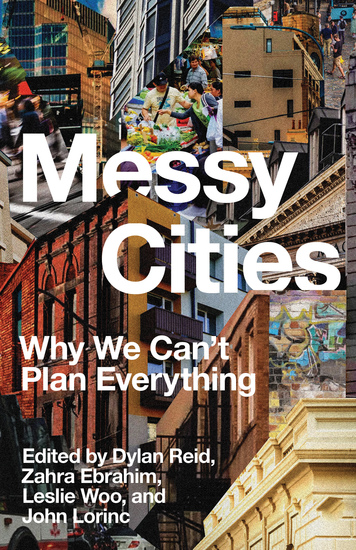
    Can messiness make our cities more liveable, lively, and inclusive? 
    Crowded streets, sidewalk vendors, jumbled architecture, constant clamour, graffitied walls, parks gone wild: are these signs of a poorly managed city or indicators of urban vitality? 
    Messy Cities: Why We Can’t Plan Everything argues that spontaneity and urban workarounds are not liabilities but essential elements in all thriving cities. 
    Forty-three essays by a range of writers from around the world illuminate the role of messy urbanism in enabling creativity, enterprise, and grassroots initiatives to flourish within dense modern cities. 
    With pieces on guerrilla beaches, desire lines, urban interruptions, and the inner lives of unlovely buildings written by experts from all walks of life, Messy Cities makes the case for embracing disorder while not shying away from confronting its challenges.
    Show book
  • Guided meditation to stop procrastinating - A guided meditation - DST Hypno with Stu Newman - cover

    Guided meditation to stop...

    Stuart Newman

    • 0
    • 0
    • 0
    If you're looking for a way to stop procrastinating and get more done, then look no further than DST Hypno with Stu Newman.  
    This guided meditation is designed to help you gain control over your thoughts and focus on the task at hand.  
    With practical advice, calming music and positive affirmations, this meditation will help clear your mind of distractions so that you can stay motivated and productive throughout the day.  
    It's an easy-to-follow program that will make it easier for you to stick with tasks until completion without getting sidetracked or overwhelmed by stress or anxiety.  
    So don't wait any longer - try out DST Hypno with Stu Newman today!
    Show book