Join us on a literary world trip!
Add this book to bookshelf
Grey
Write a new comment Default profile 50px
Grey
Subscribe to read the full book or read the first pages for free!
All characters reduced
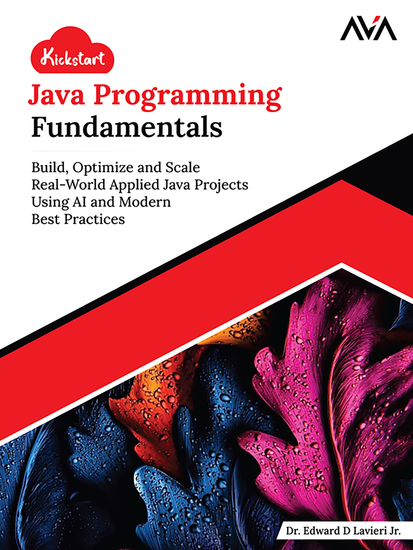
Kickstart Java Programming Fundamentals - Build Optimize and Scale Real-World Applied Java Projects Using AI and Modern Best Practices - cover

Kickstart Java Programming Fundamentals - Build Optimize and Scale Real-World Applied Java Projects Using AI and Modern Best Practices

Dr. Edward Lavieri Jr.

Publisher: Orange Education Pvt. Ltd

  • 0
  • 0
  • 0

Summary

Become a Java Pro through Real, Hands-On Coding Experience.
Book Description
In today’s tech-driven world, applied Java programming with AI integration is a game-changer. Java remains a backbone of enterprise and application development—but its real power emerges when combined with hands-on skills and modern technologies like artificial intelligence.
Kickstart Java Programming Fundamentals offers a practical, real-world path to mastering Java—from basic syntax to building intelligent systems. Structured into three progressive sections, you'll begin with foundational topics such as variables, loops, OOP, and exception handling. Then, dive into core Java development with I/O operations, GUI programming, multithreading, and data structures. The final section guides you through advanced programming, including performance tuning, mobile and web development, design patterns, and incorporating AI techniques such as logic-based decision making and intelligent automation using Java.
Table of Contents
1. Introduction to Java Programming
2. Variables, Data Types, Operators, and Control Structures
3. Object-Oriented Programming (OOP) Basics
4. Methods and Functions
5. File and Exception Handling
6. Input/Output Streams
7. GUI Programming
8. Concurrency and Mutli-Threading
9. Working with Collections and Data Structures
10. Networking in Java
11. Database Connectivity with JDBC
12. Java Performance Tuning and Optimization
13. Security, Testing, and Debugging
14. Exploring Popular Java Frameworks
15. Java for Web Development
16. Advanced Java Features
17. Mobile Development with Java
18. Design Patterns in Java
19. Using AI with Java Programming
20. Final Project and Next Steps       

Index
Available since: 07/24/2025.
Other books that might interest you

  • Applied Physics - Practical Solutions for Engineering Technology and Everyday Life - cover

    Applied Physics - Practical...

    Jeron Iris

    • 0
    • 0
    • 0
    Explore the incredible world where physics theory meets practical innovation. This book takes you on a journey through the scientific principles that drive real-world advancements, from cutting-edge technology and engineering to medical breakthroughs and sustainable energy solutions. This comprehensive guide explores how fundamental concepts—like electromagnetism, thermodynamics, quantum mechanics, and optics—are transformed into tangible applications that impact our everyday lives. 
    Whether you're a student, researcher, or curious learner, this book offers a clear understanding of how physics is used to solve complex problems and drive new discoveries. With real-life examples, experiments, and case studies, you’ll see how applied physics continues to shape our world, revolutionizing industries and pushing the boundaries of what’s possible. Dive into the science behind modern marvels and discover how applied physics can unlock a deeper understanding of the universe and the innovative possibilities within it.
    Show book
  • Wild Enthusiasm - A Very British Safari - cover

    Wild Enthusiasm - A Very British...

    Steve Wright

    • 0
    • 0
    • 0
    No need to travel halfway round the globe to spot iconic wildlife – it's right here on our doorstep in the UK and Steve Wright, keen amateur naturalist, travels from the Isle of Man to Norfolk, to the Orkneys, Northern Ireland and everywhere in-between on his various short holiday expeditions, clutching his specific wildlife wish-list for each trip.  
    The result is an inspiring and engaging diary of his personal encounters with white-tailed eagles, otters, bottlenose dolphins, fulmars, puffins, osprey, sand lizards, even red-necked wallabies. And the characters he meets on the way. He hears snipe drumming, watches a shrew in Wales, admires pilot whales off Lewis.  
    Steve's wildlife travel diaries give excellent practical tips, such as bird-hide etiquette, how to identify birds on the wing, how to consult local wildlife rangers about what might be spotted on each outing and where to find that species.  
    But most importantly his highly-readable wildlife travels are a call to others to book themselves in to pubs and small hotels the length and breadth of Britain and follow his example, for a series of fun British wildlife safaris.   
    Show book
  • UX Writing Essentials - A Simple Guide for All - cover

    UX Writing Essentials - A Simple...

    Atila Velo

    • 0
    • 0
    • 0
    A comprehensive guide to UX Writing that bridges foundational concepts with advanced insights, suitable for all backgrounds. This audiobook covers microcopy, brand voice, user journeys, research, and the evolving roles of ContentOps and AI. Designed for clarity and depth, it equips readers to navigate challenges, avoid pitfalls, and elevate digital communication across diverse contexts.
    Show book
  • Cosmology's Dark Secrets - Understanding Space Beyond Light - cover

    Cosmology's Dark Secrets -...

    Dirk Fallon

    • 0
    • 0
    • 0
    The vastness of the universe has always stirred human curiosity, evoking questions that seem to stretch beyond the reach of science and into the realm of the unknown. As far back as ancient civilizations, people looked up at the night sky and wondered about the lights scattered across it. With the advancement of technology and scientific understanding, we have come to learn much about what lies beyond our atmosphere. Yet, despite all we know, there remains an overwhelming sense that we are only scratching the surface of a far deeper reality. 
    The observable universe refers to the portion of the cosmos we can detect through light and other forms of radiation. With telescopes, we can peer billions of light-years into space, essentially looking back in time to the early moments following the Big Bang. However, what we can observe is just a fraction of the entire cosmos. Beyond this visible boundary lies a realm shrouded in darkness, not because it is absent, but because it is inaccessible to our current instruments. This horizon, defined by the limits of the speed of light and the age of the universe, presents a fundamental boundary to what we can ever know. 
    Despite the sophistication of our tools, human perception is still tied to what light allows us to see. We rely heavily on electromagnetic radiation—visible light, radio waves, X-rays—to map and understand the structure of the cosmos. However, this reliance imposes a narrow filter on our understanding. There may be phenomena that exist completely outside the spectrum we can currently detect. The deeper we explore, the more we realize that the cosmos may be full of activity and matter that leave no trace in the form of light.
    Show book
  • Pierce the Design Fog - Develop High-Quality Products Faster through Team Innovation - cover

    Pierce the Design Fog - Develop...

    Dianna Deeney

    • 0
    • 0
    • 0
    A proven framework to align teams, define clear design inputs, and accelerate product success 
     
    In product development, great ideas can get lost in translation. Teams kick off with enthusiasm, but somewhere between the first design iteration meeting and the engineering handoff, misaligned assumptions lead to costly rework, stalled timelines, and products that miss the mark.
     
    In Pierce the Design Fog, quality advocate and senior engineer Dianna Deeney reveals why 85% of companies struggle to get product development right—and how to fix it. Drawing from over 25 years in manufacturing, quality engineering, and cross-functional leadership, she shares practical methods for bridging the gap between concept development and engineering-ready designs.
     
    Using her ADEPT Team Framework and Concept Space Model, Deeney provides a repeatable process to unite diverse perspectives, surface hidden requirements, and define clear design inputs focused on user experience. This hands-on playbook for managers, engineers, and product leaders uses step-by-step guidance, real-world examples, and ready-to-use templates to engage every stakeholder from the start and turn ideas into high-quality, customer-focused design inputs.
     
    You will learn how to:
    
    Identify and avoid the "Ta-da Flop" by validating concepts before engineering begins.
    Lead efficient, collaborative meetings that produce actionable design inputs.
    Translate end user needs into prioritized, measurable requirements.
    Apply quality engineering tools to reduce design loops and speed approvals.
    Foster stronger cross-functional team alignment and earlier buy-in. 
    
     
    If you lead engineers, market products, or manage cross-functional teams, Pierce the Design Fog will change the way you start projects—with results your customers will notice.
    Show book
  • The Feynman Lectures on Physics - A Comprehensive Introduction to the Principles of Physics - cover

    The Feynman Lectures on Physics...

    Mark Hedges

    • 0
    • 0
    • 0
    Physics is the study of the fundamental principles that govern the universe. It seeks to understand how the natural world works, from the smallest particles to the largest galaxies. At its core, physics is about exploring the behavior of matter and energy and how they interact. By uncovering these basic laws of nature, physicists have been able to make incredible advances in technology and our understanding of the universe, transforming how we live and think. 
    The nature and scope of physics are vast. It is divided into several branches, each focusing on different aspects of the physical world. Classical mechanics, electromagnetism, thermodynamics, and quantum mechanics are just a few examples of the areas of physics that explore different phenomena. Classical mechanics deals with the motion of objects and the forces acting upon them, while electromagnetism studies the behavior of electric and magnetic fields. Thermodynamics focuses on heat and energy transfer, and quantum mechanics explores the behavior of matter and energy at the smallest scales. 
    At its foundation, physics relies on a few core principles, such as the conservation of energy, the principle of least action, and Newton's laws of motion. These principles are fundamental to understanding how objects move, interact, and behave. The law of conservation of energy, for example, states that energy cannot be created or destroyed but only transformed from one form to another. Newton’s laws of motion provide the framework for understanding how forces affect the movement of objects. These laws have been used for centuries to explain everything from the motion of falling apples to the launch of rockets into space.
    Show book