Join us on a literary world trip!
Add this book to bookshelf
Grey
Write a new comment Default profile 50px
Grey
Subscribe to read the full book or read the first pages for free!
All characters reduced
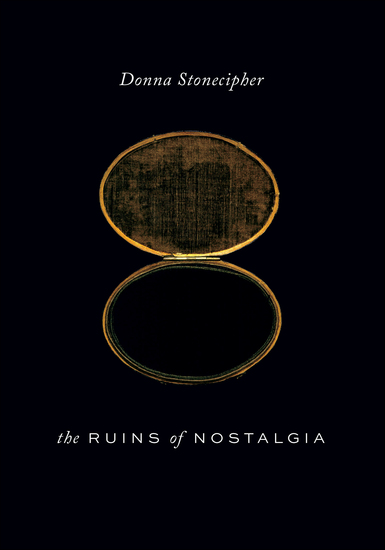
The Ruins of Nostalgia - cover

The Ruins of Nostalgia

Donna Stonecipher

Publisher: Wesleyan University Press

  • 0
  • 0
  • 0

Summary

What is it to feel nostalgia, to be skeptical of it yet cleave intently to the complex truths of feeling and thought? In a series of 64 gorgeous, ramifying, unsettling prose poems addressing late-twentieth- and twenty-first century experience and its discontents, The Ruins of Nostalgia offers a strikingly original exploration of the misunderstood phenomenon of nostalgia as both feeling-state and historical phenomenon. Each poem, also titled The Ruins of Nostalgia, is a kind of lyrical mini-essay, playful, passionate, analytic. Some poems take a location, memory, conceit, or object as their theme. Throughout the series, the poems recognize and celebrate the nostalgias they ironize, which are in turn celebrated and then ironized again. Written often in the fictional persona of the first-person plural, The Ruins of Nostalgia explores the rich territory where individual response meets a collective phenomenon.[sample poem]The Ruins of Nostalgia 13Where once there had been a low-end stationery store minded by an elderly beauty queen, there was now a store for high-end espresso machines minded by nobody. Where once there had been an illegal beer garden in a weedy lot, there was now a complex of luxury lofts with Parisian-style ivory façades. Where once there had been a bookstore and a bike shop and a bakery, there was now a wax museum for tourists. Where once there had been an empty lot there was now a building. Where once there had been an empty lot there was now a building. Where once there had been an empty lot there was now a building. Where once there had been an empty lot there was now a building. Where once there had been farms there were now subdivisions. Where once there had been subdivisions there were now sub-subdivisions. We lived in a sub-subdivision of a subdivision. We ourselves had become subdivided—where once we had merely been of two minds. * Where once there had been a river there was now a road. A vocal local group had started a movement to break up the road and "daylight" the river, which still flowed, in the dark, underneath the road. * Could we daylight the farms, the empty lots, the stationery store, the elderly beauty queen, the city we moved to? Was it still flowing somewhere, under the luxury lofts, deliquescing in the dark, inhabited by our luxury selves, not yet subdivided, because not yet whole? * Could we daylight the ruins of nostalgia?
Available since: 10/10/2023.
Print length: 81 pages.
Other books that might interest you

  • The Tenderness of Silent Minds - Benjamin Britten and his War Requiem - cover

    The Tenderness of Silent Minds -...

    Martha C. Nussbaum

    • 0
    • 0
    • 0
    The human body is the primary instrument of war, yet those waging war often confront soldiers' bodies in a detached or merely intellectual way. In The Tenderness of Silent Minds, Martha C. Nussbaum, a leading thinker on emotion, morality, and justice, conducts a pioneering study of Benjamin Britten's musical representations of the tender male body amidst the brutality of war, and their ability to transform consciousness by evoking potent, non-personal emotions. 


    Offering a reading of Britten's views about the value and beauty of the body that situates these in the context of his thirty-nine year partnership with his lover, the singer Peter Pears, and also surveying pacifist themes in works written both before and after War Requiem, Nussbaum presents a compelling framework for critically assessing Britten's oeuvre. Nussbaum engages with a remarkably wide range of Britten's works, examining his treatment of aggression and its roots in his collaborations with the poet W. H. Auden, offering readings of the value placed on the body in early partnerships with Britten's beloved and singer Peter Pears, and surveying pacifist themes in Britten's earlier works. The analysis throughout is enriched with perspectives from Britten's personal letters and thoughtful study of the social and political backdrop of fear and homophobic disgust in mid-twentieth century Britain.
    Show book
  • The Century - Poems - cover

    The Century - Poems

    Éireann Lorsung

    • 0
    • 0
    • 0
    A meticulously detailed catalogue of ordinary people performing acts of extraordinary violence, The Century charts an awakening to structures of dominance and violence. In the tradition of witness poetry, The Century tugs apart the quotidian horrors required to perpetuate acts of violence like the Holocaust, the deployment of nuclear weapons in Japan and Iraq, American slavery and its lingering aftermath. When Éireann Lorsung writes of death and dying, of “bodies in the fields becoming the fields,” it’s the simplicity that’s most haunting. After a fire, “some of their skin moved off of them as they ran, a very / simple melting…” But these poems don’t just witness; they also resist and serve as models for resistant lives. Pushing back against form and grammar, constructions of time and geography, Lorsung traces decades of technological, geopolitical, and cultural shifts through generations and across continents as networks of dominance continue to be stubbornly upheld.The Century is evasive but thorny, splintering in the mind. This collection is a reminder that the arrival of each new century, decade, or year brings with it an invitation to join ongoing movements of resistance, air pockets of hope in the waters that we all swim or drown in.  
    Show book
  • Ascension The Path To Liberation - cover

    Ascension The Path To Liberation

    Justin Wesenberg

    • 0
    • 0
    • 0
    Ascension is a channeled poetry book about finding freedom so that you can realize your highest potential in this lifetime.  
    This poetry book is for those who are ready to liberate their soul and find complete freedom. 
    How can I thank 
    All these teachers of mine 
    For sharing with me 
    A love that is divine 
    So that I could find 
    My inner light 
    Trust myself 
    Learn to shine bright 
    And radiate love 
    To all that I meet 
    To the people of Earth 
    I bow at your feet 
    So that I may discover 
    The Most High 
    Trust the guidance 
    And let myself fly 
    To the land beyond 
    That which we know 
    An infinite space 
    To learn and grow 
    This channeled poetry book was inspired by my time living at an ashram receiving teachings from Shiva, the Archangels and Ascended Masters, and the Divine Mother. 
    If you’re on the path to creating more freedom, love, and joy in your life, Ascension The Path To Liberation will guide you on your journey to liberate your soul!
    Show book
  • Poetry of the Romantics - cover

    Poetry of the Romantics

    John Keats

    • 0
    • 0
    • 0
    The period of English romantic poetry occurred roughly between 1800 and 1850 and was represented by poets such as William Blake, Lord Byron, Samuel Taylor Coleridge, John Keats, Percy Bysshe Shelley, and William Wordsworth. All of these poets are featured in this collection of more than 50 poems read by award-winning actors that include Joan Allen, Julie Christie, Stephen Fry, Glenda Jackson, and Jude Law.
    Show book
  • The Wolf - cover

    The Wolf

    Mike Blake

    • 0
    • 0
    • 0
    The Wolf poem :: was inspired by William Blake's - 'The Tyger'. 
    It has the same regular form & meter as The Tyger. 
    With tempo and stanza (of the quatrain type), and is about one single animal in the natural world. 
    Where it differs from William Blake's poem is that the Poem Tyger has more religious connotations, not surprising for the times in which it was written. 
    Whereas 'The Wolf' written by myself, has more of Natures influences. 
    It's also about the possible demise totally of the Wolf through man, and a warning of this. 
    As we take care of The Wolf and other similiar 'top predator' animals, 
    so we automatically take care of the natural habitat that they live in - something that is increasing in peoples consciousness today. 
    To see more Poems by the same Author please follow the link below: 
    https://www.amazon.com/-/e/B00SG40RM8 
    **If you enjoy reading this Poem, can you Please leave your feedback, many thanks. 
    To contact the Author: Please add me Mike Miko on Facebook & then message me, thanks. https://www.facebook.com/mike.cco1 I will then contact the Author your behalf. or on 
    Twitter: miko_1_dollar ~ Tumblr : ccobes ~ 
    Instagram: Wild.Poetry.Webs / wild_poetrys 
    TikTok: @Wild_Poetrys 
    FB: https://www.facebook.com/New.Poets.Corner/
    Show book
  • Herman Melville - Chapter & Verse - Poetry and prose together from literary greats - cover

    Herman Melville - Chapter &...

    Herman Melville

    • 0
    • 0
    • 0
    Literature is a world of words and wonder, able to take us on almost unimaginable journeys from the wild and fantastic to the grind and minutiae of life. 
     
    An author’s ideas are his building blocks, his architecture of the mind, building a structure on which all else will rest; the narrative, the characters, the words - those few words that begin the adventure. 
     
    In this series we look at some of our leading classic authors across two genres: the short story and the poem.  In this modern world there is an insatiable need to categorise and pigeon-hole everyone and everything.  But ideas, these grains and saplings of the brain, need to roam, to explore and find their perfect literary use vehicle.  Our authors are masters of many literary forms, perhaps known for one but themselves favouring another. 
     
    Story. Poems. Story.  Within these boundaries come all manner of invention and cast of characters.  And, of course, each author has their own way of revealing their own chapter and verse.    
     
    1 - Chapter & Verse - Herman Melville - An Introduction 
    2 - Bartleby the Scrivener - Part 1 by Herman Melville 
    3 - Bartleby the Scrivener - Part 2 by Herman Melville 
    4 - Billy in the Darbies by Herman Melville 
    5 - The Eagle of the Blue by Herman Melville 
    6 - John Marr and Other Sailors by Herman Melville 
    7 - A Dirge for McPherson by Herman Melville 
    8 - Gettysburg by Herman Melville 
    9 - The March into Virginia by Herman Melville 
    10 - The Released Rebel Prisoner by Herman Melville 
    11 - The Martyr by Herman Melville 
    12 - Monody by Herman Melville 
    13 - Immolated by Herman Melville 
    14 - The Fiddler by Herman Melville
    Show book