Junte-se a nós em uma viagem ao mundo dos livros!
Adicionar este livro à prateleira
Grey
Deixe um novo comentário Default profile 50px
Grey
Assine para ler o livro completo ou leia as primeiras páginas de graça!
All characters reduced
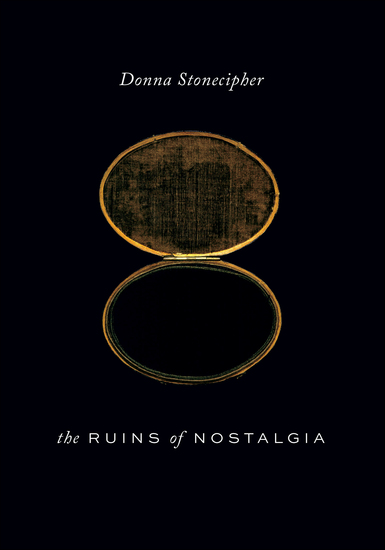
The Ruins of Nostalgia - cover
LER

The Ruins of Nostalgia

Donna Stonecipher

Editora: Wesleyan University Press

  • 0
  • 0
  • 0

Sinopse

What is it to feel nostalgia, to be skeptical of it yet cleave intently to the complex truths of feeling and thought? In a series of 64 gorgeous, ramifying, unsettling prose poems addressing late-twentieth- and twenty-first century experience and its discontents, The Ruins of Nostalgia offers a strikingly original exploration of the misunderstood phenomenon of nostalgia as both feeling-state and historical phenomenon. Each poem, also titled The Ruins of Nostalgia, is a kind of lyrical mini-essay, playful, passionate, analytic. Some poems take a location, memory, conceit, or object as their theme. Throughout the series, the poems recognize and celebrate the nostalgias they ironize, which are in turn celebrated and then ironized again. Written often in the fictional persona of the first-person plural, The Ruins of Nostalgia explores the rich territory where individual response meets a collective phenomenon.[sample poem]The Ruins of Nostalgia 13Where once there had been a low-end stationery store minded by an elderly beauty queen, there was now a store for high-end espresso machines minded by nobody. Where once there had been an illegal beer garden in a weedy lot, there was now a complex of luxury lofts with Parisian-style ivory façades. Where once there had been a bookstore and a bike shop and a bakery, there was now a wax museum for tourists. Where once there had been an empty lot there was now a building. Where once there had been an empty lot there was now a building. Where once there had been an empty lot there was now a building. Where once there had been an empty lot there was now a building. Where once there had been farms there were now subdivisions. Where once there had been subdivisions there were now sub-subdivisions. We lived in a sub-subdivision of a subdivision. We ourselves had become subdivided—where once we had merely been of two minds. * Where once there had been a river there was now a road. A vocal local group had started a movement to break up the road and "daylight" the river, which still flowed, in the dark, underneath the road. * Could we daylight the farms, the empty lots, the stationery store, the elderly beauty queen, the city we moved to? Was it still flowing somewhere, under the luxury lofts, deliquescing in the dark, inhabited by our luxury selves, not yet subdivided, because not yet whole? * Could we daylight the ruins of nostalgia?
Disponível desde: 10/10/2023.
Comprimento de impressão: 81 páginas.

Outros livros que poderiam interessá-lo

  • Annabel Lee - cover

    Annabel Lee

    Edgar Allan Poe

    • 0
    • 0
    • 0
    Annabel Lee is the last complete poem by Edgar Allan Poe. Like many of Poe's poems, it explores the theme of the death of a beautiful woman. 
    The narrator, who fell in love with Annabel Lee when they were young, has a love for her so strong that even angels are jealous. He retains his love for her even after her death. 
    There has been debate over who - if anyone - was the inspiration for Annabel Lee. Though many women have been suggested, Poe's wife Virginia Eliza Clemm Poe is one of the more credible candidates. 
    ©2009 Listen & Live Audio, Inc.; (P)2009 Listen & Live Audio, Inc.
    Ver livro
  • The Time is Not Yet Ripe - cover

    The Time is Not Yet Ripe

    Thomas Louis Buvelot Esson

    • 0
    • 0
    • 0
    Thomas Louis Buvelot Esson (1878 - 1943) was an Australian poet, journalist and playwright. He was born in Edinburgh but moved to Melbourne, Australia when he was three. He attended the University of Melbourne and began working as a journalist and playwright soon after.His best known work is the political comedy, The Time is Not Yet Ripe, first performed in 1912.  It has since come to be acknowledged as an Australian classic, and has often been revived. - Summary Adapted from Wikipedia by Algy PugCast list:Sir Joseph Quiverton:  Algy PugDoris: Beth ThomasEnglish Butler: Frances BrownSir Henry Pilsbury: Jon SmithLady Pilsbury:  ToddHWJohn K. Hill: Nick BulkaSydney Barrett/Socialists: Kristin GjerløwMiss Perkins: Libby GohnOtto/Socialists: Lars RolanderHarry Hopkins/Socialists: Phil BensonPeter Jensen/Socialists: Lars RolanderArthur Gray/Socialists: Peter TuckerBertie Wainwright: Ben Lindsey-ClarkViolet Faulkner: SavannahA Fat Man/Crowd: balaA Cheeky Youth/Crowd: Victoria PA Working Woman/Crowd:  AvailleAn Old Man/Crowd: Robert DixonNarrator: JanetEdited by: ToddHWCoordinated by:  Algy Pug
    Ver livro
  • Alexa What Is There to Know About Love? - A hilarious and moving poetry collection - cover

    Alexa What Is There to Know...

    Brian Bilston

    • 0
    • 0
    • 0
    'Brian Bilston is a laureate for our fractured times.' Ian McMillan'Someone who knows their way round both a joke and a bittersweet narrative.' The Times'Part John Cooper Clarke, part Frank Sidebottom . . . all brilliant.' Esquire'Bilston is a magician with words' GuardianAlexa, what is there to know about love? is a wonderful collection of poems about love in all its forms, covering everything from romantic love to familial love, to long-distance love, and even love on the internet.The collection also features poems about the true passions for many booklovers, reading and literature, and the odd one about the subject causing many of us heartbreak: politics. With titles like ‘Hold My Hand While We Jump Off This Cliff’ and ‘Remembrance of Things Pasta’, there’s something for even the most jaded romantic within these pages.The perfect, witty gift for Valentine’s and beyond.**Brian's next book, How to Lay an Egg with a Horse Inside: An Alternative Guide to Writing and Enjoying Poetry, is available for pre-order now!**
    Ver livro
  • Waste Land The (version 3) - cover

    Waste Land The (version 3)

    T.S. Eliot

    • 0
    • 0
    • 0
    The Waste Land is T. S. Eliot's Modernist masterpiece, first published in 1920. Rich in allusions to Shakespeare, Dante, Baudelaire, the Bible, Marvell, Buddha, and the folklore of the Holy Grail, among other sources, the poem emphasizes the fundamental fragmentation and lack of connection that characterizes modern life and relationships. (Summary by Elizabeth Klett)
    Ver livro
  • Short Story Press Presents Broken Rocks - cover

    Short Story Press Presents...

    Short Story Press, Cynthia Haltom

    • 0
    • 0
    • 0
    Julia has been let go from her job of 20 years, as a ground water geologist in Eastern Washington and must find a new way to support herself. She decides to pack up her belongings and return to her family's cottage on Pine Island. There she hopes to find a new meaning to her life, while living in the peaceful and serene setting that she always experienced in the northern woods of Canada. 
    She is surprised to discover that her old buddy, Andrew, still spends every summer across the river on Brown's Island, where he spent his youth with his family. The two had always spent their childhoods playing, fishing and enjoying the tranquility of island life as children. Once again, they share time enjoying the love of the great north. 
    Julia had left for college over two decades ago, to make a life for herself working on the plutonium ground water cleanup project left from the atomic bomb processing, at the Hanford Nuclear Site in Richland, Washington. There she had made a life for herself; not returning to the island she loved so much. Destiny forced her to reevaluate her life and priorities encompassing many changes in attitudes and lifestyle. 
    Short Story Press publishes short stories written by everyday writers.
    Ver livro
  • Death-bed - cover

    Death-bed

    Thomas Hood

    • 0
    • 0
    • 0
    Thomas Hood  was an English poet, author, and humourist, best known for poems such as The Bridge of Sighs and The Song of the Shirt. Hood wrote regularly for The London Magazine, the Athenaeum, and Punch. He later published a magazine largely consisting of his own works. Hood, never robust, lapsed into invalidism by the age of 41 and died at the age of 45. William Michael Rossetti in 1903 called him "the finest English poet" between the generations of Shelley and Tennyson. - Summary by Wikipedia
    Ver livro