Join us on a literary world trip!
Add this book to bookshelf
Grey
Write a new comment Default profile 50px
Grey
Subscribe to read the full book or read the first pages for free!
All characters reduced
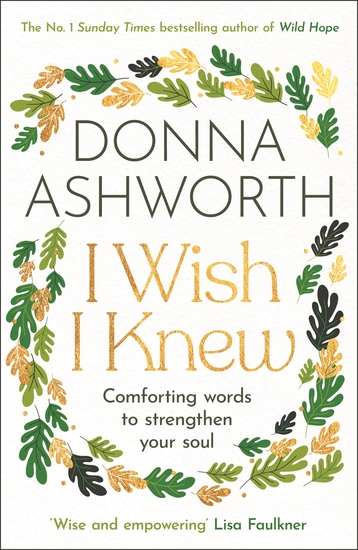
I Wish I Knew - Comforting words to strengthen your soul - cover

I Wish I Knew - Comforting words to strengthen your soul

Donna Bessant

Publisher: Mango Media

  • 0
  • 0
  • 0

Summary

Challenge negativity with these incredible poems about joy, transformation, and embracing your beautiful pathway from the bestselling author of Wild Hope.Change your life with words of wisdom. Feeling lost in life can be so easy to fall into, yet harder to escape. Instead of listening to self-doubt, discover how one-of-a-kind you are through Donna Ashworth’s life-changing book. I Wish I Knew is a poetry book full of mantras, reflections, and affirmations for women that will redefine the chaos in your life into life-changing revelations. With this poetry book, featuring hopeful truths that will strengthen your heart, mind, and soul, you’ll be able to experience your journey with meaning and gratitude.Life isn’t perfect, so why let perfectionism take over yours? Follow Donna Ashworth as she shines a light on her journey of taking chances instead of stagnating in expectations and hopelessness. Each poem explores the transformative lessons she discovered along the way, and how doubting your potential for happiness can stop you from finding yourself. Full of beautiful, compassionate poetry, this manual for life offers you methods to persevere through pressure and make the most out of the one-of-a-kind path you are on.There is something for everyone inside I Wish I Knew, such as:The healing power of accepting small winsThe rare moments of your inner strength that often go unnoticedThe simplicity that unveils what you’re looking forSo if you enjoyed poem books such as Call Us What You Carry, You Could Make This Place Beautiful, or Wild Hope, then you’ll love I Wish I Knew.
Available since: 04/16/2024.
Print length: 138 pages.

Other books that might interest you

  • Top 10 Poets The - Georgian - Five poems each from some of the best Georgian era poets - cover

    Top 10 Poets The - Georgian -...

    Wilfred Owen, A E Housman,...

    • 0
    • 0
    • 0
    The language of Poetry is an art that most of us attempt at some point in our lives.  Although its commonplace exposure has been somewhat marginalised in today’s often fast-paced lives we all recognise good verse that can empathise with our thoughts or open us up to experience new things in new ways, to better understand and to enjoy the many strands of our lives. 
    But finding a starting point can be overwhelming, even off-putting, so in this series we offer up our Top 10 classic poets, who brim with talent and verse, on a range of subjects and themes that we can all enjoy. 
    In this volume we explore the poets and poetry of that short poetry movement; The Georgians.  In a handful of years, they forged their careers and expressed themselves in ways that illuminate and discover both themselves and the world around them.
    Show book
  • Wild Life - cover

    Wild Life

    James McDermott

    • 0
    • 0
    • 0
    Wild Life by James McDermott explores the nature of queerness, the queerness of nature, and the queerness of 'natural' masculinity. In bold poems that root themselves firmly in the coastal landscapes of North Norfolk, a vivid and radical dialogue between nature, sexuality and self-discovery emerges. McDermott brings a lyrical physicality to poetry which focuses on the body, desire, shame, and tenderness, creation and re-creation, and where there is 'everything always opening / everything always coming out'. These poems skilfully graft and touch, draw parallels between moments of transformation in the many kinds of ecosystems we exist in – whether outside and between woodland, shoreline and skyline, where the wildlife will 'see me as just another animal', or in human interactions in schools, gyms, and pubs where ideas of manhood, self, and society's expectations collide. Like the coastal spaces where McDermott finds an innate connection, Wild Life identifies that which is fluid and constantly changing – and that nature itself isn't afraid of being colourful, excessive, too much.
    Show book
  • Sonnets For the Soul - 31 Inspiring Sonnets for Daily Christian Living Volume I - cover

    Sonnets For the Soul - 31...

    Christian Life Coaching Lta

    • 0
    • 0
    • 0
    Sonnets for the Soul. 
    Some people don't feel they've ever been loved or even feel that they are worthy of love. The Truth is, God loves you. You were chosen and His love is eternal and never ending. His love will fill and satisfy you until you become transformed by it. Sonnets for the Soul is a celebration of hope while encountering His grace through scripture. Sonnets for the Soul is God's love letter to your mind, heart, soul, and body. Enjoy your journey through the 31 sonnets and have your heart awakened to your Father's love for you. 
    ENDORSEMENT: 
    An inspiring devotional, contemplative but easy to read and helps you see yourself through God's eyes. - M. Hacker. 
    ABOUT THE AUTHOR: 
    LtA is a certified Christian Life Coach and Bible-study author. LtA teaches with a particular focus on purposeful living involving how to love and live on God's Word. LtA shares biblical truths with practical applications people can apply to their lives. God has provided LtA opportunities to minister to people and share the gospel in pragmatic ways through Christian Life Coaching by LtA.
    Show book
  • Butterfly & Bee - Volume Three of a Collection of Haikulisms - cover

    Butterfly & Bee - Volume Three...

    Ron Kule

    • 0
    • 0
    • 0
    Haiku poetry when composed by Ron Kule is known as "haikulism," a coined word from haiku + Kule (the poet's last name pronounced "cool"). Beginning in 2018, Kule shared with his Muse haikulisms inspired by her beauty and loyalty to their friendship. Butterfly & Bee is the complete collection to date (2021) - 165 expressions of the dynamics of love.
    Show book
  • Stormbound - cover

    Stormbound

    Irtika Kazi

    • 0
    • 0
    • 0
    n her first poetry chapbook, the poet talks about her growth as a writer, how she was encouraged, amidst uncertainty and fear, by time spent in different landscapes and by exposure to evolution, to the wide array of events that took place in congruence with art and writing. The poems in this chapbook are interwoven with diverse themes ranging from emotions to social concerns and slivers of mythology.
    Show book
  • Poetics - cover

    Poetics

    Aristotle

    • 0
    • 0
    • 0
    Aristotle's Poetics (Greek: Περὶ ποιητικῆς; Latin: De Poetica) is the earliest surviving work of dramatic theory and first extant philosophical treatise to focus on literary theory. In it, Aristotle offers an account of what he calls "poetry" (a term that derives from a classical Greek term, ποιητής, that means "poet; author; maker" and in this context includes verse drama – comedy, tragedy, and the satyr play – as well as lyric poetry and epic poetry). They are similar in the fact that they are all imitations but different in the three ways that Aristotle describes: Differences in music rhythm, harmony, meter and melody. Difference of goodness in the characters.Difference in how the narrative is presented: telling a story or acting it out. In examining its "first principles", Aristotle finds two: 1) imitation and 2) genres and other concepts by which that of truth is applied/revealed in the poesis. His analysis of tragedy constitutes the core of the discussion. Although Aristotle's Poetics is universally acknowledged in the Western critical tradition, "almost every detail about his seminal work has aroused divergent opinions". The work was lost to the Western world for a long time. It was available in the Middle Ages and early Renaissance only through a Latin translation of an Arabic version written by Averroes.Aristotle's work on aesthetics consists of the Poetics, Politics and Rhetoric. The Poetics is specifically concerned with drama. At some point, Aristotle's original work was divided in two, each "book" written on a separate roll of papyrus.
    Show book