Join us on a literary world trip!
Add this book to bookshelf
Grey
Write a new comment Default profile 50px
Grey
Subscribe to read the full book or read the first pages for free!
All characters reduced
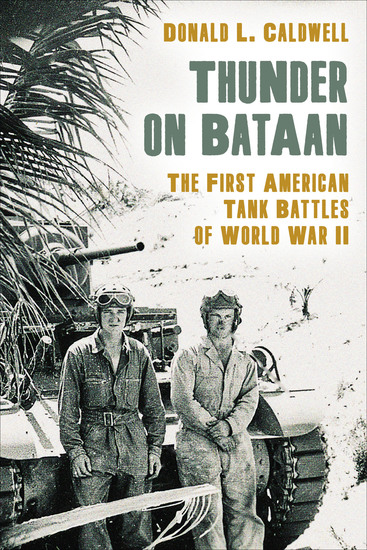
Thunder on Bataan - The First American Tank Battles of World War II - cover

Thunder on Bataan - The First American Tank Battles of World War II

Donald L Caldwell

Publisher: Stackpole Books

  • 0
  • 0
  • 0

Summary

“An incisive, readable account of a group of National Guard tankers who fought in the Philippines in the opening phase of America’s war in the Pacific.” —Robert S. Cameron, Ph.D., military historian and author of Mobility, Shock, and Firepower: The Emergence of the U.S. Army’s Armor Branch, 1917-1945   The American Provisional Tank Group had been in the Philippines only three weeks when the Japanese attacked the islands hours after the raid on Pearl Harbor. Sent north to meet the Japanese landings in Lingayen Gulf, the men of the PTG found themselves thrust into a critical role when the Philippine Army could not hold back the Japanese. When General MacArthur ordered the retreat to Bataan, the PTG proved itself indispensable. During early months of 1942, the light tanks of the PTG patrolled Bataan’s beaches, encircling and destroying Japanese penetrations and small amphibious landings. By April 1942, the situation had become untenable, and 15,000 Americans, along with 60,000 Filipinos, surrendered in one of the worst defeats in U.S. military history. The Provisional Tank Group ceased to exist, and its men endured the Bataan Death March, the torture and starvation of POW camps, the hell ships that took them to Japan and Manchuria for slave labor, and the Palawan massacre.  In an evocatively written book, Donald L. Caldwell reveals the largely ignored role of tanks in the Philippine campaign. Conducting impressive primary research to bring to life the combat history of the PTG, Caldwell has dug deeper to tell the stories of soldiers from each of the group’s six companies, recounting their service from enlistment, training, and combat to imprisonment, liberation, and return home.    “Remarkable . . . [A] well-told history . . . highly recommended.” —Jay A. Stout, LtCol (Ret), USMC, author of Air Apaches
Available since: 06/14/2023.
Print length: 321 pages.

Other books that might interest you

  • Fight for the Final Frontier - Irregular Warfare in Space - cover

    Fight for the Final Frontier -...

    John Jordan Klein

    • 0
    • 0
    • 0
    Fight for the Final Frontier uses the concepts associated with irregular warfare to offer new insights for understanding the nature of strategic competition in space. Today's most pressing security concerns are best considered using an irregular warfare lens because incidents and points of potential conflict fall outside the definition of armed conflict. While some universal rules of combat apply across all domains, conflict in space up-ends those assumed standards of understanding. 


    John Klein provides a solution to reckoning with the many malicious, nefarious, and irresponsible behaviors in the space domain by using the irregular warfare framework. This offers a new paradigm through which one can view and study conflict involving state and non-state actors. A "war" in space will be utterly unlike any that have happened on Earth, though scholars can provide lessons from past conflict to understand the flashpoints in the heavens. 


    Fight for the Final Frontier makes the case that irregular warfare in the space domain is shaped by the fundamental nature of all warfare, along with universal principles of strategy and the essential unity of all strategic experience. Klein outlines the new arenas for battle, new areas of conflict and competition, and the necessary concepts for operating in this bold new frontier.
    Show book
  • Foundational Existential Thinkers - Early Reflections on Freedom Existence and Meaning (2 in 1) - cover

    Foundational Existential...

    Hector Davidson

    • 0
    • 0
    • 0
    This book contains these titles: 
    Kierkegaard - Søren Kierkegaard, often regarded as the father of existentialism, was born on May 5, 1813, in Copenhagen, Denmark. His early life was marked by tragedy, as his mother died when he was just a child, and his father, a deeply religious man, instilled in him a sense of guilt and the weight of existential questioning. Kierkegaard’s relationship with his father deeply influenced his philosophical development, particularly in his exploration of faith, despair, and the individual's relationship with God. 
    Jean-Paul Sartre - Jean-Paul Sartre, a towering figure in 20th-century philosophy, is perhaps best known for his development of existentialism, a school of thought that emphasizes individual freedom, choice, and the creation of meaning in an otherwise indifferent universe. Sartre’s philosophy arises from the existentialist tradition but distinguishes itself through its rigorous approach to human freedom and responsibility. At the heart of Sartre's thought is the idea that human beings are condemned to be free, burdened with the constant task of making choices without any external justification or predetermined essence.
    Show book
  • Everybody Listen To The Constitution - cover

    Everybody Listen To The...

    The Founding Fathers

    • 0
    • 0
    • 0
    The Constitution of the United States is the supreme law of the United States of America. It superseded the Articles of Confederation, the nation's first constitution, in 1789. Originally comprising seven articles, it delineates the national frame of government. Its first three articles embody the doctrine of the separation of powers, whereby the federal government is divided into three branches: the legislative, consisting of the bicameral Congress (Article I); the executive, consisting of the president and subordinate officers (Article II); and the judicial, consisting of the Supreme Court and other federal courts (Article III). Article IV, Article V, and Article VI embody concepts of federalism, describing the rights and responsibilities of state governments, the states in relationship to the federal government, and the shared process of a constitutional amendment. Article VII establishes the procedure subsequently used by the 13 states to ratify it. It is regarded as the oldest written and codified national constitution in force. 
     
    Since the Constitution came into force in 1789, it has been amended 27 times, including one amendment that repealed a previous one, in order to meet the needs of a nation that has profoundly changed since the 18th century. In general, the first ten amendments, known collectively as the Bill of Rights, offer specific protections of individual liberty and justice and place restrictions on the powers of government within the U.S. states. The majority of the 17 later amendments expand individual civil rights protections. Others address issues related to federal authority or modify government processes and procedures. Amendments to the United States Constitution, unlike ones made to many constitutions worldwide, are appended to the document. The original U.S. Constitution was written on five pages of parchment.
    Show book
  • The Joy of Fish - cover

    The Joy of Fish

    Wang Dongyue, Translated by...

    • 0
    • 0
    • 0
    Do you know what truth or subsistence means to humanity? 
    What does wisdom or knowledge mean to humanity? 
    Do you really believe humanity has a choice for its future? 
    If you are unsure of the answers to these questions, the short essays in this book may give you a better idea. This book consists of thirty essays that talk about how civilized human beings think, believe, and behave toward truth, goodness, wisdom, and knowledge from different perspectives. These essays were written in a humorous style, allowing readers to easily get a glimpse of the author's philosophical ideas while avoiding difficult philosophical demonstrations.
    Show book
  • The Joyful Wisdom - cover

    The Joyful Wisdom

    Friedrich Nietzsche

    • 0
    • 0
    • 0
    What if laughter held more truth than solemnity? What if wisdom danced - light-footed, irreverent, and defiant - instead of cloaking itself in the heavy robes of tradition? 
    In The Joyful Wisdom (also known as La Gaya Scienza), Friedrich Nietzsche unveils a luminous and lyrical philosophy that challenges the deepest convictions of Western thought. Written during a moment of personal renewal, this daring work blends poetry, paradox, and razor-sharp insight into a celebration of life’s uncertainties—and the courage to embrace them. 
    Here, Nietzsche proclaims the death of God - not as despair, but as a liberation from dogma. He guides us through a labyrinth of aphorisms that question morality, truth, art, and the nature of existence itself. In the celebrated Book IV, "Sanctus Januarius," we find the seeds of eternal recurrence, a provocative vision of time and will that shaped existential and postmodern thought. The closing section, “Songs of Prince Vogelfrei,” offers poetic fragments that sing with ecstatic defiance. 
    Nietzsche’s legacy endures not only in philosophy but in literature, psychology, and cultural theory. His voice - bold, ironic, and unrelentingly modern -continues to speak to anyone seeking to break free from inherited beliefs and live with creative authenticity. 
    This immersive audiobook experience allows you to hear Nietzsche’s rhythmic prose and aphorisms in clear, intelligent narration powered by advanced AI -delivering both precision and nuance, perfectly suited to the musicality and complexity of the original text. 
    Step into the vibrant mind of one of history’s most original thinkers. Let The Joyful Wisdom unsettle, awaken, and inspire. 
    Buy now and begin your journey into a philosophy that dances on the edge of reason - with joy.
    Show book
  • A Rare Recording of President John F Kennedy’s 1961 Inaugural Address - cover

    A Rare Recording of President...

    President John Fitzgerald Kennedy

    • 0
    • 0
    • 0
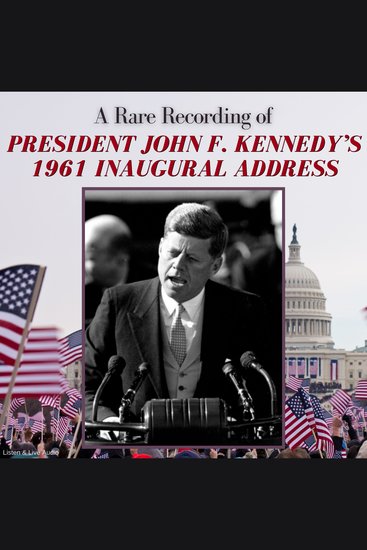
    President John Fitzgerald Kennedy (May 29, 1917 - November 22, 1963), often referred to by his initials JFK, was an American politician who served as the 35th president of the United States from 1961 until his assassination in 1963. He was the youngest person to assume the presidency by election and the youngest president at the end of his tenure. Kennedy served at the climax of the Cold War, and the majority of his foreign policy concerned relations with the Soviet Union and Cuba. A Democrat, Kennedy represented Massachusetts in both houses of the U.S. Congress prior to his presidency. The following recording is of his January 20, 1961, inaugural address.
    Show book