Join us on a literary world trip!
Add this book to bookshelf
Grey
Write a new comment Default profile 50px
Grey
Subscribe to read the full book or read the first pages for free!
All characters reduced
Maria and her Mom - cover

Maria and her Mom

Dinkleberry

Publisher: _Boruma Publishing, LLC

  • 0
  • 0
  • 0

Summary

Being a girl is awesome! As women, we’re allowed to display our emotions. We can express our feelings by joyously hugging our girlfriends. Spontaneously, we can kiss our best friend to show our happiness of being with them. When a daughter loves her mother completely, she can hug, kiss, and physically bond with her. Mother and daughter can display their love many ways. Yes, being a girl is awesome!
 
~~~~~  Excerpt  ~~~~~
 
“What’s up, Mom?” She turned toward me and smiled, showing her small white teeth.
 
It was another beautiful warm day. Being Wednesday, she had no classes today and I was off from work. A few months ago, I began to work a ‘flex-shift.’ Rather than five 8-hour days, I worked four 10-hour days, which allowed me to enjoy a midweek break. It was especially nice since this school semester Maria only had class on Tuesday and Thursday, allowing us to be together and alone.
 
“Are you fully comfortable with your body?” I asked my younger, better me.
 
Quizzened, she looked at me. She wondered, “Why do you ask?”
 
“I just want to make sure everything is alright with my Baby Girl,” I comforted. Baby Girl was a nickname I gave her when she was a little girl; and Maria refused to let me give up. Whereas other children outgrow their baby-name, Maria embraced hers and grew into becoming my Baby Girl. She got up from her deckchair. Taking the couple of steps needed, she came over me and sat on my lap. She wrapped an arm behind my neck and leaned her head against mine. With her cheek against mine, I couldn’t help but notice the sweet smell of her perspiration.
 
“What’s up Mom? What are you really thinking?” she sagely wondered.
 
I wrapped an arm around her petite hips and shifted her little butt so she sat on my thighs more comfortably. Merrily perched on her mom’s lap like a contented kitten, my Baby Girl snuggled up closer to me. I loved the fact Maria never outgrew being physically affectionate with her mom. As kids, her sister and brother learned to resent their mother giving them hugs and kisses. After a while, they began to fuss if I even reached over to adjust their clothes or fix their hair. Yet Maria continued to enjoy getting a hug or kiss from her mom, even in front of her friends! She would even sometimes lovingly demand, “Where’s my hug and kiss?”
 
Girlfriends, we loved doing all the girlie stuff together. We often did each other’s hair and nails. I knew she enjoyed “putting on her mom’s face,” and since she did a better job than I could, I always appreciated when she did my makeup. When she did her mom’s hair, I sat there and indulged enjoying her attentions. Her hair was so similar to my own that when I brushed out her long, soft mane I found it as soothing as if brushing my own.
 
“I was just thinking about when I was young and when I… umm… umm, when I developed. I know it’s hard to believe I was once your age…” I joked.
 
“Oh, give me a break,” Maria interrupted and rolled her eyes. “If people didn’t know, they’d think you were my sister before Mercy. Are you fishing for a compliment? You know you’re too young to be a cougar and too hot to be a MILF. So, there,” and the impetuous brat blew me a raspberry. I laughed at Baby Girl sticking her tongue out at her mom; and tried to refocus my thoughts away from it.
Available since: 01/11/2023.
Print length: 44 pages.

Other books that might interest you

  • Living without Psychology - A Journey Through Self-Interest & the Beginning of Co-operation - cover

    Living without Psychology - A...

    Shareef Mokdad

    • 0
    • 0
    • 0
    Career, love, security, family, country, social cause, reform, revolution, ideology, entertainment, self-reinvention, pursuit of the unknown. Have you ever noticed how these things shape the years and decades not only of our own lives but of humanity, right through old age, regardless of demographic, cultural, and professional differences? Have you ever noticed how all of us - the living, the ancestors and posterity - tread the exact same path across time, from generation to generation, century to century, without ever getting past that one common denominator: our own self-interest? And, what kind of society have we built around our self-interests? Not only are we not profoundly better people but we have also destroyed each other and the world.  
    Long with me, dear friend, to go beyond our self-centered psychological needs, including righteous ones as self-awareness and self-actualization, and to tap into what undoubtedly is the calling of our time: co-operation. At this critical juncture in human history, let us find out what it takes to bring about a level of co-operation unknown to humanity - in allfields including relationship, academia, diet, and environmental change - without which the world stands no chance. 
    This is not a spiritual self-help book but an invitation to free oneself from psychology, in all its traditional and modern forms, so that a new world is built right in the heart of our highly destructive society. 


    Show book
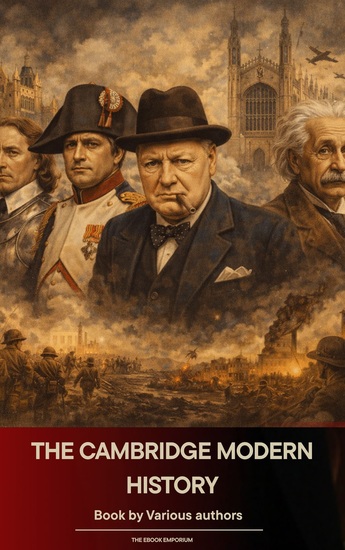
  • The Cambridge Modern History - cover

    The Cambridge Modern History

    J.B. Bury, R. Nisbet Bain,...

    • 0
    • 0
    • 0
    How did the modern world take shape?
    
    The Cambridge Modern History is one of the most ambitious and respected historical projects ever produced. Written by leading scholars and historians, this landmark work offers a comprehensive account of global history from the late medieval period through the early twentieth century.
    
    Covering politics, religion, economics, diplomacy, intellectual movements, and social change, the series presents history not as isolated events, but as interconnected forces shaping nations and civilizations. Its balanced, analytical approach made it a cornerstone of modern historical scholarship and a trusted reference for generations.
    
    This Kindle edition brings together this monumental work in a clear, accessible format, ideal for study, research, or deep reading.
    
    Inside this eBook, you'll explore:
    
    A comprehensive scholarly history of the modern era
    
    Contributions from distinguished historians and academics
    
    Global perspectives on political, social, and intellectual change
    
    A foundational reference work in historical studies
    
    Long regarded as a classic of historical scholarship, The Cambridge Modern History remains essential reading for anyone seeking a serious understanding of how the modern world emerged.
    
    Study the past with clarity and depth. Buy now and explore one of the great achievements of historical writing.
    Show book
  • Quit Everything - Interpreting Depression - cover

    Quit Everything - Interpreting...

    Franco Bifo Berardi

    • 0
    • 0
    • 0
    Analyzes the current wave of depression, or "desertion," that is causing more and more people to abandon hope and desire in a world where social, political, and environment collapse seems inevitable. 


    Depression is rife amongst young people the world over. But what if this isn't depression as we know it, but instead a reaction to the chaos and collapse of a seemingly unchangeable and unlivable future? 


    In Quit Everything, Franco Berardi argues that this "depression" is actually conscious or unconscious withdrawal of psychological energy and a dis-investment of desire that he defines instead as "desertion." A desertion from political participation, from the daily grind of capitalism, from the brutal reality of climate collapse, and from a society which offers nothing but chaos and pain. 


    Berardi analyzes why this desertion is on the rise and why more people are quitting everything in our age of political impotence and the rise of the far-right, asking if we can find some political hope in desertion amongst the ruins of a world on the brink of collapse.
    Show book
  • Lao-tse TAO TE KING - The Book of Tao and Spiritual Force - cover

    Lao-tse TAO TE KING - The Book...

    Zensho W. Kopp

    • 0
    • 0
    • 0
    The 2500 year old Tao Te King by the Chinese sage Lao-Tse is a jewel of Eastern wisdom. It is counted among the most profound and most translated books of world literature. In deep, mystical language of incomparable imagery, the Tao Te King speaks of the Tao, the divine origin of all existence, and its spiritual force within us. Its intention is to lead us back to the original oneness with the Tao, and so into harmony with the all-embracing wholeness of existence. In this outstanding new transcription, Zen Master Zensho has wonderfully succeeded in portraying the entire mystical expressive force of this work whilst strictly adhering to the original sense, and thus opening up a completely new, profounder dimension. A timeless book of unique mystical fullness and linguistic beauty.
    Show book
  • Our Tortured Souls - The 29th Infantry Division in the Rhineland November–December 1944 - cover

    Our Tortured Souls - The 29th...

    Joseph Balkoski

    • 0
    • 0
    • 0
    The acclaimed WWII historian continues his in-depth chronicle of the 29th Infantry Division as it made its brutal push into Germany. By November of 1944, the U.S. 29th Infantry Division had stormed Omaha Beach on D-Day and embarked on an epic and arduous path toward Allied victory. In Our Tortured Souls, acclaimed military historian Joseph Balkoski picks up the story of the 29th on the eve of the all-out offensive intended to carry the Allies to the Rhine River by Christmas and end the war soon afterward.  The plan for the 29th seemed simple enough. As part of General William Simpson’s Ninth Army, the division was to drive ten miles eastward, breaking through several German strongpoints, crossing the Roer, and seizing Jülich, beyond which lay the Rhine and Germany’s heartland.   The offensive encountered problems from the very beginning, on November 16th, when it took days to crack the German’s first line of defense. By the time the offensive was halted on the banks of the Roer three weeks later, the 29th Infantry Division had suffered 2,600 casualties and fallen short of its objectives. Balkoski reconstructs this tragic chapter in the division’s history with his trademark combination of meticulous research and vivid st
    Show book
  • Plantagenet Princesses - The Daughters of Eleanor of Aquitaine and Henry II - cover

    Plantagenet Princesses - The...

    Douglas Boyd

    • 0
    • 0
    • 0
    A unique look at the lives of two daughters that highlights the dichotomy of lives of royal women, as both daughters and mothers of kings, who also knew both prison and power. 


    The names of few medieval monarchs and their queens are better known than Eleanor of Aquitaine, uniquely queen of France and queen of England, and her second husband Henry II. Although academically labeled "medieval," their era was the violent transition from the Dark Ages, when countries' borders were defined with fire and sword. If princes fought for their succession to crowns, the princesses were traded—usually by their mothers—to strangers for political power without the bloodshed. Years before what would today be marriageable age, royal girls were dispatched to countries whose speech was unknown to them and there became the property of unknown men. Eleanor's daughters Marie and Alix were abandoned in Paris when she divorced Louis VII of France. By Henry II, she bore Matilda, Aliénor, and Joanna. Joanna was imprisoned by William II of Sicily and worse treated by her brutal second husband in Toulouse. If Eleanor was libeled as a whore, Aliénor's descendants include two saints, Louis of France and Fernando of Spain. And then there were the illegitimate daughters, whose lives read like novels . . .
    Show book