Join us on a literary world trip!
Add this book to bookshelf
Grey
Write a new comment Default profile 50px
Grey
Subscribe to read the full book or read the first pages for free!
All characters reduced
Malayland - cover

Malayland

Dina Zaman

Publisher: Ethos Books x Faction Press

  • 0
  • 0
  • 0

Summary

What does it mean to be Malay in the 21st century? Especially in a country like Malaysia where identity politics is questioned on an almost daily basis, and policed by the state. 16 years later after the publication of I Am Muslim, Dina Zaman returns to write a memoir, writing about what it means to be Malay, and Muslim in the 21st century.  
 
The writer embarked on Malayland during the Covid pandemic, to understand the anger and frustrations of her fellow ethnic Malays who were fighting against (imagined) enemies and a new world order impacted by a virus that killed over seven million people globally. She grew up in a Malaysia that was seething with anger, bubbling underneath the many nightclubs Malaysia was famed for in the 1980s, that witnessed how secularism killed its Malay Muslim heritage. The 1998 Reformasi movement changed Malaysia and whether for the better, is left up to Malaysians to decide.  
 
Today race and faith are discussed and embraced frenetically, where hateful extremism is hidden under the guise of nationalism. Young Malaysians are asserting their political and birth identities through social media. And along the way, the sense of irony and humour that Malaysia is known for, has lost its way. Malayland is a reflective book: memories and flashbacks of a childhood filled with earthquakes, spooks and a sense of wonderment and curiosity about a country that is fighting for a desired identity.
Available since: 11/01/2024.
Print length: 176 pages.


Other books that might interest you

  • Yuan Dynasty - Mongol Rule and the Blending of Cultures - cover

    Yuan Dynasty - Mongol Rule and...

    Rolf Hedger

    • 0
    • 0
    • 0
    The Yuan Dynasty emerged from the ambitions of Kublai Khan, the grandson of Genghis Khan, who sought to consolidate Mongol rule over China. Before the establishment of the Yuan, the Mongols had waged a relentless military campaign against the Song Dynasty, the ruling power in southern China. After decades of conflict, Kublai Khan successfully defeated the Song in 1279, marking the first time in history that all of China was under foreign rule. His ascension to the throne not only signified the dominance of the Mongols but also introduced a new era of governance that blended Mongol traditions with Chinese administration. 
    Kublai Khan declared himself emperor in 1271 and named his dynasty "Yuan," meaning "Great Origin," a term rooted in Chinese philosophy and symbolic of the vast scope of Mongol rule. Unlike his predecessors, who maintained a nomadic lifestyle, Kublai recognized the necessity of adopting Chinese customs to effectively govern a vast and diverse population. He moved the capital from Karakorum to Dadu, present-day Beijing, reinforcing his commitment to ruling as a Chinese emperor while still maintaining Mongol authority. His reign sought to balance the military-driven expansion of his ancestors with the complexities of ruling a settled, bureaucratic society. 
    Despite his efforts to integrate into Chinese political traditions, Kublai faced challenges in legitimizing his rule. Many Han Chinese viewed the Mongols as outsiders and resisted their authority. To solidify his claim, Kublai adopted Confucian principles and retained elements of the Chinese imperial structure, appointing Chinese officials in lower government positions while keeping key positions reserved for Mongols and trusted foreign allies. This approach ensured Mongol dominance while utilizing the administrative expertise of the Chinese.
    Show book
  • The War in the Air - How Aerial Combat Changed Warfare Forever - cover

    The War in the Air - How Aerial...

    Sage Winters

    • 0
    • 0
    • 0
    The early 20th century marked a transformative period in military history, where the introduction of flight reshaped the very nature of warfare. Prior to this, battles were fought on the ground and at sea, with strategy revolving around infantry, artillery, and naval power. However, as aviation technology advanced rapidly, it presented military commanders with new opportunities and challenges that would forever alter how conflicts were conducted. 
      
    At the outset of World War I, the concept of aerial combat was in its infancy. Airplanes were initially seen as reconnaissance tools, providing vital intelligence for ground forces. Yet, it didn’t take long for the potential of aircraft to be realized in more aggressive terms. Pioneers such as the Wright brothers had already demonstrated the possibilities of flight, but the practical application of aircraft in combat was a game-changer. The skies above the battlefield soon became a new front, and aviation quickly proved indispensable in both strategic and tactical operations. 
      
    The early airmen of World War I were explorers of a new domain, and their role would evolve from mere observers to active participants in combat. The introduction of fighter aircraft, along with advancements in technology like the machine gun, turned the skies into a dangerous and dynamic environment. Aerial dogfights became iconic moments of the war, and the stakes of air superiority were made clear. As aircraft became faster, more maneuverable, and capable of carrying greater payloads, they not only impacted the outcome of individual battles but also began to influence the strategic decisions of entire nations.
    Show book
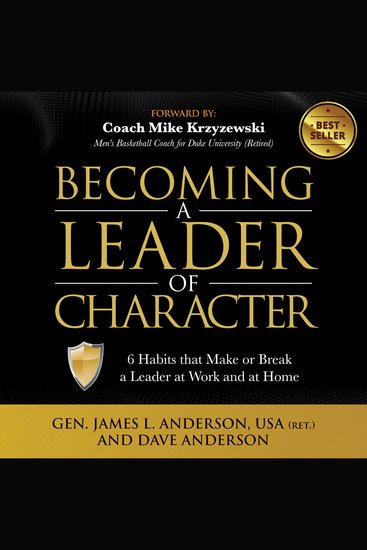
  • Becoming a Leader of Character - Six Habits that Make or Break a Leader at Work and at Home - cover

    Becoming a Leader of Character -...

    USA (Ret.) General James L...

    • 0
    • 0
    • 0
    We have to stop treating a pneumonia patient with cough syrup! The majority of leadership books focus on treating the symptoms of poor leadership and not the disease itself. In leadership the symptoms may be low employee engagement, bad communication, lack of trust, and micromanagement, but the underlying disease relates to CHARACTER. 
    Our data proves that people want to follow character. 
    Ask yourself, "Would you follow you?"  
    Unlike other books, Becoming a Leader of Character simply and boldly tells us HOW to develop our character instead of just telling us we need to have it. Developing character is not complicated, but it is hard. Growing always requires a little sweat! 
    "You have to DO what you want to BE!" 
    If you want something more than theories, and you want to BE the Leader of Character your business, your family, and your country desperately need, read Becoming a Leader of Character and start doing what Leaders of Character DO. 
    This book lays out a plan for you to become that leader you would want to follow - a Leader of Character.
    Show book
  • Legal Plunder - The Predatory Dimensions of Criminal Justice - cover

    Legal Plunder - The Predatory...

    Joshua Page, Joe Soss

    • 0
    • 0
    • 0
    A searing, historically rich account of how US policing and punishment have been retrofitted over the last four decades to extract public and private revenues from America’s poorest and most vulnerable communities.
     
    Alongside the rise of mass incarceration, a second profound and equally disturbing development has transpired. Since the 1980s, US policing and punishment have been remade into tools for stripping resources from the nation’s most oppressed communities and turning them into public and private revenues. Legal Plunder analyzes this development’s origins, operations, consequences, and the political struggles that it has created.
     
    Drawing on historical and contemporary evidence, including original ethnographic research, Joshua Page and Joe Soss examine the predatory dimensions of criminal legal governance to show how practices that criminalize, police, and punish have been retrofitted to siphon resources from subordinated groups, subsidize governments, and generate corporate profits. As tax burdens have declined for the affluent, this financial extraction—now a core function of the country’s sprawling criminal legal apparatus—further compounds race, class, and gender inequalities and injustices. Legal Plunder shows that we can no longer afford to overlook legal plunder or the efforts to dismantle it.
    Show book
  • A Secure Love - What Really Makes Love Work - cover

    A Secure Love - What Really...

    Love Guru

    • 0
    • 0
    • 0
    This audiobook is narrated by an AI Voice.   
    Real love isn’t found — it’s built. 
    A Secure Love: What Really Makes Love Work reveals what healthy, lasting connection looks and feels like, based on modern attachment science and emotional intelligence. 
    In under ninety minutes, you’ll learn how to: 
    • Identify your attachment style and understand your partner’s needs. 
    • Communicate without defensiveness or withdrawal. 
    • Build emotional safety that keeps passion alive over time. 
    • Repair conflict fast and grow stronger after arguments. 
    • Create trust, intimacy, and teamwork that last a lifetime. 
    This audiobook blends relationship psychology, practical scripts, and honest stories to help you experience love that’s calm, safe, and deeply connected — not chaotic or uncertain. 
    Perfect for couples, singles, and anyone ready to understand what real security feels like in love.
    Show book
  • Heartbreak - Healing a Broken Heart After a Breakup - cover

    Heartbreak - Healing a Broken...

    Cammy Dawson

    • 0
    • 0
    • 0
    The best advice I can give you about what to do after you feel dumped. 
    I think a lot of people have had their fair share of breakups. There are only a few individuals here and there who have had only one or zero relationships. Each time it is over, it hits us like a ton of bricks. What happens in our minds after a breakup? What should we do? What are the best ways to get your life on track and to eliminate feelings of misery and pain? In this book, you will find answers. Topics like the following will be addressed:The stages of mourning over the loss of a loved one you lostCoping strategies and small tips to grow and overcome feelings of despair or heartacheSeven proven steps to heal your broken heart, elaborately explainedHow to get rid of old memories and instantly create new onesSeveral ways you can find support amongst friends, family, and professionalsImportant lessons we can all learn from having a broken heartAnd much more! 
    Curious yet? Then don't wait and start listening so you don't have to remain in the dark. Save yourself the misery of common mistakes and learn from what I have learned. I will see you in the first chapter!
    Show book