Join us on a literary world trip!
Add this book to bookshelf
Grey
Write a new comment Default profile 50px
Grey
Subscribe to read the full book or read the first pages for free!
All characters reduced
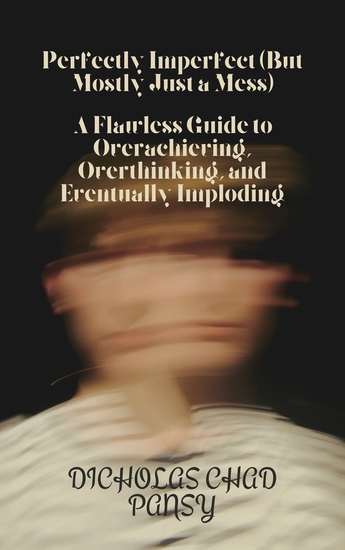
Perfectly Imperfect - A Flawless Guide to Overachieving Overthinking and Eventually Imploding - cover

Perfectly Imperfect - A Flawless Guide to Overachieving Overthinking and Eventually Imploding

Dicholas Chad Pansy

Publisher: Ruin Your Life Now

  • 0
  • 0
  • 0

Summary

🚨 ATTENTION PERFECTIONISTS: If you’ve ever rewritten an email 14 times, physically cringed at a typo, or spent an hour debating whether to sign off with "Best" or "Sincerely"—this book is your personal attack.
 
Do you spend an obscene amount of time making sure every minor detail of your life is flawless, only to burn out like an overheated laptop from 2006? Do you find yourself rewriting text messages to ensure they sound casual, yet professional, yet witty, yet effortless, yet not like you're trying too hard, but also not like you don’t care?
 
CONGRATULATIONS! 🎉 You’re a perfectionist. And it’s ruining your life.
 
In this hilariously unhinged survival guide, we’ll explore:✅ The Art of Overthinking Everything – Why make a simple decision when you could spiral into existential dread?✅ Procrastination: The Perfectionist’s Favorite Coping Mechanism – If you never start, you never fail! Genius!✅ How to Do Everything at 110% Until You Emotionally Collapse – Sleep is for the weak.✅ Lowering Your Standards: An Incredibly Painful but Necessary Life Skill – Your 80% effort is still better than Todd’s 20%, and he got promoted.
 
By the end of this book, you won’t be cured of perfectionism (LOL, good luck with that), but you will at least understand why your brain is a flaming disaster.
 
📢 WARNING: This book contains aggressive sarcasm, brutal self-awareness, and zero practical advice on how to actually fix yourself. (Because let’s be honest, you’d just overthink it anyway.)
Available since: 04/03/2025.
Print length: 62 pages.
Other books that might interest you

  • Pepper - A History of the World's Most Influential Spice - cover

    Pepper - A History of the...

    Marjorie Shaffer

    • 0
    • 0
    • 0
    “This is more than the story of a spice . . . Get ready for a sweeping ride through history.” ―David Oshinsky, Pulitzer Prize–winning authorThe perfect companion to Mark Kurlansky's Salt: A World History, Pepper illuminates the rich history of pepper for a popular audience. Vivid and entertaining, it describes the part pepper played in bringing the Europeans, and later the Americans, to Asia and details the fascinating encounters they had there. As Mark Pendergrast, author of Uncommon Grounds, said, “After reading Marjorie Shaffer's Pepper, you'll reconsider the significance of that grinder or shaker on your dining room table. The pursuit of this wizened berry with the bite changed history in ways you've never dreamed, involving extraordinary voyages, international trade, exotic locales, exploitation, brutality, disease, extinctions, and rebellions, and featuring a set of remarkable characters.”From the abundance of wildlife on the islands of the Indian Ocean, which the Europeans used as stepping stones to India and the East Indies, to colorful accounts of the sultan of Banda Aceh entertaining his European visitors with great banquets and elephant fights, this fascinating book reveals the often surprising story behind one of mankind's most common spices.“Using first-person accounts from journals and ships' logs, Shaffer crafts a textured story of exploration, danger, wealth and greed. Readers will find adventures on the high seas, pirates, ambitious Jesuits, sultans living in opulence and the plunder of what was once considered a ‘Garden of Eden’ . . . A vividly told story of a common spice’s uncommon history.” —Kirkus Reviews“A delightful history of the Indian Ocean and the South Seas.” ―Robert D. Kaplan, New York Times–bestselling author
    Show book
  • Animal Crossing - cover

    Animal Crossing

    Kelsey Lewin

    • 0
    • 0
    • 0
    Before the world of Animal Crossing became a pandemic lifeline for millions, the "social sim" communication game Dо̄butsu no Mori, or "Animal Forest," debuted in 2001 on Nintendo 64 in Japan, then once again in 2002 on GameCube to critical and commercial success all over the world. 


    An open-ended casual game ahead of its time, Animal Crossing set the stage for the series's many incarnations to come with its focus on building community and friendship, its in-game currency of Bells, and its village of Animalese-speaking friends like Tom Nook, K. K. Slider, and the mean Mr. Resetti. You could visit the villages of your friends and give them gifts—all without being connected to the internet. 


    Video game preservationist and historian Kelsey Lewin tells the story of how a mundane-sounding game full of bug-catching, letter-writing, and furniture-collecting became one of Nintendo's best-loved franchises, with Animal Crossing: New Horizons eclipsing Super Mario Bros. for all-time sales in Japan, unlocking gaming's massive potential to tap into our desire to plant trees, find friends, and make the world a better place.
    Show book
  • The Chemical History of A Candle - cover

    The Chemical History of A Candle

    Michael Faraday

    • 0
    • 0
    • 0
    The Chemical History of a Candle is a series of 6 lectures on chemistry presented to a juvenile audience in 1848. Taught by Michael Faraday - a chemist and physist, and regarded as the best experimentalist in the history of science - it is probably the most famous of the Christmas Lectures of the Royal Society. Taking the everyday burning of a candle as a starting point, Faraday spans the arc from combustion and its products, via the components of water and air (oxygen, hydrogen, nitrogen, carbon), back to the type of combustion that happens in the human body when we breathe. The final lecture "On Platinum" describes a then new method to produce large quantities of Platinum. It was delivered before the Royal Institution on February 22, 1861. (Summary by Availle.)
    Show book
  • Natural Processes in Textile Art - From Rust Dyeing to Found Objects - cover

    Natural Processes in Textile Art...

    Alice Fox

    • 0
    • 0
    • 0
    More and more textile artists are using natural processes in their work, from dyeing with rust to working with found and scavenged items, and this book is the first to bring these increasingly popular techniques together. It promotes a way of working creatively with what is close at hand, whether gathered on walks by the seashore or collected in your garden, and working in tune with natural processes, bringing the rhythms and unpredictability of nature into your work.
    Examples of this type of working include rust dyeing embroidered fabric to give it a natural patina, dyeing with garden fruits or seaweed, weaving with pieces of beachcombed fibre and printing with found objects. In all of this work nature is directly harnessed to make its mark.
    The book is illustrated with the finest examples of contemporary embroidery and textile-art work using nature, by artists whose practice is tied up with their experience of and respect for the natural environment, often capturing a very strong sense of place and a feeling of calmness and contemplation.
    Show book
  • How to Fail at Documentary Filmmaking - cover

    How to Fail at Documentary...

    Vickie Morgan

    • 0
    • 0
    • 0
    If you're a fan of Alan Doyle, you'll love and appreciate most of the stories in this book as it serves as the backdrop for a tv series that was never meant to be. Vickie Morgan had been making films and public access tv shows for years when a broadcaster trying to spend their sports budget waltzes into St. John's, Newfoundland during the pandemic (properly masked over Zoom calls of course) and offers Vickie the gig of a lifetime. 
    How to Fail at Documentary Filmmaking is a hilarious and poignant story that will give you the courage and compassion necessary to understand the problem probably isn't you.  
    "Wow, Vickie’s determination has to be admired. She'll mow her own path, she's a trooper." 
    ~ Tina Maddigan, author of Written in Stone 
    "How To Fail At Documentary Filmmaking: a novelization of the unfinished docu-series adapted from an idea for a book based on true events." ~ Josh Morgan, lives with Vickie, read the book four times
    Show book
  • Art Collecting - Buying Investing Evaluating and Dealing in Fine Art and Contemporary Art - cover

    Art Collecting - Buying...

    Jace Benett

    • 0
    • 0
    • 0
    Art has the remarkable ability to capture the essence of human creativity, emotions, and culture. For centuries, it has served as a mirror reflecting our society's ever-evolving thoughts, passions, and perspectives. From the timeless masterpieces of the Renaissance to the cutting-edge innovations of contemporary artists, art continues to inspire, provoke, and move us in profound ways. 
    Art collecting, an age-old practice that has transcended generations, allows individuals to become custodians of these profound expressions of human imagination. Whether you're an aspiring art enthusiast, a seasoned collector, or someone who's simply curious about the world of art, this book is your gateway to the captivating universe of art collecting. 
    At its core, art collecting is a deeply personal endeavor. It's about more than just acquiring pieces of artwork; it's a journey of exploration, self-expression, and appreciation. But why do people collect art? The motivations are as diverse as the art itself. Some collect for the sheer joy of surrounding themselves with beauty, while others see it as an investment opportunity. Art can be a reflection of one's identity or a means of connecting with different cultures and histories. In this book, we'll delve into the myriad reasons why individuals choose to embark on this enriching path. 
    Understanding the art market is a crucial aspect of art collecting. Over time, this market has evolved from a relatively exclusive sphere to a global industry with immense economic significance. We'll explore the historical trajectory of the art market, examining the key milestones and shifts that have shaped it.
    Show book