Join us on a literary world trip!
Add this book to bookshelf
Grey
Write a new comment Default profile 50px
Grey
Subscribe to read the full book or read the first pages for free!
All characters reduced
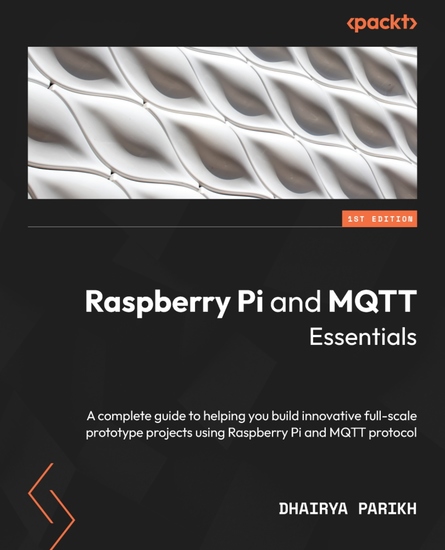
Raspberry Pi and MQTT Essentials - A complete guide to helping you build innovative full-scale prototype projects using Raspberry Pi and MQTT protocol - cover

Raspberry Pi and MQTT Essentials - A complete guide to helping you build innovative full-scale prototype projects using Raspberry Pi and MQTT protocol

Dhairya Parikh

Publisher: Packt Publishing

  • 0
  • 0
  • 0

Summary

The future of IoT has the potential to be limitless. Wouldn’t it be great if you could add it to your own technological stacks? But where to start? With the basics, of course.
In this book, you will start by learning about the most popular hardware and communication protocol, Raspberry Pi and MQTT. You will see how to use them together by setting up your own MQTT server on Raspberry Pi and understand how it works.
This book explores MQTT in detail, including the clients and devices that you can connect to your server. You will discover two very popular IoT development boards among project developers: the ESP8266 and ESP32 development boards. Then, you will learn how to build interactive dashboards on your Pi and monitor your client devices. The book also shows you how to build a dashboard using another popular software – Node-RED. You will be able to put your skills to the test by creating two full-scale projects. That’s not all: you will also learn how to host your own MQTT server on a virtual cloud service. Finally, you will be guided on how to move forward from here, what technologies to learn, and some project recommendations to polish or test your knowledge.
By the end of this book, you will be able to build meaningful projects using Raspberry Pi and MQTT and create dashboards for your projects on Node-RED.
Available since: 09/16/2022.
Print length: 272 pages.

Other books that might interest you

  • Ecological Science - The Study of Ecosystems and the Balance of Nature (2 in 1) - cover

    Ecological Science - The Study...

    Jeron Iris

    • 0
    • 0
    • 0
    This book contains two titles, which are: 
    Ecology - Ecology is the branch of biology that deals with the relationships between living organisms and their interactions with their environment. This scientific discipline explores how organisms coexist within ecosystems, interact with one another, and adapt to their surroundings. The study of ecology is vital because it provides insight into the functioning of natural systems and the impact human activities have on the environment. It emphasizes the interdependence of all life forms, from microscopic bacteria to the largest animals, and underscores the intricate balance necessary for sustaining life on Earth. At its core, ecology is concerned with understanding the distribution and abundance of organisms, as well as the processes that shape these patterns. It is a multidisciplinary field that draws from biology, geography, geology, chemistry, and physics. 
    Environmental Science - Environmental Science is an interdisciplinary field that integrates various scientific disciplines to study the natural world and the impact of human activities on it. This branch of science explores the complex interactions between living organisms, their physical surroundings, and the broader ecosystems they form. The primary goal of environmental science is to understand how natural systems function, identify environmental problems, and develop strategies for addressing these issues. At its core, environmental science seeks to answer fundamental questions about the earth's resources, how they are used, and how human actions influence the balance of ecosystems. It draws from biology, chemistry, physics, geology, and social sciences to provide a comprehensive understanding of the environment.
    Show book
  • Fundamentals of Quantum Mechanics - Basic Principles and Concepts - cover

    Fundamentals of Quantum...

    Mark Hedges

    • 0
    • 0
    • 0
    Quantum mechanics is a fundamental branch of physics that describes the behavior of matter and energy at the smallest scales, such as atoms and subatomic particles. Unlike classical mechanics, which governs macroscopic objects, quantum mechanics introduces concepts that challenge our everyday intuition, including wave-particle duality, superposition, and uncertainty. These principles form the foundation of modern physics and have led to numerous technological advancements, including semiconductors, lasers, and quantum computing. 
    The origins of quantum mechanics can be traced back to the early 20th century when classical physics failed to explain certain experimental observations. One of the earliest challenges was black-body radiation, which classical theories could not accurately describe. Max Planck introduced the idea of quantized energy levels, proposing that energy is emitted and absorbed in discrete packets called "quanta." This marked the birth of quantum theory. Soon after, Albert Einstein extended this idea by explaining the photoelectric effect, demonstrating that light itself behaves as both a particle and a wave. This dual nature of light and matter became one of the defining principles of quantum mechanics.
    Show book
  • Mastering Complexity - A Comprehensive Guide to Big O Complexity and DSA Problem Solving - cover

    Mastering Complexity - A...

    DSA Shots

    • 0
    • 0
    • 0
    Are you ready to unlock the secrets of complexity theory and become a master problem solver? Look no further than "Mastering Complexity"! This comprehensive guide covers everything you need to know about Big O complexity and how to solve difficult algorithms and data structures (DSA) problems. With detailed explanations, practical examples, and interactive exercises, you'll be able to tackle even the toughest challenges in no time. 
    In this book, we'll start by delving into the basics of Big O complexity and how it impacts problem solving. You'll learn about the different types of complexity measures, such as time, space, and probability, and how to analyze them in a systematic way. We'll then dive into the various data structures and algorithms commonly used in DSA problems, including arrays, linked lists, trees, graphs, and more. 
    But "Mastering Complexity" is more than just a dry reference guide. We'll also provide practical tips and tricks for solving DSA problems, as well as real-world examples to illustrate how these concepts are used in industry. By the end of the book, you'll be able to approach any problem with confidence, knowing that you have the tools and techniques necessary to solve it. 
    Whether you're a student looking to improve your understanding of algorithms and data structures or a professional looking to enhance your problem-solving skills, "Mastering Complexity" is the perfect resource for you. So why wait? Dive in and start mastering complexity today!
    Show book
  • The Catalyst - RNA and the Quest to Unlock Life's Deepest Secrets - cover

    The Catalyst - RNA and the Quest...

    Thomas R. Cech

    • 0
    • 0
    • 0
    For over half a century, DNA has dominated science and the popular imagination as the "secret of life." But over the last several decades, a quiet revolution has taken place. In a series of breathtaking discoveries, the biochemist Thomas R. Cech and a diverse cast of brilliant scientists have revealed that RNA—long overlooked as the passive servant of DNA—sits at the center of biology's greatest mysteries: How did life begin? What makes us human? Why do we get sick and grow old? In The Catalyst, Cech finally brings together years of research to demonstrate that RNA is the true key to understanding life on Earth, from its very origins to our future in the twenty-first century. 


    A gripping journey of discovery, The Catalyst moves from the early experiments that first hinted at RNA's spectacular powers, to Cech's own paradigm-shifting finding that it can catalyze cellular reactions, to the cutting-edge biotechnologies poised to reshape our health. We learn how RNA may have jump-started life itself, and how, at the same time, it can cut our individual lives short through viral diseases and cancer. We see how RNA is implicated in the aging process and explore the darker depths of the supposed fountain of youth, telomerase. And we catch a thrilling glimpse into how RNA-powered therapies may enable us to improve and even extend life beyond nature's current limits.
    Show book
  • Ocean Waves - Calming Sound Of The Sea (XXL) - Nature Sounds for Relaxation Meditation and Deep Sleep - cover

    Ocean Waves - Calming Sound Of...

    Calming Nature Sounds

    • 0
    • 0
    • 0
    The sound of the ocean: A hammock for the soul. Ocean sounds (without music) for relaxation of both body and mind. 
     
    With this XXL audiobook, experience the ocean like on a starry holiday night. The sound of the ocean - with 480 minutes of ocean sounds, recorded in the bay of Cala Pi (Mallorca), with state-of-the-art recording technology. Gentle to powerful ocean sounds, perfect for use in wellness and meditation, for radio/film/television, or soft background noise. 
     
    Listening to this recording instantly ensures considerable inner peace and can also have a very helpful effect on tinnitus. The feeling of endlessness and the power of the waves have always fascinated mankind. Immerse yourself in a world of limitless relaxation.
    Show book
  • Dynamic Systems Development Method - Comprehensive Guide to Agile Project Success - cover

    Dynamic Systems Development...

    Daniel Green

    • 0
    • 0
    • 0
    "Dynamic Systems Development Method: Comprehensive Guide to Agile Project Success" is the essential guide for project managers, software developers, and IT professionals seeking to implement or enhance their understanding of the Dynamic Systems Development Method (DSDM). This comprehensive book offers a deep dive into the DSDM framework, an agile project delivery framework that emphasizes user involvement, teamwork, frequent delivery, and a flexible approach to project management. 
    As businesses face ever-increasing pressure to deliver results in fast-moving environments, the need for an adaptable and efficient project management approach has never been greater. DSDM, with its roots in rapid application development (RAD), provides a solid foundation for managing projects with flexibility and efficiency, ensuring that deliverables meet business needs in a timely manner. 
    "Dynamic Systems Development Method: Comprehensive Guide to Agile Project Success" covers every aspect of the DSDM framework, from its principles and practices to real-world applications, offering readers a thorough understanding of how to apply DSDM for project success. 
    "Dynamic Systems Development Method: Comprehensive Guide to Agile Project Success" is designed to equip readers with the knowledge and skills to effectively apply the DSDM framework in their projects, ensuring they can navigate the complexities of modern project delivery with confidence and agility.  
     
    Show book