Join us on a literary world trip!
Add this book to bookshelf
Grey
Write a new comment Default profile 50px
Grey
Subscribe to read the full book or read the first pages for free!
All characters reduced
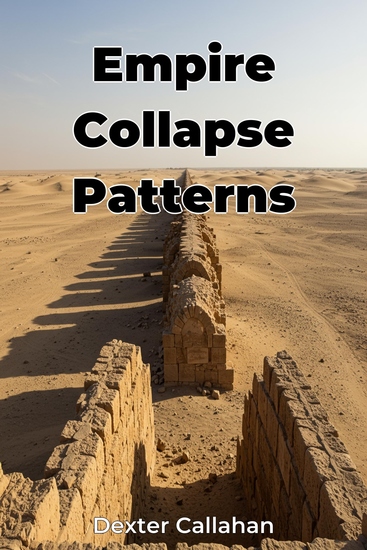
Empire Collapse Patterns - cover

Empire Collapse Patterns

Dexter Callahan

Translator A AI

Publisher: Publifye

  • 0
  • 0
  • 0

Summary

Empire Collapse Patterns explores why powerful empires decline, identifying recurring vulnerabilities across history. Resource management, socio-political fragmentation, and external pressures emerge as critical factors. Intriguingly, empires often mismanage resources, leading to economic decline and internal conflicts, while internal divisions such as ethnic or economic disparities weaken cohesion. 

 
The book analyzes political structures, economic systems, and social dynamics of empires like Rome and the Ottomans, revealing identifiable patterns. It argues that while each collapse is unique, recurring themes of resource mismanagement, internal fragmentation, and external pressures consistently signal potential decline.

 
This comparative approach uses historical texts, archaeological findings, and even quantitative methods to identify common patterns and their relevance to the modern world. Structured in three parts, the book introduces a framework, examines case studies, and synthesizes findings. It uniquely emphasizes the interconnectedness of internal and external factors, offering a more nuanced understanding of imperial decline and its applicability to contemporary global powers and international relations.
Available since: 05/05/2025.
Print length: 67 pages.


Other books that might interest you

  • The Byzantine Empire - Eastern Legacy - cover

    The Byzantine Empire - Eastern...

    Harris Ropes

    • 0
    • 0
    • 0
    The origins of the Byzantine Empire are deeply rooted in the legacy of the Roman Empire. As the Roman Empire grew increasingly difficult to manage due to its vast size, Emperor Diocletian initiated a division in the late 3rd century CE, separating the empire into Eastern and Western regions. This decision, though initially administrative, laid the groundwork for what would become two distinct political and cultural entities. While the Western Roman Empire succumbed to barbarian invasions and internal instability, the Eastern Roman Empire endured, evolving into what we now recognize as the Byzantine Empire. 
    One of the most pivotal moments in the birth of Byzantium came in 330 CE, when Emperor Constantine the Great established a new capital on the site of the ancient city of Byzantium. Renamed Constantinople, meaning "City of Constantine," it was strategically located on the Bosporus Strait, bridging Europe and Asia. This location was not only advantageous for trade but also easier to defend from invasions. Constantinople quickly rose to prominence as a center of politics, culture, and commerce, outshining Rome itself in influence and prestige. The city’s grandeur, with its towering walls and monumental architecture, symbolized the strength and ambition of the new Eastern Empire. 
    The early years of the Byzantine Empire were marked by both challenges and triumphs. While the Western Roman Empire fell in 476 CE, the Eastern Empire continued to thrive, preserving Roman laws, administrative systems, and military traditions. However, the Byzantines were not merely Roman in continuation—they adapted and transformed their identity over time. Greek became the dominant language, replacing Latin in most official and cultural contexts, and Orthodox Christianity emerged as a defining feature of Byzantine life.
    Show book
  • Accelerate or Die - cover

    Accelerate or Die

    J.P Thor, Omar Ibrahim, B. Bones

    • 0
    • 0
    • 0
    Accelerate or Die—The Choice Is Yours As the lines between technology and humanity blur, an undeniable question emerges: will we control our evolution, or be swept away by it? ACEL takes you on a thought-provoking journey through the accelerating tide of human potential, where artificial intelligence, biotechnology, and the quest for mastery over our own fate converge. In this era of boundless innovation, our greatest asset isn't just technology—it’s the expansion of human intelligence, agency, and the relentless drive to explore uncharted territories. From the intricacies of AI ethics to the untapped energies that lie within and beyond, ACEL unravels the philosophy of Acceleration: a movement that doesn't just accept change but propels it forward, challenging the limits of what it means to be human. As you turn each page, you’ll be immersed in a vision of a future where humanity stands not just as observers but as architects of a world where progress is both inevitable and essential. Will you harness this momentum and help redefine our place in the cosmos, or will you let the future outpace you? Join the evolution. Embrace your potential. The clock is ticking.
    Show book
  • Other People’s Colleges - The Origins of American Higher Education Reform - cover

    Other People’s Colleges - The...

    Ethan W. Ris

    • 0
    • 0
    • 0
    An illuminating history of the reform agenda in higher education. 
     
    For well over one hundred years, people have been attempting to make American colleges and universities more efficient and more accountable. Indeed, Ethan Ris argues in Other People’s Colleges, the reform impulse is baked into American higher education, the result of generations of elite reformers who have called for sweeping changes in the sector and raised existential questions about its sustainability. When that reform is beneficial, offering major rewards for minor changes, colleges and universities know how to assimilate it. When it is hostile, attacking autonomy or values, they know how to resist it. The result is a sector that has learned to accept top-down reform as part of its existence. 
      
    In the early twentieth century, the “academic engineers,” a cadre of elite, external reformers from foundations, businesses, and government, worked to reshape and reorganize the vast base of the higher education pyramid. Their reform efforts were largely directed at the lower tiers of higher education, but those efforts fell short, despite the wealth and power of their backers, leaving a legacy of successful resistance that affects every college and university in the United States. Today, another coalition of business leaders, philanthropists, and politicians is again demanding efficiency, accountability, and utility from American higher education. But, as Ris argues, top-down design is not destiny. Drawing on extensive and original archival research, Other People’s Colleges offers an account of higher education that sheds light on today’s reform agenda. 
    Show book
  • Top Ten Ancient World Secrets - cover

    Top Ten Ancient World Secrets

    Raphael Terra

    • 0
    • 0
    • 0
    This audiobook has been recorded using Text to speech (TTS). 
     
    Welcome to a world full of mystery, folklore and legend. From supposed stargates to powerful deities; from fantastic giants to steampunk style science-fiction. This is not an alien planet or a fantasy land, this is planet Earth of the past. And yet, it was a world of wonder and great physical and mental achievements. Now, even with our modern day science, there are a great many remnants of the ancient world that remain an enigma. 
     
    From the great civilizations of antiquity we will discover the amazing works of architecture and art. Huge monuments erected for gods and kings. Mysterious artefacts re-discovered after remaining hidden for thousands of years. From the Great Pyramid of Giza to the Statue of Zeus at Olympia; from the Temple of Artemis at Ephesus to the strange Antikythera mechanism. And as we move around the planet we will unlock the secrets of Stonehenge and through that the movements of the planets. 
     
    Welcome to the Top Ten Ancient World Secrets.
    Show book
  • Space Crone - cover

    Space Crone

    Ursula K. Le Guin

    • 0
    • 0
    • 0
    Winner of the Locus Award 2024 for Non-Fiction  
     
    Ursula K. Le Guin witnessed and contributed to many of the twentieth century’s rebellions and upheavals, including women’s liberation, the Civil Rights movement and US anti-war and environmental activism. Spanning fifty years of her life and work, Space Crone brings together Le Guin’s writings on feminism and gender for the first time, offering new insights into her imaginative, multispecies feminist consciousness: from its roots in deep ecology and philosophies of non-violence to her self-education about racism and her writing on motherhood and ageing.
    Show book
  • Brief History of the Antarctic Exploration - cover

    Brief History of the Antarctic...

    Gerardo Bartolome

    • 0
    • 0
    • 0
    Antarctica, a continent like no other. Not only because of its beauty but also because of its unique history, without wars, kings or indigenous cultures. This book delves into its exploration, offering key insights into events and motivations. A concise overview, it's designed for those preparing for an Antarctic journey or seeking quick insights into its history. With over 150 images, it captures the essence of this exceptional place. For more in-depth explorations, additional resources are suggested in the final appendix. Explore Antarctica's history through a succinct and enjoyable reading experience.
    Show book