Junte-se a nós em uma viagem ao mundo dos livros!
Adicionar este livro à prateleira
Grey
Deixe um novo comentário Default profile 50px
Grey
Assine para ler o livro completo ou leia as primeiras páginas de graça!
All characters reduced
In Praise of Error - Productive Mistakes in Culture Cuisine and Science - cover
LER

In Praise of Error - Productive Mistakes in Culture Cuisine and Science

Derek Mueller

Editora: Ideenbrücke Verlag

  • 0
  • 1
  • 0

Sinopse

Many people know that Columbus wouldn't have dared to sail across the Atlantic if he had been aware how far the way to Asia really is. But there exist a lot more errors which turned out to be useful. Great thinkers like Copernicus and Einstein, but also ordinary people made mistakes which changed our world in many ways. 

A collection of the most interesting and useful errors in history, science, kitchen and art.

Contents: 
Errors – always negative?
To err as a program? Trial and error or: What geniuses and rainworms have in common
Mistakes? How delicious! – Potato crisps and cauliflower
The great fried potatoes failure
Tofu, cheese, wine & Co.
Cauliflower and beyond
In wine there is error
Copernicus or: a rounder rounding
… and Kepler
Discovering America with Aristotle
El Dorado: the mirage of greed
Dreams, lies and literature: Schliemann
Creative misunderstandings in literature
Kandinsky or: The right wrong view
Only relatively right assumptions: theory of relativity
Unsuccessful, but still a masterpiece: the Michelson–Morley experiment
A bit of theory on error
Sloppiness saves the lives of millions
Can false prophecies be useful?
Disponível desde: 05/11/2016.
Comprimento de impressão: 125 páginas.

Outros livros que poderiam interessá-lo

  • The Loss Prescription - cover

    The Loss Prescription

    Dr Chloe Paidoussis-Mitchell

    • 0
    • 0
    • 0
    'Dr Chloe helped me understand how to grieve and keep living, how to find the light in the darkest of days. I know this book will be of great comfort to many.' Zoe Ball 
    Nobody gets through life free from the pain of loss. 
    However, we aren’t very good at processing what grief does to us. If left unchecked, it can seriously damage our mental health. 
    In this book, chartered psychologist and trauma counsellor Dr Chloe Paidoussis-Mitchell offers a roadmap for grief recovery. With guidance drawn from her decades of clinical experience and work with clients, plus a series of practical tools and exercises, she will help you work through your loss so you can embrace life with hope again. 
    This is an expert source of support for anyone seeking light in the dark after loss. 
    Dr Chloe Paidoussis-Mitchell, a renowned psychologist, delves deep into the realms of grief, bereavement, and the psychology of loss. Her expertise in the field of non-fiction self-help guides shines through as she navigates the complex web of emotions surrounding death, separation, and divorce. 
    For fans of Megan Devine (How to Carry What Can't Be Fixed), Joshua Fletcher (And How Does That Make You Feel?), Donna Ashworth (Growing Brave), Sally Douglas (Good Mourning), and Matt Haig (The Comfort Book). 
    HarperCollins 2024
    Ver livro
  • Origin of the Illuminati - cover

    Origin of the Illuminati

    Raphael Terra

    • 0
    • 0
    • 0
    This audiobook has been recorded using Text to speech (TTS). 
     
    There is an elite group that control the world. They run governments, companies and religions. They have done so for a very long time. 
     
    Their names have changed, their faces altered but their bloodlines remain the same. 
     
    We see glimpses of their power. We see the outcomes of their plots and schemes. We see revolutions and war. We succumb to their propaganda and manipulation again and again. Most have no idea that they are under the spell. 
     
    In the 18th century they emerged briefly into the spotlight to bring about world-wide cataclysmic change and they called themselves the Illuminati. 
     
    Quickly they spread and embedded themselves and their ideals within other secret societies. The French had a bloody revolution. America turned the tide against a royal regime. Russia, Spain and more, all fell to the zeal of a new world order. 
     
    This is the story of the world's most powerful secret and sacred order.
    Ver livro
  • Battle of White Mountain The: The History and Legacy of the First Major Battle of the Thirty Years’ War - cover

    Battle of White Mountain The:...

    Editors Charles River

    • 0
    • 0
    • 0
    It has been famously pointed out that the Holy Roman Empire was neither holy, nor Roman, but it was also not an empire in the sense people expect when hearing the term. In theory, the emperor was the highest prince in Christendom, and his dominion extended the length and breadth of Western Europe. The tensions between the Holy Roman Empire and Church over the power to invest bishops with authority led to decades of civil war in Germany on the way to establishing the relationship between Church and State, elevating the status of the papacy and weakening the Holy Roman Empire. 
    	The Thirty Years' War was one of the most horrific conflicts in history, resulting in the deaths of nearly two-thirds of Germany's population, and the Battle of White Mountain in 1620 was the first major battle of that war. The battle was fought mainly due to Holy Roman Emperor Ferdinand II’s dealings with the Bohemians and their new king, Frederick of the Palatinate, who Ferdinand regarded as illegitimate. It was also partly a struggle between the centralizing attempts of the Habsburg dynasty conflicting with the traditional regional autonomy that existed within the legislative institutions called the Estates. What gave it an emotional element was the enmity between Bohemian Protestantism and Ferdinand II’s zealous Catholicism, and that would help draw in several European powers. At the Battle of White Mountain, the armies of the Bohemian Confederation and the Habsburgs met each other near Prague, and the combatants included officers and soldiers from nearly every nation in Europe, including the Netherlands, Germany, Italy, Poland, Bohemia, Moravia, Bavaria, Italy, Spain, Hungary, Transylvania, England, Scotland, and Ireland. The decisive result would permanently affect the course of the conflict over the coming decades, and with it the fate of modern Europe. 
    Ver livro
  • A Rare Recording of Corrie ten Boom Vol 1 - cover

    A Rare Recording of Corrie ten...

    Corrie ten Boom

    • 0
    • 0
    • 0
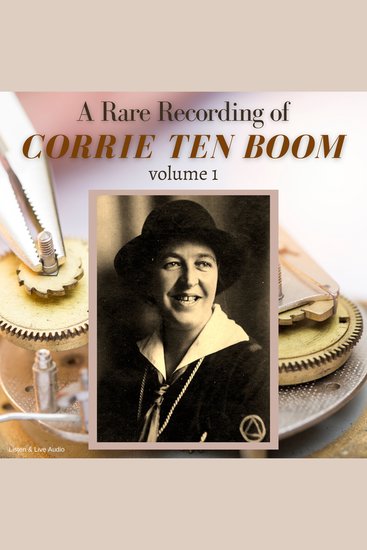
    Cornelia Arnolda Johanna "Corrie" ten Boom (April 15, 1892 - April 15, 1983) was a Dutch watchmaker who worked with her father Casper and other family members to help, reportedly, 800 Jews escape the Nazi Holocaust during World War II by hiding them in their home. Eventually, the family was caught, and ten Boom was arrested and sent to Ravensbrück concentration camp, but released after ten months due to a clerical error. Later in life, ten Boom wrote, "The Hiding Place," a biography that recounts the story of her family's efforts and how she was able to find hope while imprisoned at the concentration camp. It was later made in to a movie.
    Ver livro
  • Wonderstruck - How Wonder and Awe Shape the Way We Think - cover

    Wonderstruck - How Wonder and...

    Helen De Cruz

    • 0
    • 0
    • 0
    Wonder and awe lie at the heart of life's most profound questions. Wonderstruck shows how these emotions respond to our fundamental need to make sense of ourselves and everything around us, and how they enable us to engage with the world as if we are experiencing it for the first time. 


    Drawing on the latest psychological insights on emotions, Helen De Cruz argues that wonder and awe are emotional drives that motivate us to inquire and discover new things, and that humanity has deliberately nurtured these emotions in cultural domains such as religion, science, and magic. Tracing how wonder and awe unify philosophy, the humanities, and the sciences, De Cruz provides new perspectives on figures such as Plato, Aristotle, Adam Smith, William James, Rachel Carson, Maurice Merleau-Ponty, Jean-Paul Sartre, and Abraham Heschel. Along the way, she explains how these singular emotions empower us to be open-minded, to experience joy and hope, and to be resilient in the face of personal troubles and global challenges. 


    Taking inspiration from Descartes's portrayal of wonder as "that sudden surprise of the soul," this illuminating book reveals how wonder and awe are catalysts that can help us reclaim what makes life worth living and preserve the things we find wonderful and valuable in our lives.
    Ver livro
  • Statistical Physics - The Physics of Particles and Systems - cover

    Statistical Physics - The...

    Mark Hedges

    • 0
    • 0
    • 0
    Statistical mechanics is the branch of physics that applies probability theory and statistics to describe the behavior of systems with a large number of particles. It provides a framework for understanding macroscopic phenomena in terms of the microscopic properties of individual particles. The central goal of statistical mechanics is to connect the microscopic world of atoms and molecules with the macroscopic world of thermodynamic variables like temperature, pressure, and volume. 
    Historically, statistical mechanics emerged in the 19th century as scientists sought to explain the observed laws of thermodynamics, which describe the behavior of systems in equilibrium. Classical thermodynamics, while incredibly successful, was primarily phenomenological and lacked a fundamental microscopic understanding. This gap was filled by the development of statistical mechanics, largely attributed to the works of Ludwig Boltzmann, James Clerk Maxwell, and Josiah Willard Gibbs. 
    At its core, statistical mechanics is based on the idea that the behavior of macroscopic systems can be understood by considering the collective behavior of their microscopic constituents. Instead of directly tracking every particle, which is practically impossible for large systems, statistical mechanics calculates the statistical properties of the system. These properties are derived from the laws of probability
    Ver livro