Join us on a literary world trip!
Add this book to bookshelf
Grey
Write a new comment Default profile 50px
Grey
Subscribe to read the full book or read the first pages for free!
All characters reduced
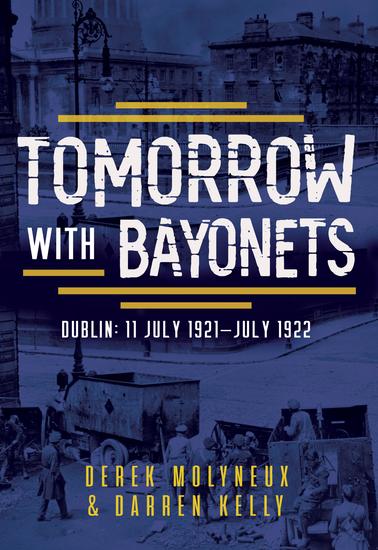
Tomorrow with Bayonets - Dublin: July 1921 – July 1922 - cover

Tomorrow with Bayonets - Dublin: July 1921 – July 1922

Derek Molyneux, Darren Kelly

Publisher: Mercier Press

  • 0
  • 0
  • 0

Summary

The raw intensity of the Irish Civil War is brought to life in this gripping, fast-paced journey from July 1921 to July 1922 – a year of change and conflict. Dublin's descent into violent unrest surpasses the turbulence of the Easter Rising. Treaty debates spark dissension, and as tensions mount, Dublin becomes a tinderbox of espionage, betrayal, and guerrilla warfare. Former allies who fought shoulder to shoulder in the IRA now find themselves divided and entrenched in an ideological struggle that threatens to tear Dublin and Ireland apart. More than a historical recount, 'Tomorrow With Bayonets' offers a visceral portrayal of a nation grappling with its identity and sovereignty, seen through the eyes of combatants, leaders, and civilians caught in the crossfire.


The Provisional Government's National Army and the IRA engage in sporadic but fierce clashes as unrelenting violence and chaos engulf the country. In Northern Ireland, there is growing disillusionment among IRA units due to the diminishing credibility of assurances from Michael Collins. Ongoing assaults on their communities, the nationalist population experiences a rising number of casualties due to rampant brutality from unionist militias. A suppression of inquiries into killings leads to a widespread feeling of abandonment by the Provisional Government.


On June 4 1922, the Provisional Government implemented 'a policy of peaceful obstruction' towards the Belfast Government, explicitly forbidding any troops from the twenty-six counties from entering the six-county area. In an apocalyptic climax, Dublin is engulfed in explosions, assassinations and relentless urban warfare. This powerful account, not for the faint-hearted, leaves a lasting impact, resonating with the reader long after the final page.
Available since: 04/01/2024.
Print length: 320 pages.


Other books that might interest you

  • The Golden Age of Piracy - The Rise Fall and Enduring Popularity of Pirates - cover

    The Golden Age of Piracy - The...

    David Head

    • 0
    • 0
    • 0
    Twelve authors shed new light on the true history and enduring mythology of seventeenth– and eighteenth–century pirates in this anthology of scholarly essays. 


    The twelve entries in The Golden Age of Piracy discuss why pirates thrived in the seas of the New World, how pirates operated their plundering ventures, how governments battled piracy, and when and why piracy declined. Separating Hollywood myth from historical fact, these essays bring the real pirates of the Caribbean to life with a level of rigor and insight rarely applied to the subject. 


    The Golden Age of Piracy also delves into the enduring status of pirates as pop culture icons. Audiences have devoured stories about cutthroats such as Blackbeard and Henry Morgan since before Robert Louis Stevenson wrote Treasure Island. By looking at the ideas of gender and sexuality surrounding pirate stories, the renewed interest in hunting for pirate treasure, and the construction of pirate myths, the contributing authors tell a new story about the dangerous men, and a few dangerous women, who terrorized the high seas.
    Show book
  • The First Anzacs - cover

    The First Anzacs

    Jimmy Thomson, George Hulse

    • 0
    • 0
    • 0
    This is the unknown story of the combat engineers who kept World War I running. Although it has been repeatedly denied by the army, they were the first Australians to land at Anzac Cove: in any combat, even today, sappers are always the first in and last out. 
     
     
    They were airbrushed out of history. Official historian Charles Bean claimed the first Australian ashore at the Gallipoli landing on 25 April 1915 was an infantry officer. But Bean wasn't there, and a bunch of Australian and New Zealand army engineers were. Even today, the army is reluctant to accept that sappers were among the very first Australian soldiers ashore. 
     
    This is the untold story of the Australian and New Zealand sappers - combat engineers - who fought in World War I. They were always in the vanguard, clearing defences, and building bridges, roads and walkways for the troops who followed, usually under fire. At Gallipoli, strafed by machine guns and targeted by snipers, they dug trenches and tunnels to advance on the Turkish defences. On the Western Front, they burrowed under the German lines to plant massive explosives, whose eruption could be heard in England. In Egypt they demolished a Turkish railway in a day. 
     
    From Gallipoli to the sands of the Middle East, to the blood-soaked battlefields of France and Belgium, engineers put down their tools to also fight as combat soldiers at every major battle and campaign, often with heroic feats of astonishing courage. Three sappers stole a giant field gun from under German noses at Amiens. Sappers were classic Aussie larrikins, indefatigably practical men who don't take kindly to bureaucracy. Typically under-appreciated, two were cheated of their well-earned VCs by a British general after they, working alone, tricked a German platoon into surrendering. 
     
     
    'Sappers are the unsung heroes of the First World War and this book helps bring them back into the limelight where they belong.' WILL DAVIES, Beneath Hill 60 
     
     
    'It has taken 111 years for true stories to appear in a book adequately honouring Australian sappers in WW1 - you will remember these heroes forever'. COLONEL SANDY MACGREGOR MC (rtd) 
     
     
    'An excellent insight into the role of the Field Engineers as part of the combined arms team in World War One' BRIGADIER MICK SAY DSC, Head of Corps, Royal Australian Engineers
    Show book
  • Narcissism - The Rise of Narcissism in Modern Society - cover

    Narcissism - The Rise of...

    Valerie Vogue

    • 0
    • 0
    • 0
    Narcissism is a complex and multifaceted personality trait, often characterized by an inflated sense of self-importance, a strong need for admiration, and a lack of empathy for others. While the term "narcissism" is often used casually to describe someone who appears vain or self-centered, its psychological meaning is more intricate and refers to a spectrum of behaviors that can range from mild self-interest to full-blown Narcissistic Personality Disorder (NPD). 
    At its core, narcissism is a defense mechanism that helps individuals maintain an exaggerated sense of self-worth. This inflated self-image may stem from deep insecurities or past trauma, and it can be a way for individuals to shield themselves from feelings of inadequacy or vulnerability. Narcissists often rely on external validation—through admiration, praise, and attention—to affirm their worth, which means their sense of self is fragile and dependent on how others perceive them. 
    A key component of narcissism is the lack of empathy. Narcissists struggle to recognize or care about the feelings and needs of others. Instead, they view people primarily as tools for boosting their own status or fulfilling their desires. This absence of empathy can lead to shallow relationships and exploitation, as narcissists often fail to consider the emotional consequences of their actions on others.
    Show book
  • Sikh Wars The: A Captivating Guide to the Origins Battles and Legacy of the 19th-Century Anglo-Sikh Conflicts - cover

    Sikh Wars The: A Captivating...

    Captivating History

    • 0
    • 0
    • 0
    Uncover the Saga of the Sikh Empire and Its Last Stand against the British Raj  
    In this audiobook, the astonishing chronicle of the Sikh Empire unfolds, revealing a story of valor, resilience, and the fierce clash of empires. This audiobook is a portal to a bygone era, where the Sikh Army, hailed as the most formidable Indian force the British ever encountered, carved a 200,000-square-mile empire in the heart of the Punjab. 
    Embark on a Journey Through TimeWitness the birth of the Sikh faith through the divine visions of Guru Nanak and how it evolved into a warrior creed under the guidance of the gurus.Marvel at the strategic prowess of Ranjit Singh, the one-eyed lion of the Punjab, who rose to forge a formidable Sikh Empire after inheriting a kingdom at the age of twelve.Explore the tumultuous aftermath of Ranjit Singh’s demise and how it led to a treacherous power struggle and the army’s fateful confrontation with the British. 
    In this audiobook:Unravel the tale of Ranjit Singh’s youngest queen, the beautiful daughter of the palace dog keeper, and how she became a powerful and able regent for her infant son, the last maharaja of the Punjab.Discover how Irish General Gough led the British forces in India to victory over the Sikhs and why his statue was blown up by the Irish Republican Army a century later.Relive the strategic brilliance and tragic betrayal within the Sikh ranks.Experience the fury of the Sikh artillery and the heart-wrenching separation of Maharani Jind Kaur from her son.Follow the odyssey of the legendary Koh-i-Noor diamond from Ranjit Singh’s vault to the hands of British conquerors. 
    Click the “add to cart” button now, and embark on an unforgettable journey into the past. Your exploration of these remarkable wars awaits!
    Show book
  • The Chemical Marriage - cover

    The Chemical Marriage

    Manly Palmer Hall

    • 0
    • 0
    • 0
    The self-admitted author of The Chemical Marriage, Johann Valentin Andreæ, born in Württemberg in 1586, was twenty-eight years of age when that work was first published. It was presumably written about twelve years prior to its publication--or when the author was fifteen or sixteen years old. The fact is almost incredible that one so young could produce a volume containing the wealth of symbolic thought and philosophy hidden between the lines of The Chemical Marriage. This book makes the earliest known reference to Christian Rosencreutz, and is generally regarded as the third of the series of original Rosicrucian manifestoes. As a symbolic work, the book itself is hopelessly irreconcilable with the statements made by Andreæ concerning it. The story of The Chemical Marriage relates in detail a series of incidents occurring to an aged man, presumably the Father C.R.C. of the Fama and Confessio. If Father C.R.C. was born in 1378, as stated in the Confessio, and is identical with the Christian Rosencreutz of The Chemical Marriage, he was elevated to the dignity of a Knight of the Golden Stone in the eighty-first year of his life (1459). In the light of his own statements, it is inconceivable that Andreæ could have been Father Rosy Cross.
    Show book
  • Cave of Bones - cover

    Cave of Bones

    Lee Berger, John Hawkes

    • 0
    • 0
    • 0
    In the summer of 2022, Lee Berger lost 50 pounds in order to wriggle though impossibly small openings in the Rising Star cave complex in South Africa—spaces where his team has been unearthing the remains of Homo naledi, a proto-human likely to have coexisted with Homo sapiens some 250,000 years ago. The lead researcher on the site, still Berger had never made his way into the dark, cramped, dangerous underground spaces where many of the naledi fossils had been found. Now he was ready to do so. Once inside the cave, Berger made shocking new discoveries that expand our understanding of this early hominid—discoveries that stand to alter our fundamental understanding of what makes us human. So what does it all mean? Join Berger on the adventure of a lifetime as he explores the Rising Star cave system and begins the complicated process of explaining these extraordinary finds—finds that force a rethinking of human evolution, and discoveries that Berger calls "the Rosetta stone of the human mind."
    Show book