Join us on a literary world trip!
Add this book to bookshelf
Grey
Write a new comment Default profile 50px
Grey
Subscribe to read the full book or read the first pages for free!
All characters reduced
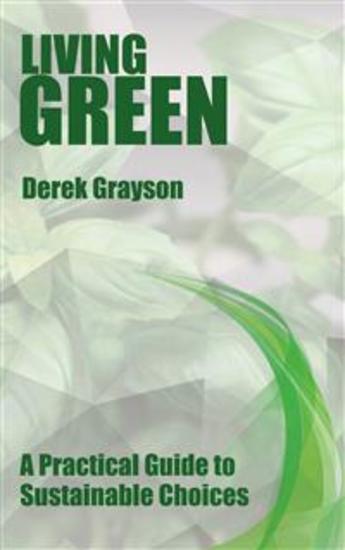
Living Green - A Practical Guide to Sustainable Choices - cover

Living Green - A Practical Guide to Sustainable Choices

Derek Grayson

Publisher: Lulu.com

  • 0
  • 0
  • 0

Summary

"Living Green - A Practical Guide to Sustainable Choices" is your essential roadmap to adopting eco-friendly habits in everyday life. This comprehensive guide simplifies the path to sustainability, offering actionable tips and practical insights to reduce your environmental footprint. From making conscious purchasing decisions to adopting energy-saving practices at home, this book empowers you to live in harmony with the planet. Whether you’re a beginner or a seasoned environmentalist, "Living Green" provides the knowledge and tools to make a lasting impact on the world around you.
Available since: 09/17/2024.

Other books that might interest you

  • The Chicken Little Agenda - Debunking "Experts'" Lies - cover

    The Chicken Little Agenda -...

    Anonymous

    • 0
    • 0
    • 0
    A scientist takes on the distortions and outright lies foisted on the public! 
    "A much-needed antidote to the prevailing plague of desperate (and often groundless) pessimism." —Michael Medved, Nationally Syndicated Radio Host 
    Robert G. Williscroft firmly establishes that the sky is not falling. By using scientific research and solid reasoning, he explains some of the most disturbing problems facing our nation including global warming, the safety of nuclear power, the politics of education, and the oxymoron of government efficiency. With a clear message, he discerns what is true from what is merely Chicken Little gibberish.
    Show book
  • Classical Mechanics - A Detailed Study of Mechanics and Dynamics - cover

    Classical Mechanics - A Detailed...

    Mark Hedges

    • 0
    • 0
    • 0
    Classical mechanics is the foundation of physics, describing the motion of objects under the influence of forces. It is based on Newtonian principles and provides the groundwork for various fields such as engineering, astronomy, and applied sciences. This chapter introduces the fundamental concepts, historical context, and different approaches to classical mechanics. 
    Classical mechanics originated with the pioneering work of Galileo Galilei and Sir Isaac Newton. Galileo’s studies of motion laid the foundation for Newton’s laws, which were later formalized in Philosophiæ Naturalis Principia Mathematica (1687). These laws revolutionized the understanding of motion and force, enabling precise predictions of mechanical systems. Before Newton, the Aristotelian view dominated, which incorrectly stated that objects require a continuous force to remain in motion. Newton’s insights replaced this with the concept of inertia, fundamentally changing physics. 
    At its core, classical mechanics describes the relationship between forces, motion, and energy. It assumes that time and space are absolute and independent entities. Unlike quantum mechanics and relativity, which describe extreme conditions, classical mechanics applies to everyday objects moving at speeds much lower than the speed of light. The field is traditionally divided into several branches, including kinematics, which studies motion without considering forces, and dynamics, which examines forces and their effects.
    Show book
  • Why the Dose Matters - Assessing the Health Risk of Exposure to Toxicants - cover

    Why the Dose Matters - Assessing...

    Urs A. Boelsterli

    • 0
    • 0
    • 0
    Each day we are exposed to a myriad of natural and human-made chemicals in our food, drinking water, air, soil, at home or at the workplace—pesticide residues, food additives, drugs, household products—but how can we gauge the human health risk posed by these chemicals? Should we believe the somber headlines that depict a serious threat for humans and the environment, or should we follow the reassuring voices of others who claim that the angst is totally unfounded? 


    Why the Dose Matters: Assessing the Health Risk of Exposure to Toxicants uses a rational, science-based approach to explain in plain language that a quantitative view is key for understanding and predicting potentially toxic effects of chemicals. 


    Key Features: 


    ● Explains the basics of toxicology in easily understandable terms. 


    ● Includes numerous examples. 


    ● Clears up common misconceptions and dispels myths. 


    ● Provides take-home messages for each chapter.
    Show book
  • Aircraft Systems - cover

    Aircraft Systems

    Facundo Conforti

    • 0
    • 0
    • 0
    This audiobook is narrated by an AI Voice.   
    Aircraft Systems have been an under explored subject in flight academies. The truth is, a pilot must be familiar with each of their aircraft's systems before commencing their initial flights. 
    	In this work, you will learn everything about the basic systems of the main light or small aircraft: landing gear, tires, flight controls, fuel, electricity, cables and control rods, control surfaces, and all the key systems that make up your aircraft’s equipment. 
    	Learning aircraft systems should take place during the initial flight hours for aviation students. This will provide them with the necessary tools to understand what is happening with the operation of each of these systems at all times. A particular skill that will maximize safety in flight operations. 
    	All of us, as human beings, need to understand how our body functions to identify deficiencies and stay healthy. As pilots, we need to understand how our aircraft systems work to identify malfunctions and manage emergencies efficiently and safely.
    Show book
  • Inside the Britannic - Uncovering the Wreck of the Titanic's Sister Ship - cover

    Inside the Britannic -...

    Simon Mills

    • 0
    • 0
    • 0
    The Olympic Class ships were intended to be the greatest liners to ever sail the oceans, but the Britannic sank only four years after her sister ship the Titanic. While the wreck of the Titanic is two miles below the surface and rapidly deteriorating, the Britannic is much more accessible (only 400 ft down) and remains largely intact. One of the largest passenger ships ever to have sunk, her wreck presents a unique opportunity to explore the interior of the Olympic Class liners, and examine areas which on the Titanic simply no longer exist. 


    Simon Mills bought the wreck of the Britannic in 1996 and has spent more time exploring it than anyone else. Inside the Britannic is the sum of decades of work covering every inch of the shipwreck as he searches for answers to century-old questions, and discovers new mysteries to solve. Simon takes a forensic approach but this book is more than just the autopsy report of a ship. 


    The Britannic may have been lost over a century ago, but Simon Mills's fascinating new book gives everyone unparalleled access to rediscover her.
    Show book
  • Creatures That Eat People - Why Wild Animals Might Eat You - cover

    Creatures That Eat People - Why...

    Richard Freeman

    • 0
    • 0
    • 0
    Wild Animals Might Eat You—Learn Which Ones 


    Avoid getting eaten! Do you find yourself wondering: Do bears eat humans? Do birds eat people? Do kangaroos? Could I survive people eating predators of any kind? Perfect for anyone with a fun or morbid interest in wildlife or survivalism, Creatures That Eat People is full of stories of strange animals that eat humans and the situations that lead to it. 


    Learn which wild animals might eat you—from an expert. Cryptozoologist, former zookeeper, current zoological director, bestselling author, and animal enthusiast Richard Freeman examines all the cool man eaters in the animal kingdom—so you can be prepared on your next adventure. 


    You'll find: tips for visiting different types of areas with apex predators in them; bears, sharks, birds, kangaroos, squids, lions, raptors, and all of the other other weird, wild animals that eat people; and real-life, thrilling stories of animals eating people—and some survive and some don't. 


    If you liked How To Survive A Freakin' Bear Attack, Plants That Kill, Surviving the Wild, or In Search of Real Monsters, and if you enjoyed shows like Tiger King or Human Prey, you'll love Creatures That Eat People.
    Show book