Join us on a literary world trip!
Add this book to bookshelf
Grey
Write a new comment Default profile 50px
Grey
Subscribe to read the full book or read the first pages for free!
All characters reduced
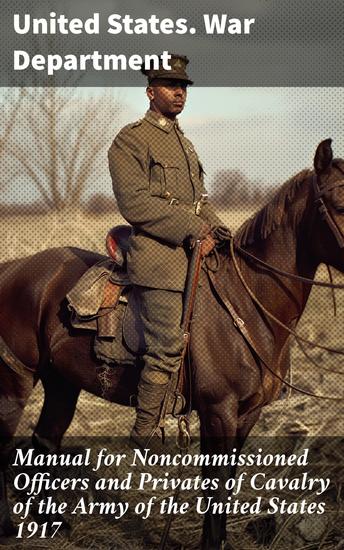
Manual for Noncommissioned Officers and Privates of Cavalry of the Army of the United States 1917 - To be also used by Engineer Companies (Mounted) for Cavalry Instruction and Training - cover

Manual for Noncommissioned Officers and Privates of Cavalry of the Army of the United States 1917 - To be also used by Engineer Companies (Mounted) for Cavalry Instruction and Training

Department United States. War

Publisher: Good Press

  • 0
  • 0
  • 0

Summary

The "Manual for Noncommissioned Officers and Privates of Cavalry of the Army of the United States 1917" is a meticulously crafted guide that encapsulates the operational procedures, tactical training, and discipline expected of cavalry personnel during a pivotal moment in American military history. This manual embodies the pragmatic and instructive style typical of military literature, offering a wealth of detailed information on formations, equipment, and communication that underscores the evolving dynamics of cavalry warfare in the early 20th century. As World War I loomed, the text reflects both the historical context of American military preparedness and the desire to standardize practices among ranks to enhance effectiveness in battle. Authored by the United States War Department, this work draws on the extensive experiences and lessons learned from previous conflicts, as military leaders recognized the necessity for structured training and the professionalization of enlisted men. The War Department's commitment to fostering a well-informed and disciplined cavalry force is evident, reflecting the broader changes in American military doctrine during a transformative period in global conflicts. For historians, military enthusiasts, and scholars of the early 20th century, this manual serves not only as a valuable document of military protocol but also as a fascinating glimpse into the mindset of a nation poised for international engagement. The clarity and specificity of its guidance make it essential reading for anyone interested in the evolution of military training and strategy.
Available since: 10/05/2023.
Print length: 372 pages.

Other books that might interest you

  • Grey Wolf Grey Sea - Aboard the German Submarine U-124 in World War II - cover

    Grey Wolf Grey Sea - Aboard the...

    E.B. Gasaway

    • 0
    • 0
    • 0
    The inside story of life aboard the deadly Nazi U-Boat that sank forty-nine ships. 


    The history of one of World War II's most successful submarines, U-124, is chronicled in Grey Wolf, Grey Sea, from its few defeats to a legion of victories. Kapitanleutnant Jochen Mohr commanded his German submarine and navigated it through the treacherous waters of one of the most destructive, savage wars the world has known.
    Show book
  • The Importance of Being Urban - Designing the Progressive School District 1890-1940 - cover

    The Importance of Being Urban -...

    David A. Gamson

    • 0
    • 0
    • 0
    From the 1890s through World War II, the greatest hopes of American progressive reformers lay not in the government, the markets, or other seats of power but in urban school districts and classrooms. The Importance of Being Urban focuses on four western school systems—in Denver, Oakland, Portland, and Seattle—and their efforts to reconfigure public education in the face of rapid industrialization and the perceived perils of the modern city. In an era of accelerated immigration, shifting economic foundations, and widespread municipal shake-ups, reformers argued that the urban school district could provide the broad blend of social, cultural, and educational services needed to prepare students for twentieth-century life. These school districts were a crucial force not only in orchestrating educational change, but in delivering on the promise of democracy. David A. Gamson’s book provides eye-opening views of the histories of American education, urban politics, and the Progressive Era.
    Show book
  • Shattering the Illusions: How Wealth Shapes Our Reality - "Elevate your mindset! Access compelling audio lessons that reveal how wealth influences your world" - cover

    Shattering the Illusions: How...

    Rylan Hargrove

    • 0
    • 0
    • 0
    Shattering the Illusions: How Wealth Shapes Our Reality 
    ⭐⭐ A Simplified Guide & Explanations Included ⭐⭐ 
    Are you ready to advance your career and enhance your expertise in understanding powerful nonverbal signals?  
    In search of an all-encompassing resource that covers everything you need to know about unlocking influence through these signals?  
    Look no further! 
    This guide is your essential companion for deepening your insights, honing your skills, and engaging in practical exercises. With this resource, you're on the path to success. 
    Updated to reflect the latest insights and strategies. 
    Key Features of This Comprehensive Guide Include: 
    - In-depth insights on leveraging powerful nonverbal signals 
    - Thorough explanations on the significance of understanding these signals 
    - Effective strategies for preparation and implementation 
    Our guide stands out through its extensive coverage, which is crucial for your journey toward mastering these concepts. Topics are explored with meticulous detail, ensuring you fully grasp each aspect. 
    Crafted with a clear layout and accessible language, our guide guarantees a seamless flow between topics. Say farewell to complex terminology and embrace content that is clear, precise, and technically accurate. 
    So, why delay? Click the BUY NOW button, secure your guide, and embark on your journey to mastering the influence that understanding powerful nonverbal signals can offer! 
    'Shattering the Illusions: How Wealth Shapes Our Reality' is your gateway to unlocking the power of nonverbal communication.
    Show book
  • The First Anzacs - cover

    The First Anzacs

    Jimmy Thomson, George Hulse

    • 0
    • 0
    • 0
    This is the unknown story of the combat engineers who kept World War I running. Although it has been repeatedly denied by the army, they were the first Australians to land at Anzac Cove: in any combat, even today, sappers are always the first in and last out. 
     
     
    They were airbrushed out of history. Official historian Charles Bean claimed the first Australian ashore at the Gallipoli landing on 25 April 1915 was an infantry officer. But Bean wasn't there, and a bunch of Australian and New Zealand army engineers were. Even today, the army is reluctant to accept that sappers were among the very first Australian soldiers ashore. 
     
    This is the untold story of the Australian and New Zealand sappers - combat engineers - who fought in World War I. They were always in the vanguard, clearing defences, and building bridges, roads and walkways for the troops who followed, usually under fire. At Gallipoli, strafed by machine guns and targeted by snipers, they dug trenches and tunnels to advance on the Turkish defences. On the Western Front, they burrowed under the German lines to plant massive explosives, whose eruption could be heard in England. In Egypt they demolished a Turkish railway in a day. 
     
    From Gallipoli to the sands of the Middle East, to the blood-soaked battlefields of France and Belgium, engineers put down their tools to also fight as combat soldiers at every major battle and campaign, often with heroic feats of astonishing courage. Three sappers stole a giant field gun from under German noses at Amiens. Sappers were classic Aussie larrikins, indefatigably practical men who don't take kindly to bureaucracy. Typically under-appreciated, two were cheated of their well-earned VCs by a British general after they, working alone, tricked a German platoon into surrendering. 
     
     
    'Sappers are the unsung heroes of the First World War and this book helps bring them back into the limelight where they belong.' WILL DAVIES, Beneath Hill 60 
     
     
    'It has taken 111 years for true stories to appear in a book adequately honouring Australian sappers in WW1 - you will remember these heroes forever'. COLONEL SANDY MACGREGOR MC (rtd) 
     
     
    'An excellent insight into the role of the Field Engineers as part of the combined arms team in World War One' BRIGADIER MICK SAY DSC, Head of Corps, Royal Australian Engineers
    Show book
  • The Fight for Privacy - Protecting Dignity Identity and Love in the Digital Age - cover

    The Fight for Privacy -...

    Danielle Keats Citron

    • 0
    • 0
    • 0
    Privacy is disappearing. From our sex lives to our workout routines, the details of our lives once relegated to pen and paper have joined the slipstream of new technology. As a MacArthur fellow and distinguished professor of law at the University of Virginia, acclaimed civil rights advocate Danielle Citron has spent decades working with lawmakers and stakeholders across the globe to protect what she calls intimate privacy—encompassing our bodies, health, gender, and relationships. When intimate privacy becomes data, corporations know exactly when to flash that ad for a new drug or pregnancy test. Social and political forces know how to manipulate what you think and who you trust, leveraging sensitive secrets and deepfake videos to ruin or silence opponents. And as new technologies invite new violations, people have power over one another like never before, from revenge porn to blackmail, attaching life-altering risks to growing up, dating online, or falling in love. 


    A masterful new look at privacy in the twenty-first century, The Fight for Privacy takes the focus off Silicon Valley moguls to investigate the price we pay as technology migrates deeper into every aspect of our lives: entering our bedrooms and our bathrooms and our midnight texts; our relationships with friends, family, lovers, and kids; and even our relationship with ourselves.
    Show book
  • Modernising Irish Government - The Politics of Administrative Reform - cover

    Modernising Irish Government -...

    Neil Collins, Terry Cradden

    • 0
    • 0
    • 0
    Modernising Irish Government presents the major historical turning points in the development of Irish public services with a particular focus on the civil service, covering the mid-nineteenth-century reforms, the foundations of the State and the Lemass-Whittaker economic initiative. It introduces the Strategic Management Initiative, its origins and its impact, discussed in terms of efficiency, responsibility and democracy.
    Authors Neil Collins, Terry Cradden and Patrick Butler examine the current, key issues within the Civil Service, including the contentious issue of decentralisation. Providing reviews of the institutional framework for regulating monopolies in such sectors as telecommunications, aviation and retail competition, they present a critique of the new kinds of relationships between government and the people by reviewing Social Partnership, the Citizen Charters of government departments and other similar instruments.
    This textbook at once examines the scale, scope and structure of the delivery of services to the public and their relationship to the civil service, government departments, commercial semi-state companies and other public bodies, while identifying a number of significant failures in service delivery in detail and offering an analysis for their reasons.
    Show book