¡Acompáñanos a viajar por el mundo de los libros!
Añadir este libro a la estantería
Grey
Escribe un nuevo comentario Default profile 50px
Grey
Suscríbete para leer el libro completo o lee las primeras páginas gratis.
All characters reduced
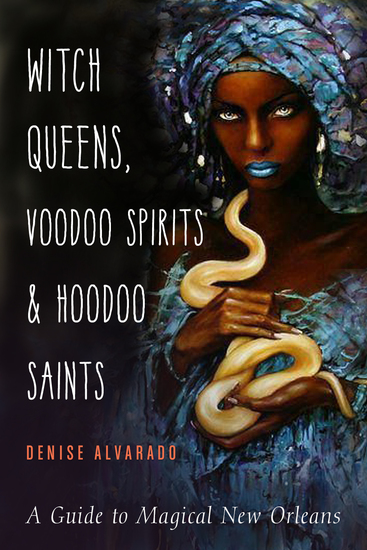
Witch Queens Voodoo Spirits and Hoodoo Saints - A Guide to Magical New Orleans - cover

Witch Queens Voodoo Spirits and Hoodoo Saints - A Guide to Magical New Orleans

Denise Alvarado

Editorial: Weiser Books

  • 0
  • 0
  • 0

Sinopsis

A magical mystery tour of the extraordinary historical characters that have defined the unique spiritual landscape of New Orleans. New Orleans has long been America’s most magical city, inhabited by a fascinating visible and invisible world, full of mysteries, known for its decadence and haunted by its spirits. If Salem, Massachusetts, is famous for its persecution of witches, New Orleans is celebrated for its embrace of the magical, mystical, and paranormal. New Orleans is acclaimed for its witches, ghosts, and vampires. Because of its unique history, New Orleans is the historical stronghold of traditional African religions and spirituality in the US. No other city worldwide is as associated with Vodou as New Orleans. In her new book, author and scholar Denise Alvarado takes us on a magical tour of New Orleans. There is a mysterious spiritual underbelly hiding in plain sight in New Orleans, and in this book Alvarado shows us where it is and who the characters are. She tells where they come from and how they persist and manifest today. Witch Queens, Voodoo Spirits, and Hoodoo Saints shines a light on notable spirits and folk saints such as Papa Legba, Annie Christmas, Black Hawk, African-American culture hero Jean St. Malo, St. Expedite, plague saint Roch, and, of course, the mother and father of New Orleans Voudou, Marie Laveau and Doctor John Montenée. Witch Queens, Voodoo Spirits, and Hoodoo Saints serves as a secret history of New Orleans, revealing details even locals may not know.
Disponible desde: 01/02/2022.
Longitud de impresión: 240 páginas.

Otros libros que te pueden interesar

  • What are we Teaching? Powerful knowledge and a capabilities curriculum - cover

    What are we Teaching? Powerful...

    Richard Bustin

    • 0
    • 1
    • 0
    Written by Richard Bustin, What are we Teaching?Powerful knowledge and a capabilities curriculum offers a fresh perspective on curriculum design, arguing that subjects are key to enabling young people to develop the powerful knowledge needed to flourish in a complex modern world. Moving ideas beyond the 'traditional vs progressive' debates that have dominated education discourse, Richard Bustin challenges the overarching emphasis on exam performance at the expense of the broader benefits of subject knowledge and capabilities such as critical and creative thinking.
    What are we Teaching? explores curriculum debates in relation to the current school climate, considering factors such as knowledge-led education, teaching to the test, and the challenge of teacher retention and recruitment issues. It includes new research involving teachers in real schools engaging with powerful knowledge, and it prompts teachers to evaluate their responsibilities as 'curriculum makers'. The book invites teachers to consider why their subject specialism is important as part of a whole school curriculum vision, and a provides language with which to articulate that.
    Part One introduces the key theories on which the book is based, including different ways of making sense of knowledge, skills and values in the curriculum, powerful knowledge and educational capabilities. What are we Teaching?is research-based, using voices of real teachers who engaged with the question 'what makes your subject powerful knowledge for young people', and Part Two, which focuses on different subject areas, examines these testimonies. The final part offers advice on building a powerful knowledge and capabilities rich curriculum in schools. Each chapter includes a set of reflective questions which can be used as part of ITE training or staff CPD.
    Essential reading for teachers, senior and subject leaders and curriculum coordinators.
    Ver libro
  • Delivered Under Fire - Absalom Markland and Freedom’s Mail - cover

    Delivered Under Fire - Absalom...

    Candice Shy Hooper

    • 0
    • 0
    • 0
    During the Civil War his movements from battlefield to battlefield were followed in the North and in the South nearly as closely as those of generals, though he was not in the military. After the war, his swift response to Ku Klux Klan violence sparked passage of a landmark civil rights law, though he was not a politician. When he died in 1888 newspapers reported his death from coast to coast, yet he's unknown today. He was the man who delivered the most valuable ingredient in United States soldiers' fighting spirit during those terrible war years—letters between the front lines and the home front. He was Absalom Markland, special agent of the United States Post Office, and this is his first biography. 


    At the beginning of the Civil War, at the request of his childhood friend Ulysses S. Grant, Markland created the most efficient military mail system ever devised, and Grant gave him the honorary title of colonel. Nearly every biography of Lincoln, Sherman, and Grant includes at least one footnote about Markland, but his important, sometimes daily interaction with them during and after the war has escaped modern notice, until now. Absalom Markland is a forgotten American hero. Delivered Under Fire tells his amazing story.
    Ver libro
  • No Self No God No Clue - David Hume and the Joy of Destroying Everything - cover

    No Self No God No Clue - David...

    Sophia Blackwell

    • 0
    • 0
    • 0
    ohn Locke: Enlightenment philosopher, father of liberalism, inventor of “natural rights,” and accidental spiritual patron of land developers, libertarians, and your uncle who won’t shut up about property taxes. 
    In this gloriously sarcastic takedown of one of Western philosophy’s most over-quoted minds, Sophia Blackwell (Kant You Not, No Self, No God, No Clue) guides you through Locke’s greatest hits—including: 
    The blank slate theory, which basically says you’re born dumb and the world makes you worse 
    His ideas on identity, which collapse the second you forget your phone password 
    His version of consent, which mostly consists of “You didn’t leave, so I assume you’re fine with it.” 
    And of course, property rights—where mixing your labor with the earth somehow makes it yours, and stealing land becomes morally correct as long as you bring a shovel 
    Locke’s political philosophy inspired democracies, revolutions, and every 400-comment Reddit thread titled “Taxation is theft.” 
    This is not a respectful biography. 
    This is a roast. A eulogy. A survival guide for understanding how Locke gave us: 
    Liberalism 
    Landlords 
    Legal headaches 
    And a political system that thinks fencing off a patch of dirt = moral superiority 
    Perfect for: 
    Recovering philosophy students 
    Political skeptics 
    Enlightenment haters 
    Property law survivors 
    And anyone who wants to laugh while questioning whether government is just a giant metaphor for a really passive-aggressive roommate agreement 
    You don’t need to read Two Treatises of Government. 
    You just need to know Locke said, “I think I own that,” and people believed him.
    Ver libro
  • The Radical Mind - The Origins of Right-Wing Catholic and Protestant Coalition Building - cover

    The Radical Mind - The Origins...

    Chelsea Ebin

    • 0
    • 0
    • 0
    The Radical Mind is a groundbreaking analysis of the origins of the Christian Right, whose political victories are radically reshaping the landscape of American society. Scholars and the public alike have traditionally regarded the New Right and the Christian Right as separate movements. Insofar as both are conservative efforts, most people view them as reactionary and driven by a culture-war backlash against liberal changes to society. 


    Chelsea Ebin's The Radical Mind aims to overturn this consensus. Through a close analysis of New Right architects Connaught Marshner and Paul Weyrich (who is often seen as secular but was a committed Catholic), this book explores the way conservative Catholics and Protestants overcame their long-standing antipathy to form a political coalition—what Ebin calls the New Christian Right. Drawing on extensive archival research, Ebin shows how the movement’s key architects infused right-wing activism with religion. 


    The radical aims of the New Christian Right have been obscured by the way they cultivated a shared identity of victimhood and manipulated the discourse about backlash to create a nostalgic idea of the past that they then leveraged to justify their right-wing policy goals. The Catholic-Protestant alliance constructed an imagined past that they projected into the future as their ideal vision of society. Ebin calls this strategy "prefigurative traditionalism"—a paradoxical prefiguring of a manufactured past. Using this tactic, the New Christian Right coalition disguised the radicality of its politics by framing their aims as reactionary and defensive rather than proactive and offensive.
    Ver libro
  • Philemon - The World English Bible Book 57 (Unabridged) - cover

    Philemon - The World English...

    Various Authors

    • 0
    • 0
    • 0
    Philemon is one of the books of the Christian New Testament. It is a prison letter, co-authored by Paul the Apostle with Timothy, to Philemon, a leader in the Colossian church. It deals with the themes of forgiveness and reconciliation.
    Ver libro
  • The Jacobins vs the Girondins - Political Factions - cover

    The Jacobins vs the Girondins -...

    Amara Blackwood

    • 0
    • 0
    • 0
    The Jacobins and Girondins were two of the most influential political factions during the French Revolution, each representing different visions for the future of France. Their rivalry played a significant role in shaping revolutionary politics and ultimately led to the radicalization of the movement. While both groups initially sought to overthrow the monarchy and establish a republic, their ideological differences and approaches to governance placed them on a collision course. 
    The Jacobins emerged as a radical force advocating for centralized power, direct democracy, and the use of revolutionary violence to achieve their goals. They were named after their meeting place, the Jacobin Club, a former Dominican convent in Paris. The Jacobins attracted members who believed in strong government control, economic regulation, and the direct involvement of the lower classes in politics. They were heavily influenced by Enlightenment ideals, particularly the belief in equality and the general will of the people, as expressed by philosophers like Jean-Jacques Rousseau. The most prominent Jacobin leaders, including Maximilien Robespierre, Georges Danton, and Jean-Paul Marat, pushed for radical reforms such as the execution of King Louis XVI and the implementation of policies that favored the common people. 
    In contrast, the Girondins represented a more moderate and decentralized vision of the revolution. Many of their members came from the Gironde region, giving the faction its name, and they were often associated with the provincial bourgeoisie. The Girondins supported a constitutional monarchy in the early stages of the revolution but later advocated for a republican form of government with more power distributed among local authorities rather than concentrated in Paris.
    Ver libro