Unisciti a noi in un viaggio nel mondo dei libri!
Aggiungi questo libro allo scaffale
Grey
Scrivi un nuovo commento Default profile 50px
Grey
Iscriviti per leggere l'intero libro o leggi le prime pagine gratuitamente!
All characters reduced
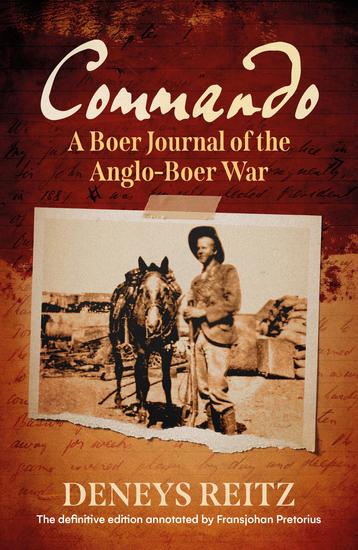
Commando - A Boer Journal of the Anglo-Boer War - cover

Commando - A Boer Journal of the Anglo-Boer War

Deneys Reitz

Casa editrice: Jonathan Ball

  • 0
  • 0
  • 0

Sinossi

The definitive account of Commando: A Boer Journal of the Anglo-Boer War, published word-for-word as Reitz first wrote it in the English translation; edited and annotated by historian and Anglo-Boer War expert, Professor Fransjohan Pretorius.
In 1899, Deneys Reitz, then aged seventeen, enlisted in the Boer army to fight the British. He had learnt to ride, shoot and swim almost as soon as he could walk. He made full use of these skills and the endurance he had acquired in the next three years of the war, during which he fought with the Boer commandos.
He was involved in major actions, like the battle of Spioen Kop, and he interacted with prolific political and military figures of the time, such as President Paul Kruger, Boer generals Piet Joubert, Louis Botha, Koos de la Rey, Christiaan Beyers, Jan Smuts and British commander Lord Kitchener. He even met the young Winston Churchill as a prisoner-of-war in Pretoria. Reitz forged a strong personal and political friendship with General Jan Smuts after the war, built on reciprocal respect.
Commando is more than a historical document; it is a literary masterpiece that transcends time.
With prose that captures both the brutality and the beauty of war, Reitz weaves a narrative that resonates with authenticity and passion.
As relevant today as when it was first penned, Commando has become a South African classic and stands as a testament to the indomitable human spirit.
Disponibile da: 26/06/2024.
Lunghezza di stampa: 310 pagine.

Altri libri che potrebbero interessarti

  • The Scientific Approach to Buddhism and The Appeal of Buddhism - Two Essays - cover

    The Scientific Approach to...

    Francis Story

    • 0
    • 0
    • 0
    This is an audiobook of Bodhi Leaves No. 55 by Francis Story (Anāgārika Sugatānanda), The Scientific Approach to Buddhism and The Appeal of Buddhism, two essays narrated by Christa Michel. The print edition can be found in the Pariyatti Edition of Collected Bodhi Leaves Vol. 2. The eBook of Bodhi Leaves No. 55 can be downloaded from the BPS website. 
    Excerpt from The Scientific Approach to Buddhism: 
    At present it may look as though man has only searched out the secrets of the universe in order to destroy himself with the power he has acquired; and of that there is certainly a danger. But I believe that a change in outlook is beginning to dawn, and that science itself, having destroyed the basis of much wrong thinking, is drawing us ever nearer to the realisation of the truth proclaimed by the Enlightened One. This is what I mean by “the scientific approach to Buddhism;” without being aware of it, the modern scientist and philosopher are being propelled irresistibly in the direction of Buddhism. Their uncertainties and doubts are spiritual “growing pains;” but a time will come quickly when they will realise that, although they have had to reject everything on which their ordinary religious and moral beliefs are founded, there is a higher religion—one based upon systematic investigation and the sincere search for truth—which will restore their lost faith in the universal principles of justice, truth and compassion. Those who now believe that man has come to the end of his tether will then see the opening up of vistas into the future that they only dimly suspect, and will recognise, beyond it all, the final goal of complete emancipation from the fetters of ignorance and delusion.
    Mostra libro
  • History of the Netherlands - The Dutch Wars Wealth Navy Trade and Culture - cover

    History of the Netherlands - The...

    Kelly Mass

    • 0
    • 0
    • 0
    This is a great package of several titles in one book. The topics are all related to the history of the Netherlands. Let’s take a look at the topics. 
    Early Dutch History: The Netherlands has a history that dates far back, even before Roman times. Let’s take a look at what happened during the times of the Romans. I remember visiting the Netherlands and visiting the city of Utrecht, a major hub in the central part of the country. 
    The Batavians: In this book, we will shed more light on the Batavians, a people in history with much bravery, innovation, and determination to form a republic with freedom for its citizens. The Republic of the 7 United Netherlands was followed by the Batavian Republic. 
    The Dutch Empire: The Dutch were all over the world. They "owned" and colonized a big portion of what was then the known world. They were among the first settlers, had the biggest haven and biggest fleet for some time. 
    The Eighty Years War: The war between the protestant Netherlands, mostly led by William of Orange, and Catholic Spain, was one of the marks in Dutch history. This war has determined the beliefs of many people who now live about the three rivers that go through the country: Most of the people north of the rivers are protestant, and most of the believers below them (even throughout Belgium as well) are Catholic. 
    The Golden Age: The Dutch Golden Era was a time in Dutch history varying circa from 1588 (the start of the Dutch Republic) to 1672 (the "Catastrophe Year"), throughout which Dutch trade, science, and art, and the Dutch armed force, were amongst the world's best.
    Mostra libro
  • Reading Black Books - How African American Literature Can Make Our Faith More Whole and Just - cover

    Reading Black Books - How...

    Claude Atcho

    • 0
    • 0
    • 0
    Learning from Black voices means listening to more than snippets. It means attending to Black stories. Reading Black Books helps Christians hear and learn from enduring Black voices and stories as captured in classic African American literature. 


    Pastor and teacher Claude Atcho offers a theological approach to ten seminal texts of twentieth-century African American literature. Each chapter takes up a theological category for inquiry through a close literary reading and theological reflection on a primary literary text, from Ralph Ellison's Invisible Man and Richard Wright's Native Son to Zora Neale Hurston's Moses, Man of the Mountain and James Baldwin's Go Tell It on the Mountain. The book includes end-of-chapter discussion questions. 


    Reading Black Books helps readers of all backgrounds learn from the contours of Christian faith formed and forged by Black stories, and it spurs continued conversations about racial justice in the church. It demonstrates that reading about Black experience as shown in the literature of great African American writers can guide us toward sharper theological thinking and more faithful living.
    Mostra libro
  • A Rare Recording of Oliver Lodge - cover

    A Rare Recording of Oliver Lodge

    Oliver Lodge

    • 0
    • 0
    • 0
    This is a rare recording of Oliver Joseph Lodge, June 12, 1851 – August 22, 1940, a British physicist and writer involved in the development of, and holder of key patents for, radio.  
    In addition, Lodge wrote more than 40 books, about the afterlife, aether, relativity, and electromagnetic theory. 
    ©2016 Listen & Live Audio (P)2016 Listen & Live Audio
    Mostra libro
  • Rashtrakuta Empire - Military Prowess and Architectural Marvels - cover

    Rashtrakuta Empire - Military...

    Rolf Hedger

    • 0
    • 0
    • 0
    The Rashtrakutas were one of the most powerful dynasties in Indian history, ruling vast territories across the Deccan and beyond. Their origins, however, remain a subject of debate among historians due to conflicting inscriptions and interpretations. Some sources trace their roots to the Kannada-speaking regions, while others suggest connections to northern India. Despite the uncertainty, it is widely accepted that the Rashtrakutas emerged as a prominent force in the Deccan by the 8th century. 
    The dynasty first gained prominence under the rule of Dantidurga, who established Rashtrakuta authority by overthrowing the Chalukyas of Badami. However, evidence suggests that the Rashtrakutas had been a significant regional power even before his reign. The earliest references to the name "Rashtrakuta" appear in inscriptions from the 6th and 7th centuries, indicating that they were already influential feudatories before rising to imperial status. Some scholars believe they originally served as administrators or military governors under the Chalukyas before asserting their independence. 
    The question of the dynasty’s ethnic and linguistic identity has long been debated. Some sources claim that they were of Kannada origin, citing inscriptions and literary works composed in the Kannada language under their patronage. Others argue that they may have had northern Indian roots, pointing to their interactions with Rajput and Gurjara clans. Regardless of their precise origins, the Rashtrakutas embraced the cultural diversity of the Deccan, ruling over a population that spoke multiple languages, including Kannada, Sanskrit, and Marathi.
    Mostra libro
  • Nok Civilization - The Mysterious Sculptor of Terracotta and West Africa's Early Culture - cover

    Nok Civilization - The...

    Rolf Hedger

    • 0
    • 0
    • 0
    The Nok civilization is one of the most fascinating and mysterious ancient cultures of West Africa. It flourished between approximately 1500 BCE and 500 CE, making it one of the earliest known complex societies in sub-Saharan Africa. The Nok people are best known for their remarkable terracotta sculptures, which provide valuable insights into their artistry, beliefs, and way of life. Despite their historical significance, much about the Nok civilization remains unknown, leaving archaeologists and historians to piece together their story from scattered artifacts and excavation sites. 
    The first discovery of Nok artifacts occurred in 1928, when British archaeologist Bernard Fagg came across a series of terracotta figurines in central Nigeria. These artifacts, found near the village of Nok, revealed an advanced artistic style that was distinct from any previously known African culture. The sculptures depicted human figures with intricate hairstyles, elaborate jewelry, and expressive facial features, suggesting a highly developed artistic tradition. This discovery marked the beginning of a deeper exploration into the Nok civilization, leading to further excavations that uncovered tools, pottery, and evidence of early ironworking. 
    One of the most significant aspects of Nok’s discovery was its role in the history of metallurgy in Africa. Archaeological findings suggest that the Nok people were among the earliest in West Africa to practice iron smelting, a technological advancement that contributed to agricultural development and societal growth. The presence of iron tools indicates that they engaged in farming, hunting, and trade, supporting the idea that Nok society was well-organized and economically active.
    Mostra libro