Join us on a literary world trip!
Add this book to bookshelf
Grey
Write a new comment Default profile 50px
Grey
Subscribe to read the full book or read the first pages for free!
All characters reduced
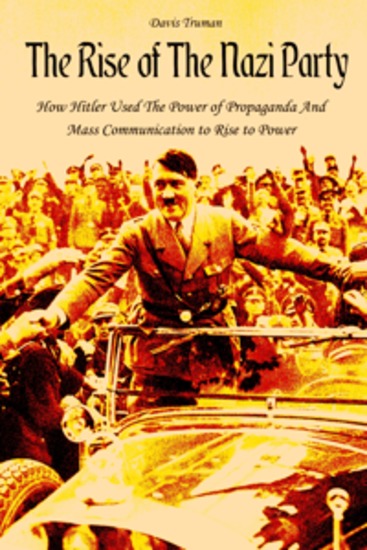
The Rise of The Nazi Party - How Hitler Used The Power of Propaganda And Mass Communication to Rise to Power - cover

The Rise of The Nazi Party - How Hitler Used The Power of Propaganda And Mass Communication to Rise to Power

Davis Truman

Publisher: Davis Truman

  • 0
  • 0
  • 0

Summary

The Nazi party's rise to power in Germany during the 1930s is widely attributed to its leaders' strategic use of propaganda, most notably Adolf Hitler. Propaganda played a significant role in shaping public opinion and manipulating the masses to support the Nazi party's extremist ideologies, ultimately leading to one of the most catastrophic events in human history - World War II. This rise to power was not a sudden occurrence, but a gradual process involving an extensive and sophisticated propaganda campaign that targeted various aspects of German society. In this book, we will explore how propaganda was used to fuel the Nazi party's rise and examine how it gained support from the German people, including through symbols, slogans, and persuasive rhetoric. The consequences of this propaganda-driven rise to power continue to profoundly impact modern politics and our perception of how propaganda shapes public opinion.
Available since: 04/19/2025.
Print length: 115 pages.

Other books that might interest you

  • Hope and Honor - Jewish Resistance during the Holocaust - cover

    Hope and Honor - Jewish...

    Rachel L. Einwohner

    • 0
    • 0
    • 0
    A powerful account of Jewish resistance in Nazi-occupied Europe and why such resistance was so remarkable. 


    Most popular accounts of the Holocaust typically cast Jewish victims as meek and ask, "Why didn't Jews resist?" But we know now that Jews did resist, staging armed uprisings in ghettos and camps throughout Nazi-occupied Europe. In Hope and Honor, Rachel L. Einwohner illustrates the dangers in attempting resistance under unimaginable conditions and shows how remarkable such resistance was. She draws on oral testimonies, published and unpublished diaries and memoirs, and other written materials produced both by survivors and those who perished to show how Jews living under Nazi occupation in the ghettos of Warsaw, Vilna, and Lódz reached decisions about resistance. Using methods of comparative-historical sociology, Einwohner shows that decisions about resistance rested on Jews' assessments of the threats facing them, and somewhat ironically, armed resistance took place only once activists reached the critical conclusion that they had no hope for survival. Rather than ask the typical question of why Jews generally didn't resist, this powerful account of Jewish resistance seeks to explain why they resisted at all when there was no hope for success, and they faced almost certain death.
    Show book
  • Analysis of Tarot Cards An - cover

    Analysis of Tarot Cards An

    Manly Palmer Hall

    • 0
    • 0
    • 0
    Opinions of authorities differ widely concerning the origin of playing cards, the purpose for which they were intended, and the time of their introduction into Europe. In his Researches into the History of Playing Cards, Samuel Weller Singer advances the opinion that cards reached Southern Europe from India by way of Arabia. It is probable that the Tarot cards were part of the magical and philosophical lore secured by the Knights Templars from the Saracens or one of the mystical sects then flourishing in Syria. Returning to Europe, the Templars, to avoid persecution, concealed the arcane meaning of the symbols by introducing the leaves of their magical book ostensibly as a device for amusement and gambling. 
    Through the Gypsies the Tarot cards may be traced back to the religious symbolism of the ancient Egyptians. In his remarkable work, The Gypsies, Samuel Roberts presents ample proof of their Egyptian origin. In one place he writes: "When Gypsies originally arrived in England is very uncertain. They are first noticed in our laws, by several statutes against them in the reign of Henry VIII.; in which they are described as 'an outlandish people, calling themselves Egyptians,--who do not profess any craft or trade, but go about in great numbers, * * *.'" A curious legend relates that after the destruction of the Serapeum in Alexandria, the large body of attendant priests banded themselves together to preserve the secrets of the rites of Serapis. Their descendants (Gypsies) carrying with them the most precious of the volumes saved from the burning library--the Book of Enoch, or Thoth (the Tarot)--became wanderers upon the face of the earth, remaining a people apart with an ancient language and a birthright of magic and mystery.
    Show book
  • Short stories (Early works 1837-1852) - cover

    Short stories (Early works...

    Elizabeth Cleghorn Gaskell

    • 0
    • 0
    • 0
    "Delve into the early works of Elizabeth Cleghorn Gaskell with this audiobook collection of short stories. Before she became a celebrated novelist, Gaskell penned a series of captivating tales that showcase her budding talent as a storyteller.These early works, written between 1837 and 1852, offer a glimpse into the formative years of a literary genius. Gaskell's stories are a reflection of the society and culture of her time, exploring themes of love, class, and social dynamics.As you listen to these tales, you'll witness the development of Gaskell's distinctive narrative style and her ability to create vivid, relatable characters. Her insights into human nature and her skill at conveying the complexities of human relationships are already apparent in these early writings.This audiobook is a literary treasure trove for both Gaskell enthusiasts and those new to her work, providing a fresh perspective on the evolution of a great author's craft."
    Show book
  • Building a History - The Lego Group - cover

    Building a History - The Lego Group

    Sarah Herman

    • 0
    • 1
    • 0
    The story of these beloved bricks and the people who built an empire with them.   From its inception in the early 1930s right up until today, the LEGO Group’s history is as colorful as the toys it makes. Few other playthings share the LEGO brand’s creative spirit, educational benefits, resilience, quality, and universal appeal. This history charts the birth of the LEGO Group from the workshop of a Danish carpenter and its steady growth as a small, family-run toy manufacturer to its current position as a market-leading, award-winning brand. The company’s growing catalogue of products—including the earliest wooden toys, plastic bricks, play themes and other building systems such as DUPLO, Technic, and MINDSTORMS—are chronicled in detail, alongside the manufacturing process, LEGOLAND parks, licensed toys, and computer games.   Learn all about how LEGO pulled itself out of an economic crisis and embraced technology to make building blocks relevant to twenty-first century children, and discover the vibrant fan community of kids and adults whose conventions, websites, and artwork keep the LEGO spirit alive. Building a History will have you reminiscing about old Classic Space sets, rummaging through the attic for forgotten minifigure friends, and playing with whatever LEGO bricks you can get your hands on (even if it means sharing with your kids).
    Show book
  • The Enemy Harassed - Washington's New Jersey Campaign of 1777 - cover

    The Enemy Harassed -...

    Jim Stempel

    • 0
    • 0
    • 0
    In late December 1776, the American War of Independence appeared to be on its last legs. General George Washington's continental forces had been reduced to a shadow of their former strength, and the British Army had chased them across the Delaware River into Pennsylvania. Desperate times call for desperate measures, however, and George Washington responded to this crisis with astonishing audacity. On Christmas night 1776, he recrossed the Delaware as a nor'easter churned up the coast, burying his small detachment under howling sheets of snow and ice. Undaunted, they attacked a Hessian brigade at Trenton, New Jersey, taking the German auxiliaries by complete surprise. Then, only three days later, Washington struck again, crossing the Delaware, slipping away from the British at Trenton, and attacking the Redcoats at Princeton. 


    The British, now back on their heels, retreated toward New Brunswick as Washington's reinvigorated force followed them north into Jersey. Over the next eight months, Washington's continentals and the state militias of New Jersey would go head-to-head with the British in a multitude of battles, eventually forcing the British to flee New Jersey by sea. In this captivating narrative of the American War of Independence, Jim Stempel brings to life one of the most violent, courageous, yet virtually forgotten periods of the Revolutionary War.
    Show book
  • African American History - A Very Short Introduction - cover

    African American History - A...

    Jonathan Scott Holloway

    • 0
    • 0
    • 0
    What does it mean to be an American? The story of the African American past demonstrates the difficulty of answering this seemingly simple question. This book illuminates the US's core paradoxes, inviting profound questions about what it means to be an American, a citizen, and a human being. 


    This book considers how, for centuries, African Americans have fought for what the black feminist intellectual Anna Julia Cooper called "the cause of freedom." It begins in Jamestown in 1619, when the first shipment of enslaved Africans arrived in that settlement. It narrates the creation of a system of racialized chattel slavery, the eventual dismantling of that system in the national bloodletting of the Civil War, and the ways that civil rights disputes have continued to erupt in the more than 150 years since Emancipation. This Very Short Introduction carries forward to the Black Lives Matter movement, a grass-roots activist convulsion that declared that African Americans' present and past have value and meaning. At a moment when political debates grapple with the nation's obligation to acknowledge and perhaps even repair its original sin of racialized slavery, author Jonathan Scott Holloway tells a story about American citizens' capacity and willingness to realize the ideal articulated in America's founding document, namely, that all people were created equal.
    Show book