Join us on a literary world trip!
Add this book to bookshelf
Grey
Write a new comment Default profile 50px
Grey
Subscribe to read the full book or read the first pages for free!
All characters reduced
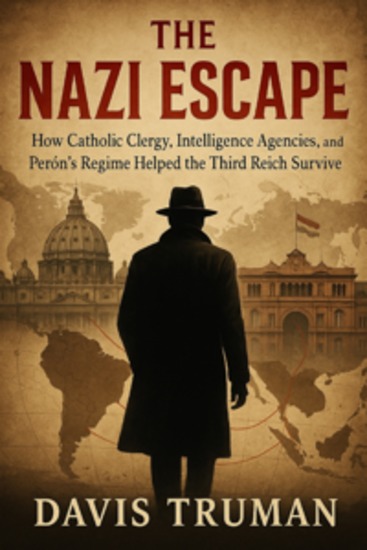
The Nazi Escape - How Catholic Clergy Intelligence Agencies and Perón's Regime Helped the Third Reich Survive - cover

The Nazi Escape - How Catholic Clergy Intelligence Agencies and Perón's Regime Helped the Third Reich Survive

Davis Truman

Publisher: Davis Truman

  • 0
  • 0
  • 0

Summary

In The Nazi Escape, uncover the shocking, meticulously researched story of how a secretive global alliance, spanning Vatican corridors, Allied intelligence networks, and Argentina’s highest political ranks, engineered one of history’s most chilling cover-ups. With the Third Reich in ruins, elite Nazi war criminals vanished without a trace. But they didn’t disappear... they were helped.This gripping exposé reveals how Catholic clergy operated covert escape routes known as “ratlines,” how Western intelligence agencies turned a blind eye, or lent a hand, and how Juan Perón’s Argentina became a haven for some of the most notorious figures of World War II.From shadowy monasteries in Rome to the pampas of South America, The Nazi Escape reads like a thriller, but every word is true. Packed with declassified documents, firsthand accounts, and shocking revelations, this is the untold story the world wasn’t supposed to know.
Available since: 05/13/2025.


Other books that might interest you

  • What is Art? - cover

    What is Art?

    Leo Tolstoy

    • 0
    • 0
    • 0
    During the decades of his world fame as sage and preacher as well as author of War and Peace and Anna Karenina, Leo Tolstoy wrote prolifically in a series of essays and polemics on issues of morality, social justice and religion.
    
    These culminated in What Is Art?, published in 1898. Although Tolstoy perceived the question of art to be a religious one, he considered and rejected the idea that art reveals and reinvents through beauty. The works of Dante, Michelangelo, Shakespeare, Beethoven, Baudelaire, and even his own novels are condemned in the course of Tolstoy's impassioned and iconoclastic redefinition of art as a force for good; for the improvement of humankind.
    Show book
  • CBT Basics and Beyond - cover

    CBT Basics and Beyond

    Noah Rudlow

    • 0
    • 0
    • 0
    CBT Basics and Beyond: The Essential Guide to Understanding and Implementing Cognitive Behavioral Therapy to Help Overcome Negative Thoughts and EmotionsCognitive Behavioral Therapy, or CBT, is a form of psychotherapy that has been proven effective in treating a wide range of mental health disorders. It is based on the idea that our thoughts and beliefs can greatly impact our feelings and behaviors, and that by identifying and changing negative or distorted thinking patterns, we can improve our emotional and physical well-being.This audiobook will teach you all about cognitive behavior therapy and how it can be used to overcome negative thoughts and emotions and help you live a more balanced life. We will explore the principles and techniques of CBT and how it can be used to effectively treat a range of mental health disorders.This audiobook will cover the following topics:- What is CBT- How CBT works- Pros and Cons of CBT- Advantage of CBT over other forms of therapy- CBT Strategies- Understanding Your Thought Patterns- Breaking Bad Habits Through CBT- CBT as cure for depression- CBT for anger management- Cognitive Distortions- And many more!CBT is widely regarded as an effective treatment for a range of mental health conditions. To learn more, scroll up and click “add to cart” now!
    Show book
  • Simón Bolívar - The Latin American Rebel Patriot and Freedom Fighter - cover

    Simón Bolívar - The Latin...

    Kelly Mass

    • 0
    • 0
    • 0
    Simón Bolívar, born Simón José Antonio de la Santísima Trinidad Bolívar, was a prominent Venezuelan military and political leader who played a pivotal role in the liberation of several South American countries from Spanish colonial rule. Bolívar's full name, a reflection of the Spanish naming tradition, encompassed multiple middle names, highlighting his family's social status. His leadership and vision helped Colombia, Venezuela, Ecuador, Panama, Peru, and Bolivia secure their independence from the Spanish Empire during the early 19th century. 
    Bolívar was born into a wealthy, aristocratic family in Caracas, Venezuela. As was customary for the sons of affluent families at the time, he was sent abroad to receive his education. Initially, he traveled to Spain and later to France, where he encountered Enlightenment ideals that deeply influenced his political and philosophical beliefs. These ideas, particularly the notions of liberty and self-determination, fueled his desire to rid Latin America of Spanish control. Bolívar’s campaign for independence began in earnest in 1808, seizing the opportunity presented by the political instability in Spain caused by the Napoleonic Wars. This chaos allowed Bolívar and other revolutionaries to push forward their independence efforts.
    Show book
  • Hamas In Palestine - cover

    Hamas In Palestine

    Davis Truman

    • 0
    • 0
    • 0
    Hamas, from the Arabic Islamic Resistance Movement, is a militant Islamist organization that aims to represent and lead a resistance movement for the liberation of Palestine from Israeli occupation. The Movement is difficult to place on the spectrum of other non-State actors, such as Hezbollah, as since 2007, it has established itself as the de facto leader of the Gaza Strip, assuming the functions of authority and government. Despite being considered a terrorist organization by the European Union, the United States, and Israel, the group rejects this designation and its diplomatic relations with major state actors such as Iran, Qatar, and Turkey.  
    The Jewish-Palestinian conflict is a complex and long-running conflict rooted in the 19th Century. It intensified during the 20th Century when Jewish immigration to Palestine grew significantly. This conflict focuses mainly on the struggle for land control between Jews and Palestinians in that region. 
    Within Israeli and Palestinian societies, the conflict generates a wide variety of positions. A distinctive feature of the conflict was the level of violence perpetrated for much of its duration. There have been clashes between regular armies, paramilitary groups, terrorist cells, and independent citizens. These clashes were not strictly limited to the military camp and caused a large number of civilian casualties on both sides.
    Show book
  • The US Congress - A Very Short Introduction - cover

    The US Congress - A Very Short...

    Donald A. Ritchie

    • 0
    • 0
    • 0
    Donald A. Ritchie, a congressional historian for forty years, takes listeners on a fascinating, behind-the-scenes tour of Capitol Hill, pointing out the key players, explaining their behavior, and translating parliamentary language into plain English. He also explores the essential necessity of compromise to accomplish anything significant in the legislative arena. However, recent events show that political polarization has hardened and produced gridlock. The 2020 election also produced a more diverse membership in terms of gender, ethnicity, religion, and ideology, with primary elections resulting in the defeat of moderate candidates, making bipartisan compromise harder to achieve. 


    Among the most significant events, the Senate ignored President Obama's last nomination to the Supreme Court and then adopted a "nuclear option" to streamline future Supreme Court confirmations. The House also twice impeached President Trump, processes that starkly expose the differences between the majority-rule requirements of the House and the super-majority requirements of the Senate. This new edition explains how the parties have changed in light of the unprecedented politics of the past four years, culminating in the mob attack on the U.S. Capitol on January 6, 2021, and how this development has affected both the House and the Senate.
    Show book
  • The Song Dynasty - Economic and Technological Innovations - cover

    The Song Dynasty - Economic and...

    Jun Liu

    • 0
    • 0
    • 0
    The Song Dynasty (960–1279) emerged from the remnants of the fragmented Five Dynasties and Ten Kingdoms period, establishing a centralized government that would shape China for centuries. Unlike previous dynasties that relied heavily on military conquest, the Song prioritized administration, economic growth, and cultural development, laying the foundation for one of the most prosperous eras in Chinese history. 
    The dynasty is traditionally divided into two periods: the Northern Song (960–1127) and the Southern Song (1127–1279). The Northern Song was founded by Emperor Taizu, who implemented policies to weaken the power of military governors and strengthen civilian rule. This shift reduced the influence of warlords, allowing for a stable bureaucratic system. However, external threats, particularly from the Khitan Liao and later the Jurchen Jin, forced the court to focus on diplomacy and financial strategies rather than military expansion. Eventually, the Jin conquest of the north in 1127 led to the retreat of the Song court to the south, marking the beginning of the Southern Song period. Despite losing control over key northern territories, the Southern Song maintained a flourishing economy, driven by trade, technological advancements, and agricultural productivity. 
    The Song Dynasty’s political structure was characterized by a well-organized bureaucracy based on merit rather than aristocratic privilege. The expansion of the civil service examination system ensured that government officials were selected through rigorous academic testing rather than birthright. This system, rooted in Confucian ideals, emphasized knowledge of classical texts and governance principles, creating a scholar-official class that played a crucial role in state affairs. While this meritocratic system promoted stability, it also created a conservative bureaucracy resistant to radical reforms.
    Show book