Join us on a literary world trip!
Add this book to bookshelf
Grey
Write a new comment Default profile 50px
Grey
Subscribe to read the full book or read the first pages for free!
All characters reduced
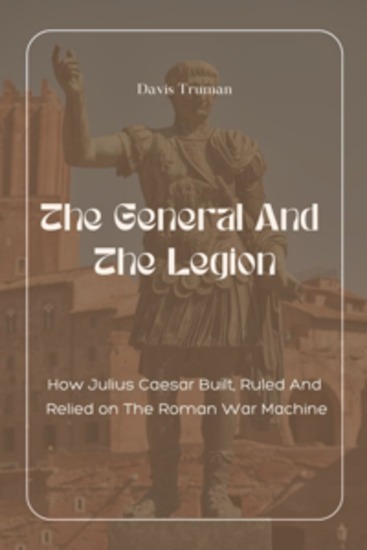
The General And The Legion - How Julius Caesar Built Ruled And Relied on The Roman War Machine - cover

The General And The Legion - How Julius Caesar Built Ruled And Relied on The Roman War Machine

Davis Truman

Publisher: Davis Truman

  • 0
  • 0
  • 0

Summary

In the annals of military history, few names evoke the same awe and legacy as Julius Caesar. The General and the Legion is a gripping exploration of how one man's political genius, military brilliance, and strategic human insight transformed a republic into an empire, one loyal legion at a time.From the chaotic streets of Roman politics to the thunder of marching boots across Gaul, this powerful narrative dissects Caesar's meteoric rise and the disciplined force that made it possible. This book peels back the layers of the myth to reveal the man who didn't just lead Rome's war machine. He embodied it.Inside, you'll discover:Caesar's evolution in the political arena and how it shaped his command style.The inner workings of Roman military life and the culture of the legions.How Caesar earned, kept, and at times manipulated the fierce loyalty of his soldiers.Insights into military pay, morale, and the subtle strategies behind soldier satisfaction.A unique look at Caesar's famed clemency and diplomatic mind, tools as deadly as his sword. The art of reward, favor, and empire-building through personal loyalty. Perfect for history lovers, military strategists, and leadership enthusiasts alike, The General and the Legion reveals how Caesar conquered and why his soldiers followed him to the ends of the earth—and beyond.
Available since: 04/12/2025.
Print length: 84 pages.

Other books that might interest you

  • Fortune and Folly - The Weird and Wonderful Life of the South's Most Eccentric Millionaire - cover

    Fortune and Folly - The Weird...

    Sara A. H. Butler

    • 0
    • 0
    • 0
    Briarcliff Mansion and the land it occupies are owned by Emory University, which refers to it as its "Briarcliff Campus." Fortune and Folly, in part, illuminates the largely lost story of how the mansion, and the entire surrounding neighborhood, got its name. But in order to understand the mansion, we have to understand the man who built it. 


    Briarcliff Mansion once belonged to a man named Asa Candler, Jr.—also known as Buddie. The second son and namesake of Coca-Cola founder Asa Griggs Candler, Buddie was a wealthy real estate developer of great successes and greater failures. A man of big vision and bigger adventures, and a socialite whose boisterous, unapologetic personality made him both beloved and reviled in the Atlanta community. But after he passed away in 1953, his stories faded from memory, either tangled up with or overshadowed by his father. 


    It's no mystery why Briarcliff garners attention. It's self-consciously grandiose, built to display maximum grandeur to the neighborhood. It towers over the landscape, set far back from the road behind a filled-in, overgrown pool. Its face is stitched together where a music hall was added two years after the main house was completed, and the bricks don't quite match up. This book offers a deep-dive into the life of Asa Candler, Jr. to excavate a piece—and place—of Atlanta history.
    Show book
  • Urban Transportation - Solutions for Sustainable Mobility - cover

    Urban Transportation - Solutions...

    Lyric Vale

    • 0
    • 0
    • 0
    Urban transportation plays a pivotal role in shaping the way cities function, impacting everything from daily commuting to the overall economic and environmental health of urban areas. In modern society, cities are becoming increasingly crowded, with more people migrating to urban centers in search of opportunities, better infrastructure, and access to services. As populations swell, urban transportation systems have struggled to keep pace with demand, leading to issues such as congestion, pollution, and inefficiency. 
    Historically, urban transportation has evolved in response to changing needs and technological advancements. Early cities relied on walking and horse-drawn carriages, but with the rise of industrialization, motorized transport took over. Streetcars, buses, and eventually cars became the main modes of transport in urban environments. However, as cities expanded and the number of vehicles grew, so did the problems associated with these systems. Traffic congestion became a daily reality in many metropolitan areas, with commuters spending hours stuck in traffic, wasting time, and burning fuel. 
    Environmental concerns further compounded the issue. The increasing number of vehicles on the road, many of which run on fossil fuels, has significantly contributed to air pollution, climate change, and the depletion of natural resources. As cities continue to grow, the challenge of balancing transportation needs with environmental sustainability has become more urgent. In response, there has been a global push to shift toward more sustainable, efficient, and inclusive transportation systems.
    Show book
  • The Death Doula's Guide to Living Fully and Dying Prepared - An Essential Workbook to Help You Reflect Back Plan Ahead and Find Peace on Your Journey - cover

    The Death Doula's Guide to...

    Francesca Lynn Arnoldy

    • 0
    • 0
    • 0
    If you are preparing for the end of life—or simply looking to bring more meaning to the here and now—The Death Doula's Guide to Living Fully and Dying Prepared imparts valuable insight to nurture clarity and your internal strength on your journey. This workbook is a first-of-its-kind publication that invites you to process your life and legacy, create remembrance projects, build connections to vital supports, and draft informative wishes and plans for your last chapter. 


    Replete with centering techniques and thought-provoking prompts, this comprehensive workbook is a welcome invitation for anyone seeking a more intentional approach to living and dying. It provides a practical template for end-of-life planning focused on designing comforting experiences that feel personally affirming—with sensitivity to all belief systems, cultures, identities, and histories of lived experience. 


    Completing this workbook is a brave act of healthy preparedness, as it breaks down a complex and often overwhelming topic into manageable tasks. You will tap into deep truths and poignant memories as you work through the exercises, often feeling lighter and less burdened upon their completion. Most importantly, you'll find your best way to live fully and die prepared, by clarifying the fundamental ideals, priorities, and requests you want honored.
    Show book
  • First Time Hammering - MM First Time - cover

    First Time Hammering - MM First...

    Rainbow Press

    • 0
    • 0
    • 0
    Jace has a big job that needs filling. 
      
    An in-home art studio is in order, and he receives a hardy recommendation for Vaughn and his team of construction workers. Having hot, sweaty men in his apartment, hammering away, is more stimulating to Jace’s artistic tastes than he had imagined. 
      
    When Vaughn gets a glimpse of the book of sketches Jace has left out, he knows exactly what kind of of job really needs filling. All Jace needs is for a big, strong man to take control of the situation and give him a nailing he’ll never forget.
    Show book
  • Stories Behind the Great Traditions of Christmas - Discovering the History of Our Favorite Christmas Celebrations - cover

    Stories Behind the Great...

    Ace Collins

    • 0
    • 0
    • 0
    Enhance your holiday celebrations as you discover the real story behind some of your most beloved Christmas customs and how they all point to Christ. 
    Ever wonder where some of our unique and meaningful Christmas traditions come from?Why are red and green popular colors of the season?Why is exchanging gifts a family tradition?  
    The golden traditions of Christmas—gifts, wreaths, stockings, carols, mistletoe, and more—infuse your celebration of the season with meaning and glowing memories. And, in ways you may not realize, they also point you to the birth of Christ. Stories Behind the Great Traditions of Christmas reveals the people, places, and events that shaped the best-loved customs of this merriest of holidays. 
    Stories Behind the Great Traditions of Christmas includes insights about:Gift givingChristmas treesCarolingNativity scenesYule logsStockingsAdvent wreathsMistletoeHolly, and more! 
      
    You will discover how:After eighteen centuries of all but ignoring the event, churches began to open the door for believers to commemorate Jesus’ incarnationThe evergreen tree, once a central theme in the worship practices of pagan cultures, came to represent the everlasting love of GodThe magi's three gifts—gold, frankincense, and myrrh—are filled with spiritual symbolism 
      
    Stories Behind the Great Traditions of Christmas is the perfect gift to infuse your celebration with spiritual insights, true-life tales, and captivating legends to intrigue you and your family. Bring new luster and depth to your modern traditions while you celebrate Jesus' birth. The traditions of Christmas lend beauty, awe, and hope to the holiday, causing people all over the world to anticipate it with joy. Warm your heart as you rediscover the true and eternal significance of Christmas.
    Show book
  • Goodbye Russia - Rachmaninoff in Exile - cover

    Goodbye Russia - Rachmaninoff in...

    Fiona Maddocks

    • 0
    • 0
    • 0
    In 1940, Sergei Rachmaninoff, living in exile in America, broke his creative silence and composed a swan song to his Russian homeland—his iconic "Symphonic Dances." What happened in those final haunted years and how did he come to write his farewell masterpiece? 


    Rachmaninoff left Petrograd (now St. Petersburg) in 1917 during the throes of the Russian Revolution. He was forty-four years old, at the peak of his powers as composer-conductor-performer, moving in elite Tsarist circles, as well as running the family estate, his refuge and solace. Reeling from the trauma of a life in upheaval, he wrote almost no music and quickly had to reinvent himself as a fêted virtuoso pianist, building up untold wealth and meeting the stars. 


    Using a wide range of sources, including important newly translated texts, Fiona Maddocks's book conjures impressions of this enigmatic figure, his friends, and the world he encountered. It explores his life as an emigré artist and how he clung to an Old Russia which no longer existed. That forging of past and present meets in his Symphonic Dances (1940), his last composition, written on Long Island shortly before his death in Beverly Hills, surrounded by a close-knit circle of exiles. Goodbye Russia is a moving and prismatic look at Rachmaninoff and his iconic final work.
    Show book